About this pathway
Repaglinide is an antidiabetic drug that belongs to meglitinide category. The mechanism of action of repaglinide is to lower blood glucose levels by blocking ATP-dependent potassium channels in pancreatic beta cells, which in turn, stimulates insulin secretion. Repaglinide acts in a dose-dependent manner, and is characterized by a fast onset, yet short duration of action. It has been used to treat patient with type 2 diabetes alone or in combination with metformin.
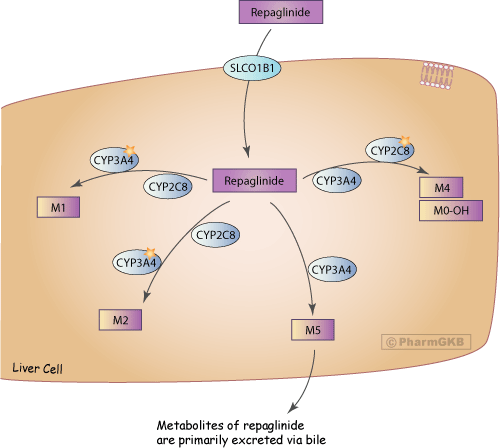
Repaglinide is orally administered and rapidly absorbed from the gastrointestinal tract. It is eliminated almost completely by hepatic metabolism through oxidative biotransformation and direct conjugation with glucuronic acid. The major metabolites of repaglinide are M1 (the aromatic amine), M2 (an oxidized dicarboxylic acid) and M4 (formed via hydroxylation on the piperidine ring). These metabolites are primarily excreted via the bile into the feces and do not contribute to the glucose lowering activity of repaglinide. The cytochrome P450 enzyme CYP3A4 and CYP2C8 are the principal catalysts for repaglinide metabolism (PMID: 12919179). CYP3A4 primarily catalyzes the formation of the M1 and M2 metabolites, while CYP2C8 is responsible for the formation of the M4 metabolite. Polymorphism in CYP2C8 (CYP2C8*3 allele) has been shown to be associated with reduced plasma concentration of repaglinide (PMID: 14534525). Genetic polymorphism in hepatic-uptake transporter SLCO1B1 (OATP1B1) is another independent determinant of the pharmacokinetics of repaglinide. The AUC of repaglinide is markedly increased in homozygous carriers of SLCO1B1 521T>C than in subjects with reference genotype 521TT (PMID: 15961978).
Drugs that are strong inhibitors or inducers of CYP3A4, CYP2C8 or SLCO1B1 may affect pharmacokinetics of repaglinide and lead to undesirable drug-drug interaction if co-administered. The CYP3A4 inhibitors cyclosporine and clarithromycin can markedly increase the plasma concentration of repaglinide (PMID: 16198658, 11452245). Careful monitoring of blood glucose is recommended in repaglinide-treated patients receiving strong inhibitors of CYP3A4 due to the increased risk of hypoglycemia.
Edit history (3)
- 2007-10-09 Create
- 2011-04-19 Update
- 2025-04-02 Update fixed typos