About this pathway
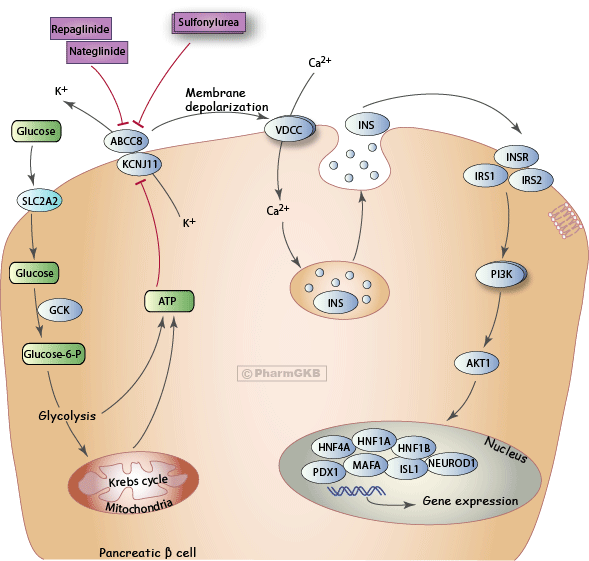
Repaglinide, nateglinide and sulfonylurea are agents used for treatment of type II diabetes. They lower blood glucose levels by blocking ATP-dependent potassium channels in pancreatic beta cells to stimulate insulin secretion. Repaglinide and nateglinide act in a dose-dependent manner, and are characterized as having a fast onset, yet with a brief duration of action. Their action is glucose dependent, and they are taken with meals for postprandial hyperglycemia. They have been shown to present reduced risk of long-lasting hypoglycemia. Sulfonylurea has a longer duration of action than repaglinide, with high potency and is dependent on functioning beta cells in the pancreatic islets. Sulfonylurea may induce hypoglycemia in elderly patients with impaired liver or renal functions.
In type II diabetes, patients either do not produce enough insulin or their cells are resistant to insulin action. Insulin is produced by pancreatic beta-cells to regulate blood glucose concentration. When blood glucose rises, glucose is transported into the beta-cells by glucose transporter 2 (SLC2A2/GLUT2). Glucokinase (GCK) then acts as glucose sensor to catalyze formation of glucose-6-phosphate and controls the rate of entry of glucose into metabolism. Glucose-6-phosphate then undergoes glycolysis and the Krebs cycle (in mitochondria) to generate ATP. The elevated ATP/ADP ratio can in turn close the ATP-sensitive K+ channels (KATP, made up of four subunits of the sulfonylurea 1 receptor (ABCC8/SUR1) and four subunits of the inwardly rectifying K+ channel Kir6.2 (KCNJ11)). In addition to glucose, drugs such as repaglinide, nateglinide and sulfonylureas can also lead to closure of the KATP channels to stimulate insulin secretion. The closure of KATP channels depolarizes the plasma membrane, and leads to the opening of voltage-dependent Ca2+ channels (VDCC) resulting in influx of extracellular Ca2+ which then triggers exocytosis and insulin release from the insulin containing granules located in pancreatic beta cells. The secreted insulin can bind to insulin receptor (INSR) and triggers activation of PI3K/Akt pathway and the transcription factors in the beta cells (HNF4A, TCF1, TCF2, PDX1, MAFA, ISL1 and NEUROD1 etc.) which control the expression of insulin (INS) and many other genes that are important for regulation of insulin secretion such as SLC2A2, GCK.
Edit history (2)
- 2008-01-22 Create
- 2011-04-02 Update