About this pathway
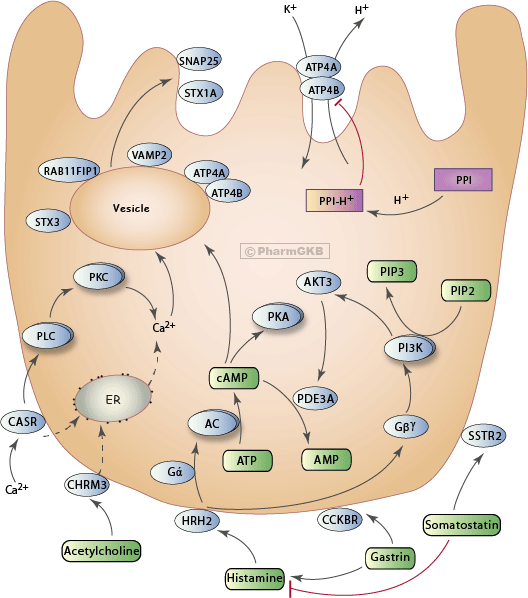
Proton pump inhibitors (PPIs) are a class of compounds that block the acid secretion from parietal cells in the stomach, thereby providing relief from acid-related disorders. PPIs are believed to enter the parietal cell through diffusion. Once they are in the cells, they are protonated to their active form upon entering the lower pH gradient that is present near the secretory canaliculus. This activated form can then covalently bind to the "proton pump" which is encoded by two genes, ATP4A and ATP4B. The binding of the proton pump inhibitor to the ATP4A/ATP4B complex prevents acid secretion, and thereby leads to a relief of acid related symptoms. The proton pumps in parietal cells are in a constant state of flux, with active proton pumps being present at the membrane, and inactive pumps in vesicles in the cytoplasm. The process for the trafficking of the vesicle from the cytoplasm to the membrane, with the subsequent integration of the proton pump is complex, and is dependent on several factors and proteins. SNAP25 and STX1A localize to the apical membrane, and are believed to help with the integration of the vesicle into the membrane. STX3, RAB11, and VAMP2 colocalize with the proton pump (ATP4A/ATP4B) in the vesicles, and may assist in recognizing SNAP25 and STX1A or with membrane integration.
Increased intracellular levels of Ca2+ and cAMP are known to increase vesicular traffic to the membrane, although all the steps involved in the signal transduction have not yet been elucidated. The signaling cascades can be initiated by the binding of a number of different ligands to their respective receptors. The primary signaling pathway is through histamine binding to the HRH2 receptor. This signal acts through a G-protein, the alpha subunit of which is believed to activate adenylate cyclase (AC), which converts ATP to cAMP. The G beta gamma subunit activates PI3K, which catalyzes the conversion of PIP2 to PIP3, and is believed to activate AKT3, which in turn can activate PDE3A, which converts cAMP to AMP thereby terminating the signal. Some reports have indicated that gastrin can stimulate acid secretion directly, but the more potent activity of gastrin is to release histamine from nearby cells through binding to the gastrin receptor CCKBR (which is also present on parietal cells). Somatostatin is believed to have a minor direct inhibitory role on acid secretion in parietal cells by binding to the SSTR2 receptor, but its primary role in acid secretion is to inhibit the release of histamine from nearby cells, thereby indirectly inhibiting acid secretion by preventing activation.
Levels of intracellular Ca2+ are also known to increase vesicular traffic to the membrane, thereby leading to more active proton pumps and increased acid secretion. The increase of intracellular Ca2+ has been linked to the binding of acetylcholine to the CHRM3 receptor, which likely releases Ca2+ from intracellular stores in the endoplasmic reticulum (ER). Another recently discovered signaling pathway is through the binding of extracellular Ca2+ to the calcium sensing receptor (CASR), which also leads to an increase in intracellular Ca2+ concentration, likely through the release of calcium stores in the ER. Both phospholipase C (PLC) and protein kinase C (PKC) are involved in the Ca2+ signaling pathway.
Edit history (2)
- 2007-08-06 Create
- 2011-04-18 Update