About this pathway
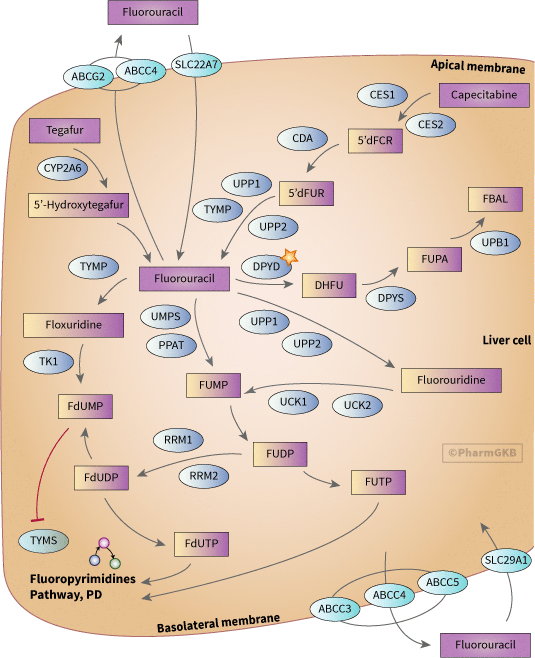
Fluoropyrimidines are antimetabolite drugs widely used in the treatment of cancer including colorectal and breast cancer and cancers of the aerodigestive tract. This graphic shows candidate genes involved in the pharmacokinetics of 5-fluorouracil (5-FU), capecitabine and tegafur.
5-FU is commonly given intravenously where more than 80% of it is metabolized in the liver [Article:2656050]. Capecitabine is an oral prodrug of 5-FU which passes unaltered through the gut wall and is converted into 5'dFCR then 5'-deoxy-5-fluorouridine (5'dFUR) in the liver by carboxylesterase and cytidine deaminase respectively [Articles:9849491, 18172246]. 5'dFUR is then converted to 5-FU via thymidine phosphorylase or uridine phosphorylase [Articles:9849491, 11956089]. Tegafur is another prodrug of 5-FU that is converted by CYP2A6 to an unstable intermediate, 5-hydroxytegafur, which spontaneously breaks down to form 5-FU [Article:18172246].
There are several routes for metabolism of 5-FU, some of which lead to activation and pharmacodynamic actions of the drug. The rate-limiting step of 5-FU catabolism is dihydropyrimidine dehydrogenase (DPYD) conversion of 5-FU to dihydrofluorouracil (DHFU) [Articles:14555507, 1272473]. DHFU is then converted to fluoro-beta-ureidopropionate (FUPA) and subsequently to fluoro-beta-alanine (FBAL) by dihydropyrimidinase (DPYS) and beta-ureidopropionase (UPB1), respectively [Article:14555507]. Deficiency in enzymes in this pathway can result in severe and even fatal 5-FU toxicity. Several variants in DPYD have been associated with toxicity including (see the DPYD VIP and curated annotations for more details). Variants in DPYS have also been shown to influence 5-FU toxicity. A rare variant DPYS:833G>A (DPYS:Gly278Asp) in exon 5 was shown to be the determining variant of severe toxicity in a Dutch patient receiving 5-FU [Article:14555507]. Variants DPYS:1635delC and DPYS:Leu7Val were shown in vitro to have reduced activity [Article:18075467]. In order to modulate the activity of fluoropyrimidines, inhibitors of DPYD such as uracil and eniluracil can be coadministered. This slows the degradation of 5-FU and can improve response rate [Article:12724731].
The main mechanism of 5-FU activation is conversion to fluorodeoxyuridine monophosphate (FdUMP) which inhibits the enzyme thymidylate synthase (TYMS), an important part of the folate-homocysteine cycle and purine and pyrimidine synthesis The conversion of 5-FU to FdUMP can occur via thymidylate phosphorylase (TYMP) to fluorodeoxyuridine (FUDR) and then by the action of thymidine kinase to FdUMP or indirectly via fluorouridine monophosphate (FUMP) or fluroridine (FUR) to fluorouridine diphosphate (FUDP) and then ribonucleotide reductase action to FdUDP and FdUMP. FUDP and FdUDP can also be converted to FUTP and FdUTP and incorporated into RNA and DNA respectively which also contributes to the pharmacodynamic actions of fluoropyrimidines.
An important consideration in the use of 5-FU and related drugs is the development of drug resistance by the tumor. Some mechanisms of resistance involve expression changes in pharmacodynamic gene candidates (TYMS and P53). Drug resistance can also involve changes in drug transport. There is conflicting data about the transporters involved in the pharmacokinetics of 5-FU. SLC29A1 expression was not associated with survival in one study of pancreatic tumors [Article:18992248] but resistance/sensitivity was associated with its expression in another study of pancreatic tumor cell lines [Article:17695509]. Transport of 5-FU has been reported in an in vitro expression system of SLC22A7 [Article:15901346]. Several transporters have been implicated in 5-FU resistance including ABCG2 [Article:18820913][Article:18837291], ABCC3, ABCC4 and ABCC5 [Article:19077464].
Reactions & interactions (53)
-
Biochemical Reaction
fluorodeoxyuridine diphosphate → fluorodeoxyuridine triphosphate
-
Biochemical Reaction
floxuridine → fluorodeoxyuridine monophosphate
-
Biochemical Reaction
fluorouridine diphosphate → fluorodeoxyuridine diphosphate
-
Biochemical Reaction
5'-deoxy-5-fluorocytidine → 5'-deoxy-5-fluorouridine
-
Biochemical Reaction
tegafur → 5'-hydroxytegafur
-
Biochemical Reaction
5'-deoxy-5-fluorouridine → fluorouracil
-
Biochemical Reaction
5'-hydroxytegafur → fluorouracil
-
Biochemical Reaction
capecitabine → 5'-deoxy-5-fluorocytidine
-
Biochemical Reaction
fluorodeoxyuridine diphosphate → fluorodeoxyuridine monophosphate
-
Biochemical Reaction
fluorouracil → dihydrofluorouracil
-
Biochemical Reaction
fluorouracil → floxuridine
-
Biochemical Reaction
fluorouridine → fluorouridine monophosphate
-
Biochemical Reaction
fluorouracil → fluorouridine monophosphate
-
Biochemical Reaction
fluorouridine diphosphate → fluorouridine triphosphate
-
Biochemical Reaction
dihydrofluorouracil → fluoro-beta-ureidopropionate
-
Biochemical Reaction
fluorouridine monophosphate → fluorouridine diphosphate
-
Biochemical Reaction
fluoro-beta-ureidopropionate → fluoro-beta-alanine
-
Biochemical Reaction
fluorouracil → fluorouridine
-
Catalysis
SLC22A7 → Transport
-
Catalysis
ABCC4 → Transport
-
Catalysis
ABCG2 → Transport
-
Catalysis
TK1 → Biochemical Reaction
-
Catalysis
RRM1 → Biochemical Reaction
-
Catalysis
RRM2 → Biochemical Reaction
-
Catalysis
CDA → Biochemical Reaction
-
Catalysis
CYP2A6 → Biochemical Reaction
-
Catalysis
UPP2 → Biochemical Reaction
-
Catalysis
UPP1 → Biochemical Reaction
-
Catalysis
TYMP → Biochemical Reaction
-
Catalysis
CES1 → Biochemical Reaction
-
Catalysis
CES2 → Biochemical Reaction
-
Catalysis
DPYD → Biochemical Reaction
-
Catalysis
TYMP → Biochemical Reaction
-
Catalysis
UCK1 → Biochemical Reaction
-
Catalysis
UCK2 → Biochemical Reaction
-
Catalysis
PPAT → Biochemical Reaction
-
Catalysis
UMPS → Biochemical Reaction
-
Catalysis
DPYS → Biochemical Reaction
-
Catalysis
ABCC3 → Transport
-
Catalysis
ABCC5 → Transport
-
Catalysis
ABCC4 → Transport
-
Catalysis
UPB1 → Biochemical Reaction
-
Catalysis
SLC29A1 → Transport
-
Catalysis
UPP2 → Biochemical Reaction
-
Catalysis
UPP1 → Biochemical Reaction
-
Inhibition
fluorodeoxyuridine monophosphate → TYMS
-
Leads To
fluorodeoxyuridine triphosphate → Fluoropyrimidine Pathway, Pharmacodynamics
-
Leads To
TYMS → Fluoropyrimidine Pathway, Pharmacodynamics
-
Leads To
fluorouridine triphosphate → Fluoropyrimidine Pathway, Pharmacodynamics
-
Transport
fluorouracil → fluorouracil
- Showing first 50 of 53 reactions — full data preserved in database.
Edit history (4)
- 2006-11-14 Create
- 2011-05-23 Update
- 2019-03-13 Update Updated to new illustrator and gpml formatting.
- 2024-05-07 Update fixed typo