About this pathway
Celecoxib (Celebrex) is a selective cycloxygenase-2 (PTGS2/ COX-2) inhibitor used for treatment of osteoarthritis and rheumatoid arthritis. It acts by reducing prostaglandin synthesis through inhibition of COX-2. Selective COX-2 inhibitors appear to provide comparable anti-inflammatory effects to conventional non-steroidal anti-inflammatory agents (NSAIDs), while avoiding serious adverse reactions, in particular, gastrointestinal toxicity observed with chronic use of NSAIDs due to COX-1(PTGS1) inhibition.
PK: After oral administration, celecoxib is rapidly absorbed and achieves peak serum concentration in about 3 hours. It is extensively metabolized in the liver with very little drug (<3%) being eliminated unchanged (PMID: 10681375). The major routes of excretion for celecoxib are feces and urine (PMID: 18378608). Celecoxib is metabolized primarily through methyl hydroxylation to form hydroxycelecoxib. This reaction is largely catalyzed by CYP2C9, although CYP3A4 also plays a minor (<25%) role (PMID: 10749518; 10681375; 12392591) (Figure 1). Hydroxycelecoxib is further oxidized to form carboxycelecoxib via cytosolic alcohol dehydrogenases ADH1 and ADH2 (PMID: 12392591), then conjugated with glucuronic acid via UDP glucuronosyltransferases (UGTs) to form the 1-O-glucuronide. None of the metabolites are pharmacologically active (PMID: 10749518).
Since celecoxib metabolism is predominantly mediated via CYP2C9, polymorphisms in CYP2C9 are likely to have a direct impact on celecoxib pharmacokinetics and variability in drug responses. Individuals who are poor metabolizers of CYP2C9 substrates (eg. CYP2C9*3 allele carriers) have increased exposure to celecoxib when compared to those with normal CYP2C9 activity (PMID: 11337938; 12392591; 12893985)(see Pharmacogenomics section). Drugs that inhibit CYP2C9 should therefore be used with caution in patients taking celecoxib.
Although not a substrate of CYP2D6, celecoxib inhibits this metabolic enzyme (PMID: 12891223). Drugs that are metabolized by CYP2D6 (eg. Metoprolol, (PMID: 12891223)) should also be used with caution in patients receiving celecoxib due to a potential risk of drug interaction.
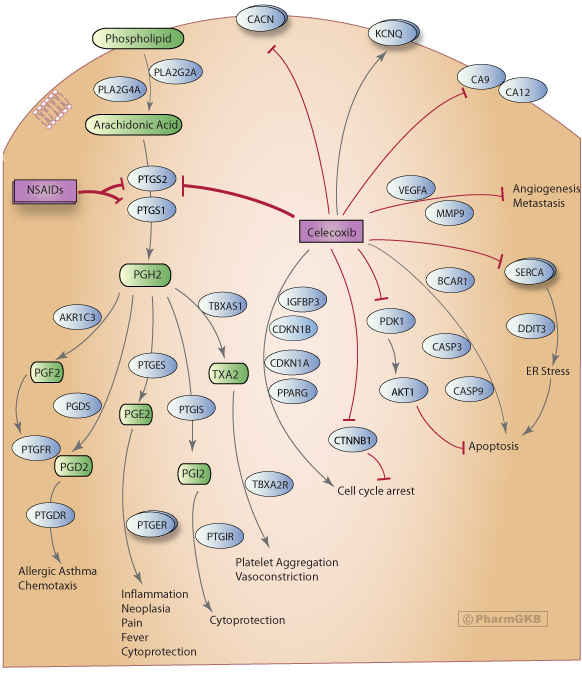
PD: Celecoxib acts by inhibiting prostaglandin synthesis via inhibition of COX2 (PTGS2). Cox enzymes (PTGS1 and PTGS2) catalyze the committed step that leads to production of prostaglandins (PGH2) from arachidonic acid. PGH2s are then converted into active metabolites (prostaglandin E2 (PGE2), prostacyclin (PGI2), thromboxane (TXA2), prostaglandin D2 (PGD2), prostaglandin F2 (PGF2)) that mediate various physiological responses such as inflammation, fever, blood pressure regulation and clotting. PTGS1/COX-1 is constitutively expressed in many cell types, while PTGS2/COX-2 expression is negligible but can be induced by growth factors, cytokines and stress in many tissues. PTGS2 level is increased in inflammatory diseases such as arthritis and in cancer cells. Most of the NSAIDs inhibit both PTGS1 and PTGS2, Selected PTGS2/COX-2 inhibitors such as celecoxib (Celebrex) and rofecoxib (Vioxx) have been developed to treat information and provide pain relief. Celecoxib is the only NSAID approved to treat Familial Adenomatous Polyposis (FAP), a genetic condition that often leads to colorectal cancer. The use of celecoxib as a possible cancer treatment is currently being explored. The exact mechanisms for its anti-cancer activity are not clear, but they most likely involve both COX-dependent and COX-independent mechanisms. The anticarcinogenic mechanisms of celecoxib generally involve induction of apoptosis, cell cycle arrest, and regulation of angiogenesis. Inhibition of cell cycle progression mediated by celecoxib is observed along with increased expression of cell cycle inhibitors CDKN1A/p21, and CDKN1B/p27 and/or decreased expression of cyclins such CCNA1, CCNB1 and CCND1. Extensive degradation of CTNNB1 (beta-catenin, which promote cell proliferation) was also observed in celecoxib treated human colon cancer cells. Induction of apoptosis by celecoxib is associated with either activation of pro-apotosis molecules such as CASP3, CASP9 and DDIT3, and/or inhibition of anti-apoptosis molecules such as PDK1 and its downstream target AKT1. Celecoxib treatment also leads to decreased expression of VEGFA and inhibition of MMP9 in cancer cells suggesting a possible mechanism for inhibition of angiogenesis and decreased tumor growth.
Edit history (2)
- 2006-04-28 Create
- 2011-10-12 Correction