About this pathway
Metabolism
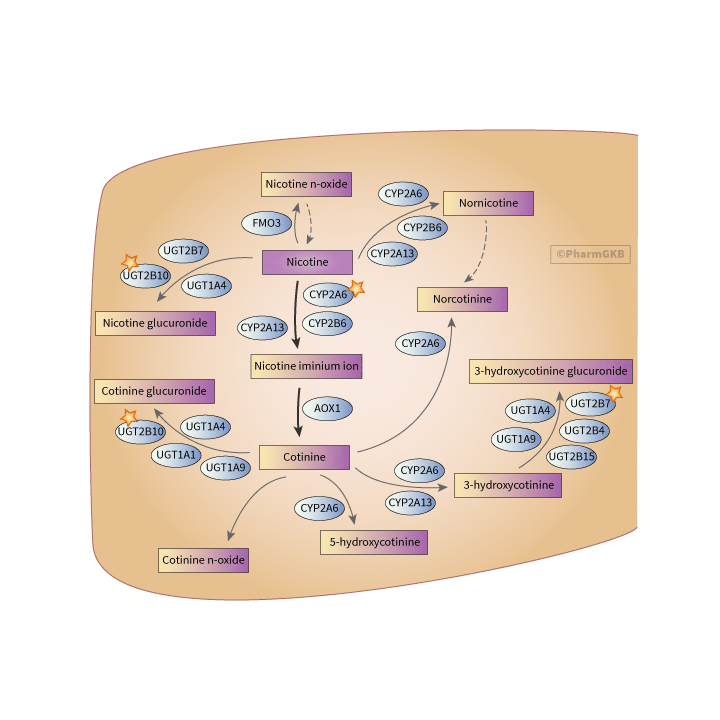
This pathway shows metabolism of nicotine in human liver including all the candidate genes which may be responsible. Nicotine is extensively metabolized to a number of metabolites in liver [Article:15109883]. Quantitatively, the most important metabolite of nicotine in most mammalian species is cotinine. In humans, about 70 to 80% of nicotine is converted to cotinine [Articles:8301571, 8937855, 25293881]. This transformation involves two steps: the first is mediated by cytochrome P450, CYP, enzymes to produce nicotine iminium ion, the second step is catalyzed by aldehyde oxidase (AOX1) [Articles:19184652, 25293881]. The main CYP involved in cotinine formation is CYP2A6, which is highly polymorphic and thus can influence the dynamics of the pathway. CYP2B6 is also involved in this step and is also polymorphic. While CYP2A13 was shown in vitro to be capable of this step, it is minimally expressed in liver but may be more important in other tissues such as lung, or individuals lacking functional CYP2A6 or CYP2B6 [Article:15528319].
Nicotine n-oxide is another primary metabolite of nicotine, although only about 4-7% of nicotine absorbed by smokers is metabolized via this route [Article:8301571]. The conversion of nicotine to nicotine n-oxide involves flavin-containing monooxygenase 3 (FMO3) [Articles:28290528, 1446003, 3380084]. It appears that nicotine n-oxide is not further metabolized to any significant extent, except by reduction back to nicotine, which may lead to recycling of nicotine in the body [Article:28290528].
Conversion of nicotine to nornicotine in humans has been demonstrated but accounts for less than one percent of nicotine from smoking or transdermal nicotine in healthy volunteers [Article:8301571]. This process can be catalyzed in vitro by CYP2A6, CYP2B6 or CYP2A13 [Article:16135656].
About 3-5% of nicotine is converted to nicotine glucuronide and excreted in urine in humans [Article:8301571]. Recent in vitro experiments suggest that UGT2B10 may be the main enzyme responsible for this conversion in liver and that gene polymorphisms may influence this [Articles:17576790, 25293881].
A number of cotinine metabolites have also been structurally characterized: 3-hydroxycotinine, 3-hydroxycotinine glucuronide, 5-hydroxycotinine, cotinine n-oxide, norcotinine and cotinine glucuronide [Article:8301571]. The most abundant metabolites found in urine are 3-hydroxycotinine and 3-hydroxycotinine glucuronide, accounting for 40-60% of the nicotine dose [Article:8301571]. The candidate genes involves in glucuronidation of cotinine are similar to those acting on nicotine with UGT2B10 considered likely the main enzyme responsible [Articles:17576790, 25293881]. The formation of 3-hydroxycotinine glucuronide involves slightly different candidate genes, with UGT2B7 more likely the main enzyme [Article:15470160].
There are additional important metabolites that are not formed to any great extent endogenously as shown by experiments with nicotine patches as the drug delivery method, but are formed during the tobacco smoking process. The most well characterized as carcinogens so far are NNK (4-(methylnitrosamino)-1-(3-pyridyl)-1-butanone) and NNAL (4-(methylnitrosamino)-1-(3-pyridyl)-1-butanol). Although not depicted here these carcinogens are also metabolized by some of the same enzymes that metabolize nicotine including CYP2A6, UGT2B10, UGT1A4 and CYP2A13.
Transport
While not depicted in the liver cell figure above and perhaps more important for activity at the blood-brain barrier, candidate genes for nicotine transporters include organic cation transporters SLC22A1, SLC22A2 and SLC22A3, the organic cation/carnitine transporters SLC22A4 and SLC22A5, multidrug and toxin extrusion protein 1 SLC47A1, and plasma membrane monoamine transporter SLC29A4 [Article:30175770].
Reactions & interactions (38)
-
Biochemical Reaction
cotinine → norcotinine
-
Biochemical Reaction
nicotine → nicotine iminium ion
-
Biochemical Reaction
nicotine n-oxide → nicotine
-
Biochemical Reaction
cotinine → 3-hydroxycotinine
-
Biochemical Reaction
cotinine → cotinine glucuronide
-
Biochemical Reaction
nicotine iminium ion → cotinine
-
Biochemical Reaction
3-hydroxycotinine → 3-hydroxycotinine glucuronide
-
Biochemical Reaction
nicotine → nicotine n-oxide
-
Biochemical Reaction
cotinine → 5-hydroxycotinine
-
Biochemical Reaction
nornicotine → norcotinine
-
Biochemical Reaction
cotinine → cotinine n-oxide
-
Biochemical Reaction
nicotine → nicotine glucuronide
-
Biochemical Reaction
nicotine → nornicotine
-
Catalysis
CYP2A6 → Biochemical Reaction
-
Catalysis
CYP2B6 → Biochemical Reaction
-
Catalysis
CYP2A13 → Biochemical Reaction
-
Catalysis
CYP2A6 → Biochemical Reaction
-
Catalysis
CYP2A6 → Biochemical Reaction
-
Catalysis
CYP2A13 → Biochemical Reaction
-
Catalysis
UGT1A9 → Biochemical Reaction
-
Catalysis
UGT2B10 → Biochemical Reaction
-
Catalysis
UGT1A4 → Biochemical Reaction
-
Catalysis
UGT1A1 → Biochemical Reaction
-
Catalysis
AOX1 → Biochemical Reaction
-
Catalysis
UGT2B7 → Biochemical Reaction
-
Catalysis
UGT2B4 → Biochemical Reaction
-
Catalysis
UGT1A9 → Biochemical Reaction
-
Catalysis
UGT1A4 → Biochemical Reaction
-
Catalysis
UGT2B15 → Biochemical Reaction
-
Catalysis
FMO3 → Biochemical Reaction
-
Catalysis
CYP2A6 → Biochemical Reaction
-
Catalysis
CYP2A13 → Biochemical Reaction
-
Catalysis
UGT2B10 → Biochemical Reaction
-
Catalysis
UGT1A4 → Biochemical Reaction
-
Catalysis
UGT2B7 → Biochemical Reaction
-
Catalysis
CYP2B6 → Biochemical Reaction
-
Catalysis
CYP2A13 → Biochemical Reaction
-
Catalysis
CYP2A6 → Biochemical Reaction
Edit history (3)
- 2004-10-14 Create
- 2019-01-29 Update Text update to include references.
- 2019-01-29 Update Update to figure and gpml to include more references and new illustrator formatting.