About this pathway
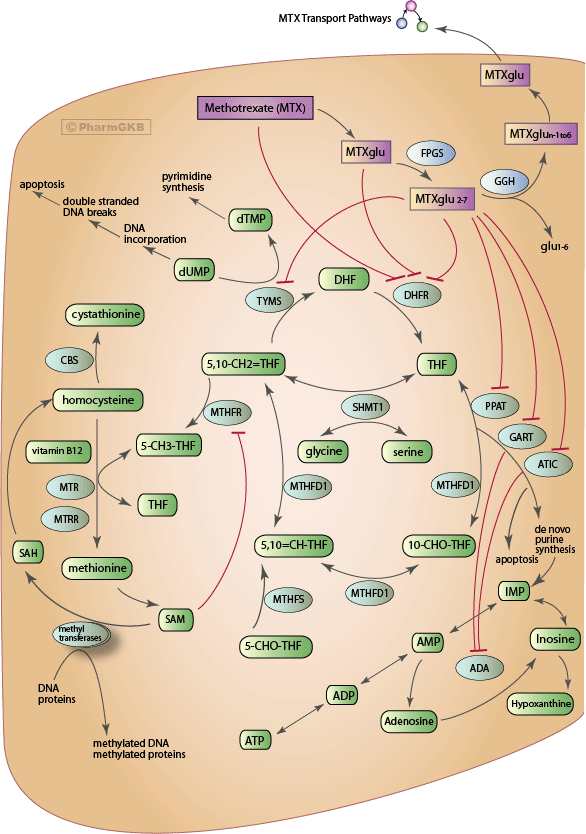
Methotrexate (MTX) is a folate analogue that is used in the treatment of cancers (e.g., acute lymphoblastic leukemia, non-Hodgkin lymphoma, osteosarcoma, and colon cancer) and autoimmune diseases (e.g., rheumatoid arthritis, Crohn's disease, and psoriasis). In the treatment of autoimmune diseases, MTX is usually administrated orally or subcutaneously, whereas in cancer treatment, it can be given orally, intramuscularly, as intrathecal injections, or as intravenous infusions [Articles:19858780, 19553647, 15139068]. The pharmacokinetics and pharmacodynamics of MTX show large interpatient variability regardless of the route of administration or disease being treated [Articles:19901119, 20418240, 10912573]. This figure illustrates the candidate genes in the MTX pathway.
The pharmacodynamic profile of MTX can to a large extent be explained by its interactions with enzymes in the folate pathway. The effects on MTX response of variations in these genes have been extensively studied in cancer treatments [Article:19538530]. At extracellular MTX concentrations below 20µM, MTX enters cancer cells primarily via the reduced folate carrier (SLC19A1)[Articles:10029593, 9748136], whereas efflux across the cell membrane is mediated by various ABC transporters; variations in these genes are known mechanisms of drug resistance in cancer cells [Article:16362298]. Inside the cells, MTX is converted to active methotrexate polyglutamates (MTXPGs) by folylpolyglutamate synthetase (FPGS), which adds glutamate residues to MTX [Article:7517720]. The primary action of MTX is inhibition of the enzyme dihydrofolate reductase (DHFR), which converts dihydrofolate (DHF) to tetrahydrofolate (THF)[Article:8793930]. THF is essential for de novo purine synthesis, and in the biologically active form, 5-methyl-THF, it is an important cofactor in one-carbon metabolism. The effect of MTX depends on the function and expression of several other enzymes in the folate pathway, including methylenetetrahydrofolate dehydrogenase (MTHFD1), 5,10-methylenetetrahydrofolate reductase (MTHFR), and thymidylate synthetase (TYMS). Compared with MTX, the active metabolites MTXPGs induce stronger inhibition of the target enzymes (i.e., TYMS and DHFR) and further inhibit key enzymes such as GART and ATIC in the de novo purine synthesis pathway. The inhibition by MTXPG results in decreased protein and DNA methylation in addition to impaired DNA formation and repair. MTXPG levels are sustained inside the cells for a longer time than those of MTX; degradation of MTXPGs to MTX depends on the activity of the lysosomal enzyme GGH, which catalyzes the removal of polyglutamates [Articles:12114448, 16041371, 16826517]. MTXPGs have been investigated in relation to clinical outcomes in Rheumatoid Arthritis (RA) and Juvenile Idiopathic Arthritis (JIA). Specifically, higher concentrations of long chain MTXPGs have been associated with favourable outcomes in RA [Article:15457444] and risk of gastrointestinal and hepatic toxicity in JIA [Article:20954192].
Gene expression and genetic variation in candidate genes have been studied extensively in relation to many MTX response measures, including MTXPG accumulation (GGH, FPGS, and SLC19A1) [Articles:10029593, 15284538, 15630450], reduction in tumor size (SLC19A1 and DHFR) [Article:10100715], toxicity (MTHFR, and TYMS) [Articles:11418485, 16501586], and relapse (DHFR, TYMS, MTHFR, DHFR, and SLC19A1) [Articles:19515727, 18096764, 20335220, 16130010, 14647408, 12411325, 15713801]. Conflicting results among studies suggest that the effects of genetic variation are therapy-dependent and probably reflect the route of administration, dose, and duration of MTX treatment [Articles:20335220, 12411325]. Although these studies have contributed to our understanding of MTX's effects and the molecular mechanisms involved in drug resistance, no genetic variant has yet been prospectively evaluated as a predictor of outcome in a clinical trial.
Genome-wide studies have linked genes outside the folate pathway to the pharmacokinetics and effects of MTX; many of these genes have not previously been analyzed in studies using the candidate approach. A recent study analyzed the association between MTXPG accumulation and genetic variations such as leukemic cell gene expression, somatic copy number variation, and SNPs [Article:19066393]. Six genes on chromosome 18 (FHOD3, IMPA2, ME2, SLC39A6, SMAD2, and SMAD4) and one on chromosome 10 (RASSF4) were found to be associated with in vivo intracellular accumulation of MTXPG in leukemic cells in all three categories of genetic variation. In another genome-wide study of patients with acute lymphoblastic leukemia, in vivo response to MTX was found to be significantly associated with expression of genes in the nucleotide pathway (e.g., TYMS) but also with genes involved in cell proliferation and apoptosis, as well as DNA repair and replication in the leukemic cells [Article:18416598]. Finally, a genome-wide association study that assessed the link between inherited genomic variation and initial treatment response in patients with acute lymphoblastic leukemia revealed 14 SNPs significantly associated with both treatment response and MTX clearance or MTXPG accumulation in leukemic cells [Article:19176441]; early treatment response assessed by eradication of leukemic cells is strongly associated with cure rates and is therefore considered an important clinical phenotype.
No genome-wide association studies have yet been performed in patients with rheumatoid arthritis, but inherited variations in most genes from the folate pathway have been examined in relation to MTX treatment response and toxicity [Articles:18381794, 16572443]. However, to see a clinically relevant effect of genetic variants in the folate, purine, and pyrimidine pathways, it seems crucial to study gene-gene interactions; it has been suggested that the effects of individual SNPs are enhanced when they occur in combination with other common SNPs in these pathways [Article:19858780]. Combinations of SNPs in the genes ATIC and Adenosine Receptor 2a (ADORA 2a) have been associated with differential MTXPG concentrations in JIA [Article:20954192]. The anti-inflammatory effect of MTX is further thought to be mediated through interaction with the adenosine biosynthesis pathway [Article:12106498]. MTXPGs inhibit the enzyme ATIC, which after a cascade of events leads to accumulation of the anti-inflammatory molecule adenosine; SNPs in genes from the adenosine biosynthesis pathway (i.e., ATIC, ITPA, and AMPD1) have been found to predict the efficacy of MTX treatment of RA and JIA [Articles:19858780, 16947783, 17530705].
Regardless of disease, it seems clear that future studies should continue to examine the combined effect of variations in multiple genes to characterize the extent of genomic determinants on variation in the pharmacokinetics and pharmacodynamics of MTX.
Reactions & interactions (69)
-
Biochemical Reaction
5,10-methylenetetrahydrofolate → dihydrofolic acid
-
Biochemical Reaction
adenosine monophosphate → adenosine diphosphate
-
Biochemical Reaction
inosine monophosphate → adenosine monophosphate
-
Biochemical Reaction
deoxyuridine monophosphate → deoxythymidine monophosphate
-
Biochemical Reaction
inosine → hypoxanthine
-
Biochemical Reaction
5,10-methylenetetrahydrofolate → 5,10-methenyltetrahydrofolate
-
Biochemical Reaction
methotrexate → methotrexate glutamate
-
Biochemical Reaction
adenosine diphosphate → adenosine triphosphate
-
Biochemical Reaction
adenosine → inosine
-
Biochemical Reaction
5,10-methenyltetrahydrofolate → 10-formyltetrahydrofolate
-
Biochemical Reaction
inosine monophosphate → inosine
-
Biochemical Reaction
proteins → methylated proteins
-
Biochemical Reaction
leucovorin → 5,10-methenyltetrahydrofolate
-
Biochemical Reaction
methotrexate polyglutamate → methotrexate glutamate
-
Biochemical Reaction
adenosine monophosphate → adenosine
-
Biochemical Reaction
tetrahydrofolic acid → 5,10-methylenetetrahydrofolate
-
Biochemical Reaction
methotrexate glutamate → methotrexate polyglutamate
-
Biochemical Reaction
dihydrofolic acid → tetrahydrofolic acid
-
Biochemical Reaction
5,10-methylenetetrahydrofolate → levomefolic acid
-
Biochemical Reaction
DNA → methylated DNA
-
Biochemical Reaction
glycine → l-serine
-
Biochemical Reaction
homocysteine → cystathionine
-
Biochemical Reaction
methionine → s-adenosylmethionine
-
Biochemical Reaction
s-adenosylhomocysteine → homocysteine
-
Biochemical Reaction
tetrahydrofolic acid → 10-formyltetrahydrofolate
-
Biochemical Reaction
homocysteine → methionine
-
Biochemical Reaction
s-adenosylmethionine → s-adenosylhomocysteine
-
Biochemical Reaction
levomefolic acid → tetrahydrofolic acid
-
Catalysis
TYMS → Biochemical Reaction
-
Catalysis
PPAT → Leads To
-
Catalysis
ATIC → Leads To
-
Catalysis
GART → Leads To
-
Catalysis
TYMS → Biochemical Reaction
-
Catalysis
MTHFD1 → Biochemical Reaction
-
Catalysis
ADA → Biochemical Reaction
-
Catalysis
MTHFD1 → Biochemical Reaction
-
Catalysis
methyl transferases → Biochemical Reaction
-
Catalysis
MTHFS → Biochemical Reaction
-
Catalysis
GGH → Biochemical Reaction
-
Catalysis
SHMT1 → Biochemical Reaction
-
Catalysis
FPGS → Biochemical Reaction
-
Catalysis
DHFR → Biochemical Reaction
-
Catalysis
MTHFR → Biochemical Reaction
-
Catalysis
methyl transferases → Biochemical Reaction
-
Catalysis
SHMT1 → Biochemical Reaction
-
Catalysis
CBS → Biochemical Reaction
-
Catalysis
MTHFD1 → Biochemical Reaction
-
Catalysis
MTR → Biochemical Reaction
-
Catalysis
cyanocobalamin → Biochemical Reaction
-
Catalysis
MTRR → Biochemical Reaction
- Showing first 50 of 69 reactions — full data preserved in database.
Edit history (3)
- 2006-11-04 Create
- 2011-01-04 Update
- 2019-06-26 Update Update to new gpml format.