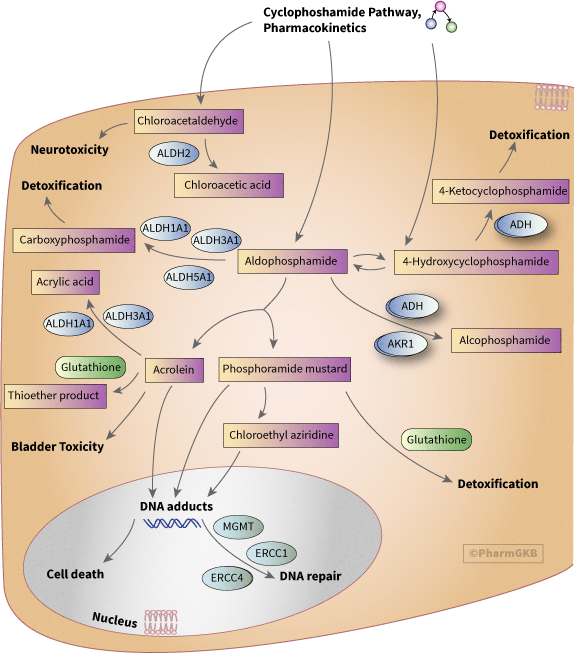
About this pathway
Cyclophosphamide (CP) is a widely used antitumor prodrug that is effective against a broad spectrum of human cancers including breast cancer and lymphomas. The toxicity profile is characterized by myelosuppression and urotoxicity. This diagram shows the genes involved in the biotransformation of CP and its metabolites and includes pathways of activation, deactivation and toxicity. Activation of CP to 4-hydroxycyclophosphamide is catalyzed by the hepatic cytochrome P450 (CYP) isozymes CYP2B6, 2C9 and 3A4 (with 2A6, 2C8 and 2C19 making more minor contributions). Competing with C-4 hydroxylation of CP is a minor (~10%) oxidative pathway that leads to N-dechloroethylation and the formation of the neurotoxic chloroacetaldehyde. CYP3A4 is primarily responsible for this undesirable side-chain oxidation with a minor contribution from CYP2B6. 4-Hydroxycyclophosphamide interconverts rapidly with its tautomer, aldophosphamide and it is likely that both of these metabolites passively diffuse out of hepatic cells, circulate, and then passively enter other cells. Aldophosphamide undergoes a spontaneous (non-enzymatic) elimination reaction to yield phosphoramide mustard (PM) and acrolein (associated with bladder toxicity). PM, which is generally believed to be the DNA crosslinking agent of clinical significance, is a circulating metabolite with its anionic form not entering cells very easily. Thus, the intracellular generation of PM from aldophosphamide is believed to be important to a therapeutic result. A major detoxification route is the oxidation of aldophosphamide to the inactive carboxyphosphamide by ALDH1A1 and, to a much lesser extent, by ALDH3A1 and ALDH5A1. Multiple CP metabolites can react with glutathione (GSH) resulting in the formation of various conjugates at different sites along the pathway. Some of these reactions with GSH may be reversible while others are irreversible; the latter are associated with detoxification pathways. Several-fold differences in the extent of metabolite formation have been observed among patients and these inter-individual differences may be due to polymorphisms in CYP enzymes. There are reports of association between CYP3A4 and 3A5 genotypes and response or survival in patients treated with CP. Many of the genetic variants that affect CP metabolism may still be unknown and further evidence of these variants will be needed to better assess clinical outcomes. It is noteworthy that CP is chiral at phosphorus and is administered as a racemate; however, enantioselectivity in the metabolism of CP does not appear to result in clinical significance.
Reactions & interactions (36)
-
Biochemical Reaction
4-hydroxycyclophosphamide → aldophosphamide
-
Biochemical Reaction
phosphoramide mustard → chloroethyl aziridine
-
Biochemical Reaction
acrolein + glutathione → thioether product
-
Biochemical Reaction
acrolein → acrylic acid
-
Biochemical Reaction
aldophosphamide → alcophosphamide
-
Biochemical Reaction
aldophosphamide → carboxyphosphamide
-
Biochemical Reaction
aldophosphamide → acrolein + phosphoramide mustard
-
Biochemical Reaction
4-hydroxycyclophosphamide → 4-ketocyclophosphamide
-
Biochemical Reaction
chloroacetaldehyde → chloroacetic acid
-
Catalysis
ERCC1 → Leads To
-
Catalysis
ERCC4 → Leads To
-
Catalysis
MGMT → Leads To
-
Catalysis
ALDH1A1 → Biochemical Reaction
-
Catalysis
ALDH3A1 → Biochemical Reaction
-
Catalysis
ADH → Biochemical Reaction
-
Catalysis
AKR1 → Biochemical Reaction
-
Catalysis
ALDH1A1 → Biochemical Reaction
-
Catalysis
ALDH5A1 → Biochemical Reaction
-
Catalysis
ALDH3A1 → Biochemical Reaction
-
Catalysis
ADH → Biochemical Reaction
-
Catalysis
ALDH2 → Biochemical Reaction
-
Leads To
glutathione → detoxification
-
Leads To
carboxyphosphamide → detoxification
-
Leads To
phosphoramide mustard → detoxification
-
Leads To
4-ketocyclophosphamide → detoxification
-
Leads To
phosphoramide mustard → DNA damage [MESH:D004249]
-
Leads To
acrolein → DNA damage [MESH:D004249]
-
Leads To
chloroethyl aziridine → DNA damage [MESH:D004249]
-
Leads To
chloroacetaldehyde → Neurotoxicity Syndromes
-
Leads To
DNA adducts [MESH:D018736] → apoptosis
-
Leads To
DNA adducts [MESH:D018736] → DNA repair [MESH:D004260]
-
Leads To
Cyclophosphamide Pathway, Pharmacokinetics → chloroacetaldehyde
-
Leads To
Cyclophosphamide Pathway, Pharmacokinetics → aldophosphamide
-
Leads To
Cyclophosphamide Pathway, Pharmacokinetics → 4-hydroxycyclophosphamide
-
Leads To
DNA damage [MESH:D004249] → DNA adducts [MESH:D018736]
-
Leads To
cyclophosphamide → Cyclophosphamide Pathway, Pharmacokinetics
Edit history (4)
- 2005-01-18 Create
- 2011-05-30 Update
- 2019-02-12 Update Updated to new illustrator formatting.
- 2019-06-28 Update Updated to new gpml and made small edit on illustrator file to connect the PK pathway.