About this pathway
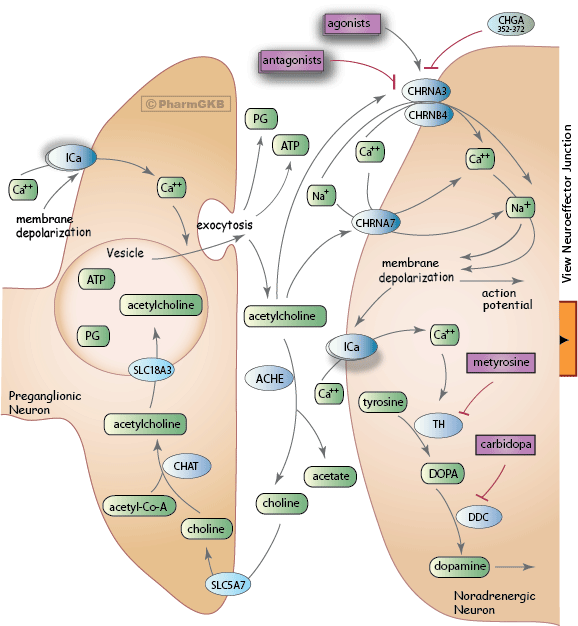
The drawing depicts an efferent sympathetic nerve (post-ganglionic sympathetic neuron). Such neurons are innervated by pre-ganglionic fibers emerging from the thoracolumbar spinal cord. The synapse joining pre- and post-ganglionic sympathetic fibers occurs in the paravertebral ganglia (or "sympathetic chain").
The pre-ganglionic axons release the neurotransmitter acetylcholine (ACh). Acetylcholine synthesis is catalyzed by choline acetyltransferase (ChAT) in the presynaptic nerve ending from acetyl CoA and choline. Synthesis can be shown to be rate limited by transport of choline through the transporter at the nerve ending (SLC5A7). A second transporter (SLC18A3) is responsible for uptake of acetylcholine into the synaptic vesicle at the nerve ending. Vesicular release is calcium dependent and is believed to result from fusion of the vesicle and nerve ending membrane in an exocytotic process. ACh diffuses across the cleft onto the postganglionic neuron's cell body, where it activates nicotinic cholinergic receptors (nAChRs), which are pentameric cation channels gated by the extracellular ligand ACh. In a sympathetic neuron, these nAChRs are either heteropentamers or homopentamers. The heteropentamers of sympathetic neurons are typically composed of two alpha-3 subunits (CHRNA3) plus three beta-4 subunits (CHRNB4). Such neurons also have homopentameric CHRNA7 receptors.
In the central nervous system, nicotinic receptors are typically either heteropentameric combinations of alpha-4 (CHRNA4) and beta-2(CHRNA2) subunits, or alpha-7 homopentamers (CHRNA7).
Acetylcholinesterase (ACHE), encoded by a single gene with multiple splice options, is responsible for the degradation of acetylcholine into choline and acetate in synapses (mainly in synaptic clefts, though some in presynaptic terminal, as well). Neither choline nor acetate has significant potency, and hydrolysis thereby terminates the action of the transmitter.
Activation of nicotinic receptors opens the central cation pore, admitting either Na+ or Ca++ (or both) to the cell interior. Such cation entry can depolarize the plasma membrane, thereby opening voltage-gated Ca++ channels, triggering exocytosis and activating transcription.
Catecholamine biosynthesis begins with tyrosine (or phenylalanine), proceeding up through norepinephrine (noradrenaline). The rate-limiting enzyme in catecholamine biosynthesis is tyrosine hydroxylase (TH), which is subject to both transcriptional and post-translational control. The final catecholamine biosynthetic step (DBH) occurs inside catecholamine storage vesicles; the other biosynthetic enzymes are cytosolic. Crucial enzymatic cofactors include: TH: tetrahydrobiopterin, Fe++. DBH: ascorbate, Cu++.
Catecholamines are transported into the storage vesicles by the VMATs, especially SLC18A2 (VMAT2) in neurons, but also SLC18A1 (VMAT1) in chromaffin cells.
After norepinephrine release, the transmitter is subject to removal or uptake from the cleft by two processes:
"Uptake-1": Typically neuronal, high-affinity, stereoselective, Na+ dependent, mediated by SLC6A2.
"Uptake-2": Typically extra-neuronal and less selective. Mediated by the organic cation transporter family, especially SLC22A3 (OCT3).
Catecholamines are also subject to metabolism in both nerves and in extraneuronal sites. In nerves, the pathways include both monoamine oxidase (MAOA and MAOB) and catechol-O-methyltransferase (COMT).
Several neuropeptides are co-stored and co-released from large dense core catecholamine storage vesicles of sympathetic nerves, including chromogranin A (CHGA), neuropeptide Y (NPY), and adrenomedullin (ADM, especially from adrenergic cells). CHGA is the source of the endogenous nicotinic cholinergic antagonist peptide "catestatin" (CHGA 352-372).
In chromaffin cells of the adrenal medulla, as well as adrenergic/epinephrinergic neurons of the CNS, another catecholamine biosynthetic step occurs: PNMT (phenylethanolamine N-methyltransferase), which N-methylates norepinephrine (noradrenaline) to form epinephrine (adrenaline). PNMT occurs in the cytosol.
In dopaminergic axons (nerves), catecholamine biosynthesis ends at dopamine, which is released and subject to reuptake by the dopamine transporter (DAT, SLC6A3).
In serotonergic axons (nerves), the rate-limiting enzyme in transmitter biosynthesis is tryptophan hydroxylase, and transmitter synthesis ends at serotonin (5HT, 5-hydroxy-tryptamine), which is released and subject to reuptake by the serotonin transporter (SERT, SLC6A4).
Edit history (3)
- 2004-09-20 Create
- 2007-04-29 Update
- 2024-05-07 Update fixed typos