About this pathway
SN38 Mechanism
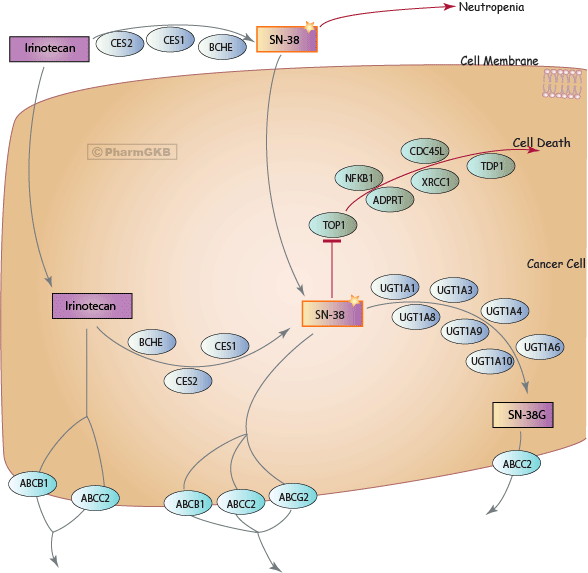
SN-38, the active metabolite of irinotecan (IRI), is transported into and out of the cell by ABCC2, ABCB1, and ABCG2 [Article:20602618] . This active metabolite is a DNA Topoisomerase I inhibitor which leads to cancer cell death. Topoisomerase I is a nuclear enzyme required in replication, responsible for unwinding DNA and preventing lethal strand breaks [Articles:22647487, 19604089]. SN-38 is cytotoxic and destabilizes the Topoisomerase I-DNA covalent complex formed in colorectal cancerous cells (CRC). SN-38 causes irreversible double strand breaks which lead to S phase arrest followed by cell death. To do so, SN-38 attaches to the complexes and blocks future replication forks preventing repairs of double strand breaks [Articles:23422270, 19604089, 21997136].
Pharmacogenomics
Little research has been done on identifying the impact of pharmacodynamics genes on variation in patient response to IRI, but genes likely involved in the process have been targeted: TOP1, PARP1, TDP1, XRCC1, ADPRT, CDC45L, and NF-kB1. Although the genes listed are involved in the dynamics of IRI in human cells, their role in patient response variation is minimal, unlike the impact of pharmacogenomics in the pharmacokinetics of IRI. Future research should be done regarding varied expression of the PXR protein (encoded by NR1I2) on the rate of SN-38 glucuronidation [Articles:19604089, 20602618].
Resistance
Increased resistance of IRI is thought to be caused by increased expression of EGFR EGFR inhibitors acting on ABC transporters and UGT1A1, and modifications in the MAP kinase pathway.
In SN-38 resistant colorectal cancer lines, SN-38 up-regulates the expression of EGF and EGFR, growth factors responsible for tumor growth. EGFR inhibitors act on ABCG2 and UGT1A1. In order to promote tumor cell death, EGFR inhibitors lower the expression of these genes while simultaneously up-regulating pro-apoptotic caspase-6 and p53. Using an EGFR inhibitor in addition to SN-38 in these resistant lines may prove to defeat the resistance by increasing apoptosis in the tumor cells [Article:21997136].
In addition, SN-38 resistant cell lines display continuous activation of MAPK p38. P38 is made up of two subunits, alpha and beta. P38 alpha (MAPK14) is responsible for cell survival so inhibition of this subunit results in apoptosis (in CRC cells by SN-38, resulting in autophagy). In colorectal cancer cells with down-regulated tumor suppressor TP53, in vitro studies have proven TP53 status of tumor cells is crucial for IRI resistance. TP53 deficient CRC cell lines with up-regulated MAPK14 leads to cell growth inhibition and survival promoting autophagy, believed to be the cause of IRI resistance. Increasing rates of MAPK14 inhibits cell growth by activating TP53 dependent cell cycle arrest, as well as independently activating survival promoting autophagy. Thus, to reduce resistance, future research could be done to investigate the inhibition of MAPK14 to restore sensitivity of CRC cells to IRI. Although TP53 status is an important predictor of IRI resistance, p53 status does not seem to play a significant role [Articles:22647487, 23422270, 22665526].
Edit history (3)
- 2003-09-12 Create
- 2011-04-18 Update
- 2024-06-27 Update fixed typos