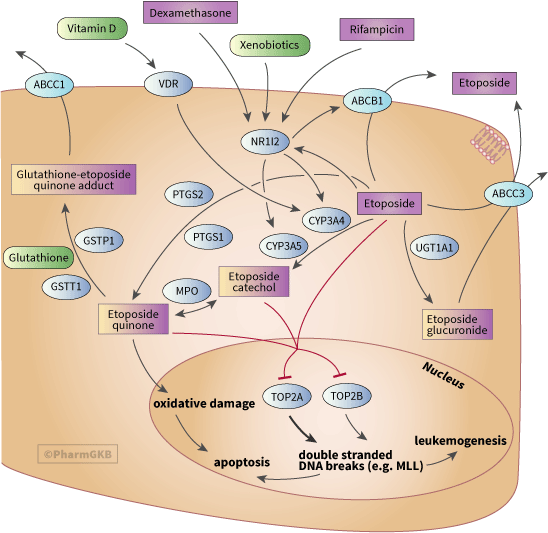
About this pathway
Etoposide and teniposide, the epipodophyllotoxins, stabilize the double stranded DNA cleavage normally catalyzed by topoisomerase II and inhibit faithful religation of DNA breaks (PMID: 1681541; 9748545). These double-strand DNA breaks subsequently trigger the desired antitumor effects of the drugs. Metabolism of etoposide is mediated by CYP3A4 and CPY3A5 (PMID: 8114683; 15319341), both of which are transcriptionally regulated by NR1I2 (i.e. Pregnane X receptor). Thus, xenobiotics that modulate NR1I2 activity (e.g. dexamethasone and rifampicin) have been observed to enhance etoposide clearance (PMID: 15578943; 12969965). In addition to CYP3A4/5 mediated reactions, conversion of etoposide to the O-demethylated metabolites (catechol and quinone) can also be catalyzed by prostaglandin synthases or myeloperoxidase (PMID: 3006680; 16841962; 11691792). These metabolites have similar potency at inhibiting topoisomerase II and are more oxidatively reactive than the parent drug (PMID: 11170441). Glutathione and glucuronide conjugation appear to inactivate parent drug and metabolite, and are mediated by GSTT1/GSTP1 and UGT1A1, respectively (PMID: 1315544; 3167829; 17151191; 12695346). Efflux of conjugated or unconjugated forms of etoposide has been associated with ABCC1, ABCC3 and ABCB1 (PMID: 8640791; 11581266), representing plausible mechanisms of drug resistance. Epipodophyllotoxins are highly effective anticancer agents, but can cause a delayed toxicity: treatment-related acute myeloid leukemia or myelodysplastic syndrome (t-ML) (PMID: 18509329; 1944468; 2822173). Drug-induced formation of MLL fusion genes has been associated with the development of t-ML (PMID: 8260707). Even though etoposide inhibits both topo II alpha and beta, the anti-tumor activity of etoposide is shown to be delivered primarily through inhibition of topo II alpha (PMID: 11531262) whilst the carcinogenic effect has been attributed to the beta isoform (PMID: 17578914). Recently, 64 genetic variants that contribute to etoposide-induced cytotoxicity were identified through a whole-genome association study (PMID: 17537913).
Reactions & interactions (34)
-
Activation
rifampin → NR1I2
-
Activation
NR1I2 → CYP3A4
-
Activation
ergocalciferol → VDR
-
Activation
NR1I2 → ABCB1
-
Activation
etoposide → NR1I2
-
Activation
<i>xenobiotics</i> → NR1I2
-
Activation
dexamethasone → NR1I2
-
Activation
VDR → CYP3A4
-
Activation
NR1I2 → CYP3A5
-
Biochemical Reaction
etoposide → etoposide catechol
-
Biochemical Reaction
quinone → glutathione conjugate
-
Biochemical Reaction
etoposide catechol → quinone
-
Biochemical Reaction
etoposide → etoposide glucuronide
-
Biochemical Reaction
etoposide → quinone
-
Catalysis
ABCC3 → Transport
-
Catalysis
CYP3A4 → Biochemical Reaction
-
Catalysis
CYP3A5 → Biochemical Reaction
-
Catalysis
ABCB1 → Transport
-
Catalysis
ABCC3 → Transport
-
Catalysis
GSTP1 → Biochemical Reaction
-
Catalysis
GSTT1 → Biochemical Reaction
-
Catalysis
ABCC1 → Transport
-
Catalysis
MPO → Biochemical Reaction
-
Catalysis
UGT1A1 → Biochemical Reaction
-
Catalysis
PTGS1 → Biochemical Reaction
-
Catalysis
PTGS2 → Biochemical Reaction
-
Inhibition
quinone → TOP2B
-
Inhibition
etoposide catechol → TOP2A
-
Inhibition
etoposide → TOP2B
-
Inhibition
quinone → TOP2A
-
Inhibition
etoposide → TOP2A
-
Transport
etoposide glucuronide → etoposide glucuronide
-
Transport
etoposide → etoposide
-
Transport
glutathione conjugate → glutathione conjugate
Edit history (2)
- 2004-06-21 Create
- 2011-05-28 Update