About this pathway
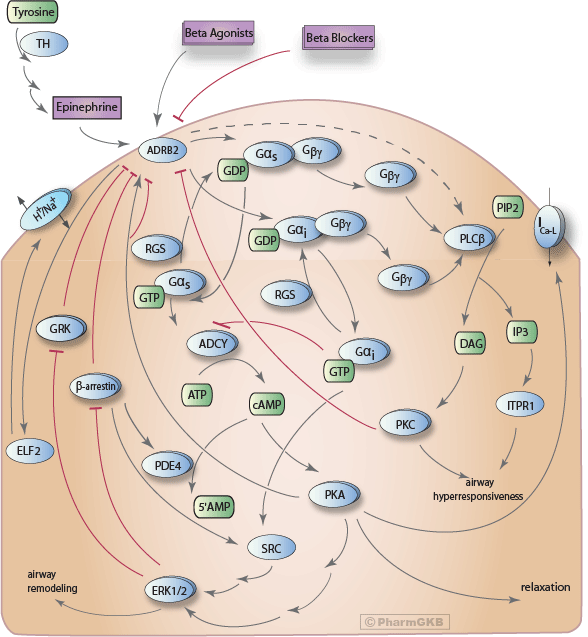
Upon the binding of agonists, the b2AR evokes a number of signals. The classic signal event for b2AR is its coupling to the heterotrimeric G- protein Gs. In the inactive state the a subunit of Gs is bound to bg subunits and GDP. Upon activation by b2AR, Gas dissociates from the complex, GDP is exchanged with GTP, and Gas activates adenylyl cyclase. This enzyme catalyzes the conversion of ATP to cAMP. cAMP activates protein kinase A (PKA) which phosphorylates multiple proteins in smooth muscle cells leading to relaxation, or in airway epithelial cells to increased ciliary beating. PKA also phosphorylates the b2AR itself, acting to decrease coupling to Gs and is one form of desensitization. The PKA-phosphorylated form of the b2AR also promotes coupling to the inhibitory G-protein Gi. The dissociated Gai acts to inhibit adenylyl cyclase. Reformation of the G-protein heterodimer, and cessation of signaling, is facilitated by action of RGS proteins which accelerate GTP hydrolysis. b2AR function is partially inhibited by several desensitization mechanisms, such as the aforementioned negative feed back loop involving PKA. The receptor is also phosphorylated by several members of the G-protein coupled receptor kinase family (GRKs), which do not require the generation of cAMP. GRK-phosphorylated b2AR serve as a substrate for the binding of b-arrestins, which act to physically interdict between receptor and G-protein and desensitize function. b-arrestin recruitment by b2AR also serves as a scaffold for transporting other proteins and initiating other signals. b-arrestin recruits the phosphodiesterase PDE4 to a receptor/adenylyl cyclase microdomain. PDE4 metabolizes cAMP, and thus acts to further desensitize downstream PKA-mediated events. b2AR recruited b-arrestin also initiates activation of C-Src, which ultimately leads to activation of ERK1 and ERK2 kinases, which participate in airway remodeling. Gai may also be required for this pathway, since ERK1/2 activation it is partially blocked by pertussis toxin. A strictly PKA-dependent pathway that results in activation of ERK1 and ERK2 is also present in some cells. Activated ERK1 and ERK2 phosphorylate both GRK2 and b-arrestin, decreasing their function and thereby modulating desensitization. The bg released from G-protein heterotrimers can activate signaling events as well. bg is required to recruit one of the major GRKs expressed in the lung, GRK2, to the b2AR during agonist-promoted desensitization. bg also can directly activate the b-isoforms of phospholipase C, leading to generation of inositol-3 phosphate (IP3) and diacylglycerol (DAG). The former acts on the IP3 receptor releasing intracellular Ca++ and enhancing contraction. DAG activates protein kinase C, which phosphorylates many cellular proteins, including the b2AR itself. This bg-PLC pathway is considered minor within the context of b2AR signaling in airway smooth muscle, but might be accentuated under pathologic conditions where Gibg is increased. After several minutes of agonist exposure, cell surface b2AR undergo internalization which requires an AP2-clathrin complex that is recruited by b-arrestin. Long-term activation of b2AR increases the cellular expression of the b1 isoform of PLC by an unknown mechanism, thereby increasing the contractile functions of receptors such as the M3-muscarinic that couple to PLC. b2AR activation by agonists also results in receptor ubiquitination, a process that ultimately contributes to receptor degradation. b2AR ubiquitination occurs via a currently unidentified E3-ub ligase that is recruited to the receptor by b-arrestin, which itself is ubiquitinated by the E3-ub ligase Mdm2. Agonist binding to b2AR also activates the sodium hydrogen exchange regulatory factor (NERF) through direct interaction with the PDZ domain in the cytoplasmic tail of the receptor. (Neither G-protein activation or b-arrestin recruitment is required.) NERF modulates a sodium-hydrogen pump which participates in intracellular ion regulation. b2AR spontaneously "toggle" to various conformations including those that favor G-protein coupling so that at any one time, even in the absence of agonist, a few receptors on the cell (relative to the total number) are signaling. Agonist binding serves to stabilize the receptor in the "active" conformation such that a larger proportion of receptors are signaling. Shown are some common agonists used for the treatment of asthma, as well as the endogenous ligand for the b2AR, epinephrine. The rate limiting enzyme for epinephrine synthesis is tyrosine hydroxylase. Also depicted are the prototypic antagonist propranolol, and the b1- b2AR antagonist carvedilol which is used for treating heart failure. Both bind to the receptor and block its access to agonist.
Edit history (3)
- 2004-05-27 Create
- 2011-04-06 Update
- 2022-09-28 Update fixed typos