About this pathway
Warfarin is one of the most widely used anticoagulant drugs worldwide. It is highly effective at antagonising the vitamin K dependent clotting pathway and is used for a wide range of diseases and conditions including atrial fibrillation and heart valve replacement. Warfarin has a narrow therapeutic window and wide inter-individual variability making dosing problematic. Under-anticoagulation can result in thrombosis but over-anticoagulation can result in dangerous bleeding episodes. Dosing is determined empirically, often based on age and underlying condition as well as increasingly now genetics, with adjustments made until the target International Normalized ratio (INR) for clotting is achieved [Article:9822057].
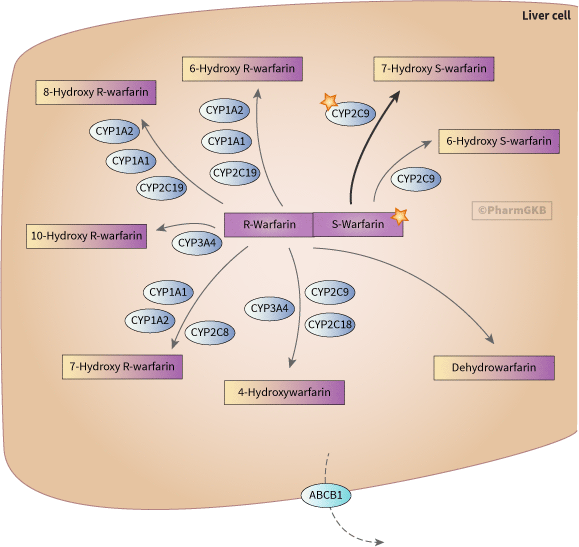
Warfarin is a natural product and given as racemic mixture of the R and S stereoisomers of the drug. S-warfarin is 3-5 times more potent an inhibitor of the vitamin K epoxide reductase complex, the target of action, than R-warfarin [Article:3567019]. The stereoisomers are metabolized by different phase 1 enzymes; the predominant metabolism of the S isomer is via CYP2C9 whereas metabolism of R-warfarin is mainly via CYP3A4 with involvement of CYP1A1, CYP1A2, CYP2C8, CYP2C9, CYP2C18 and CYP2C19 [Articles:1581537, 11353757, 8689941, 8723744] as depicted in the Warfarin Pharmacokinetics Pathway. Phase 2 metabolism of warfarin has not been well studied and is not depicted in this pathway representation, although it is known that sulfated and glucuronyl conjugates can be formed [Article:1732719]. Elimination is predominantly renal however warfarin has been shown to interact with the ABCB1 transporter in liver [Article:14676821].
Warfarin pharmacokinetics and CYP2C9 is considered a classical example of pharmacogenetics. The 2 most important variants shown to have clinical implications for warfarin dosing and prevention of adverse events are CYP2C9*2 and CYP2C9*3. Individuals with the 2 and 3 variants, who are more likely to need lower doses of warfarin, take a longer time to reach target INR on starting warfarin therapy and have an increased risk of bleeding complications [Articles:10073515, 11926893]. Several other polymorphisms in CYP2C9 have been reported some of which have also been shown to effect warfarin metabolism (*4, PMID: 12621390; *5, PMID: 11455026; *11, PMID: 15970795). Several drugs are known to interact with warfarin including 6 antibiotics (cotrimoxazole, erythromycin, fluconazole, isoniazid, metronidazole, and miconazole); 5 cardiac drugs (amiodarone, clofibrate, propafenone, propranolol, and sulfinpyrazone); phenylbutazone; piroxicam; alcohol (only with concomitant liver disease); cimetidine; and omeprazole which potentiate warfarin action, and 3 antibiotics (griseofulvin, rifampin, and nafcillin); 3 drugs active on the central nervous system (barbiturates, carbamazepine, and chlordiazepoxide); cholestyramine; sucralfate that inhibit warfarin action [Article:7944078]. Warfarin clinical outcomes can also be influenced by the interaction with diet, in particular vegetables containing vitamin K, such as spinach and kale, and avocado.
Recently the identification of the VKORC1 gene as the major subunit of the vitamin K epoxide reductase complex has resulted in new candidates for warfarin pharmacogenomics. The Warfarin Pharmacodynamics Pathway depicts vitamin K epoxide reductase and the downstream genes whose products, are postranslationally carboxylated to become Gla-containing proteins by gamma-glutamyl carboxylase (GGCX). Gla-containing proteins are involved in hemostasis (coagulation factors F2, F7, F9, F10, Protein C, S and Z) as well as bone metabolism (BGLAP), tissue matrix (MGP) and apoptosis (GAS6). So far several variants in VKORC1 have been reported to influence warfarin sensitivity including 4 mutations that are linked to warfarin resistance [Article:14765194], 1173C in the intron 1 that is more common in high daily dose patients [Article:15358623] and a haplotype of 4 variants in the promoter, introns and 3'UTR that have been shown to correlate with maintenance dose [Article:15930419] although no variants have yet been shown to be directly causative. Recently, a variant of CYP4F2 (rs2108622, V433M) has been shown to be associated with warfarin dose [Article:18250228]. CYP4F2 is a primary liver vitamin K1 oxidase that catalyzes the metabolism of vitamin K1 to hydroxyvitamin K1 and removes vitamin K from the vitamin K cycle [Article:19297519]. It acts as an important counterpart to VKORC1 in limiting excessive accumulation of vitamin K. Patients carrying the CYP4F2 rs2108622 TT genotype required approximately 1mg/day more warfarin than patients with the CC genotype. Furthermore, including CYP4F2 variant in the dosing models showed an improvement in the overall predictability of warfarin dose, in addition to functional variants in CYP2C9, VKORC1 and clinical factors. However, there are also contradictory reports showing that the contribution of this variant to warfarin dose was negligible.
Reactions & interactions (25)
-
Biochemical Reaction
warfarin → 8-hydroxy r-warfarin
-
Biochemical Reaction
warfarin → 10-hydroxy r-warfarin
-
Biochemical Reaction
warfarin → 6-hydroxy r-warfarin
-
Biochemical Reaction
warfarin → 7-hydroxy r-warfarin
-
Biochemical Reaction
warfarin → 6-hydroxy s-warfarin
-
Biochemical Reaction
warfarin → dehydrowarfarin
-
Biochemical Reaction
warfarin → 4-hydroxywarfarin
-
Biochemical Reaction
warfarin → 7-hydroxy s-warfarin
-
Catalysis
CYP1A2 → Biochemical Reaction
-
Catalysis
CYP1A1 → Biochemical Reaction
-
Catalysis
CYP2C19 → Biochemical Reaction
-
Catalysis
CYP3A4 → Biochemical Reaction
-
Catalysis
CYP2C19 → Biochemical Reaction
-
Catalysis
CYP1A2 → Biochemical Reaction
-
Catalysis
CYP1A1 → Biochemical Reaction
-
Catalysis
CYP2C8 → Biochemical Reaction
-
Catalysis
CYP1A2 → Biochemical Reaction
-
Catalysis
CYP1A1 → Biochemical Reaction
-
Catalysis
CYP2C9 → Biochemical Reaction
-
Catalysis
CYP2C9 → Biochemical Reaction
-
Catalysis
CYP2C18 → Biochemical Reaction
-
Catalysis
CYP3A4 → Biochemical Reaction
-
Catalysis
CYP2C9 → Biochemical Reaction
-
Catalysis
ABCB1 → Transport
-
Transport
warfarin → warfarin
Edit history (4)
- 2006-04-27 Create
- 2011-05-23 Update
- 2019-03-19 Update Updated xml to new formatting.
- 2019-03-20 Update Updated to new illustrator formatting.