About this pathway
Background
Verapamil is a calcium channel blocker used in the treatment of hypertension and coronary artery disease [Article:9809930].
Metabolism
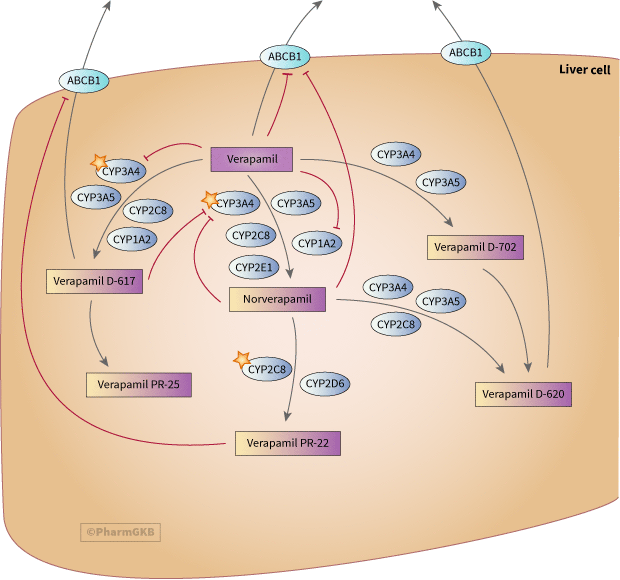
Verapamil undergoes extensive first pass metabolism with less than 5% of the parent drug excreted unchanged [Article:38084]. It is a racemic mixture of R- and S-enantiomers, with the S-enantiomer cleared more rapidly than the R-enantiomer [Article:6508982]. The main types of metabolic reactions are N-dealkylation, N-demethylation and O-demethylation [Articles:10336579, 8750925]
The main metabolite found in urine is D-617, comprising approximately 22% of verapamil dose, and is formed by N-dealkylation [Articles:38084, 8750925]. In microsomes expressing CYPs, this reaction was catalyzed by CYP3A4, CYP3A5 and CYP2C8 [Article:10336579]. The authors noted that CYP2E1 was also capable of forming D-617 but at a rate 20-fold lower than those observed with the other isoforms and likely not clinically relevant [Article:10336579]. Other reports list CYP1A2 as involved in the N-dealkylation of verapamil [Article:8750925] however experiments with expressed proteins in microsomes did not observe this [Article:10336579] and other in vitro drug-drug interaction experiments suggested verapamil acts as an inhibitor of CYP1A2 rather than as a substrate [Article:1516612]. D-617 can be further metabolized to PR-25, also described as D-717 and metabolite VII which is found excreted in urine at around 6% of dose [Articles:10336579, 38084].
Metabolites R-norverapamil (arverapamil) and S-norverapamil are formed by N-demethylation and comprise approximately 6% of dose [Article:8750925]. The main enzymes responsible for formation of these metabolites are CYP3A4, CYP3A5 and CYP2C8 [Article:10336579]. In experiments with the CYP1A2 inhibitor furafylline, the production of norverapamil from verapamil was slightly decreased indicating CYP1A2 has only a minor role in this part of the pathway [Article:1516612]. While CYP3A5 appears to metabolize R-verapamil and S-verapamil equally to form norverapamil, CYP3A4 has stereoselective preferences. When R-verapamil is the substrate for CYP3A4 then D-617 is the predominant product however when S-verapamil is the substrate then norverapamil is the main product [Article:10336579].
The third branch of metabolism is O-demethylation to D-702 and D-703 and then to D-620 [Articles:10336579, 8750925]. PubChem structures are not available for D-702 and D-703 and therefore these are not represented in the gpml. D-620 is represented in the gpml, however it can be difficult to indicate which enzymes are responsible for the reaction from verapamil to D-702 or D-703 and which for the reaction from D-702 to D-620. It is also unclear whether D-703 can be converted to D-620. Norverapamil can also be converted to D-620 by CYP2C8 and CYP3A4 [Article:10336579]. CYP3A5 has stereoselectivity in the conversion of verapamil and norverapamil to D-620, with the rate of formation from S-verapamil twice that of from R-verapamil. In addition, only the S enantiomer of norverapamil was converted to D-620 [Article:10336579].
Reactions & interactions (55)
-
Biochemical Reaction
verapamil → verapamil D-620
-
Biochemical Reaction
(s)-norverapamil → verapamil D-620
-
Biochemical Reaction
(s)-norverapamil → verapamil D-620
-
Biochemical Reaction
verapamil → (s)-norverapamil
-
Biochemical Reaction
verapamil → (s)-norverapamil
-
Biochemical Reaction
(s)-norverapamil → verapamil PR-22
-
Biochemical Reaction
verapamil → verapamil D-617
-
Biochemical Reaction
(s)-norverapamil → verapamil PR-22
-
Biochemical Reaction
verapamil D-617 → verapamil PR-25
-
Catalysis
ABCB1 → Transport
-
Catalysis
CYP3A5 → Biochemical Reaction
-
Catalysis
CYP3A4 → Biochemical Reaction
-
Catalysis
CYP2C8 → Biochemical Reaction
-
Catalysis
CYP3A4 → Biochemical Reaction
-
Catalysis
CYP3A5 → Biochemical Reaction
-
Catalysis
CYP2C8 → Biochemical Reaction
-
Catalysis
CYP3A4 → Biochemical Reaction
-
Catalysis
CYP3A5 → Biochemical Reaction
-
Catalysis
CYP2E1 → Biochemical Reaction
-
Catalysis
CYP1A2 → Biochemical Reaction
-
Catalysis
CYP3A5 → Biochemical Reaction
-
Catalysis
CYP3A4 → Biochemical Reaction
-
Catalysis
CYP2C8 → Biochemical Reaction
-
Catalysis
ABCB1 → Transport
-
Catalysis
CYP3A4 → Biochemical Reaction
-
Catalysis
CYP3A5 → Biochemical Reaction
-
Catalysis
CYP2E1 → Biochemical Reaction
-
Catalysis
CYP2C8 → Biochemical Reaction
-
Catalysis
CYP1A2 → Biochemical Reaction
-
Catalysis
CYP2C8 → Biochemical Reaction
-
Catalysis
CYP2D6 → Biochemical Reaction
-
Catalysis
CYP2C8 → Biochemical Reaction
-
Catalysis
CYP3A5 → Biochemical Reaction
-
Catalysis
CYP3A4 → Biochemical Reaction
-
Catalysis
CYP1A2 → Biochemical Reaction
-
Catalysis
CYP2C8 → Biochemical Reaction
-
Catalysis
CYP2D6 → Biochemical Reaction
-
Catalysis
ABCB1 → Transport
-
Inhibition
verapamil → ABCB1
-
Inhibition
verapamil PR-22 → ABCB1
-
Inhibition
(s)-norverapamil → ABCB1
-
Inhibition
(s)-norverapamil → CYP3A4
-
Inhibition
(s)-norverapamil → CYP3A4
-
Inhibition
(s)-norverapamil → ABCB1
-
Inhibition
furafylline → CYP1A2
-
Inhibition
verapamil → CYP1A2
-
Inhibition
grapefruit juice → CYP3A4
-
Inhibition
verapamil D-617 → CYP3A4
-
Inhibition
verapamil → CYP3A4
-
Leads To
verapamil → CYP3A5
- Showing first 50 of 55 reactions — full data preserved in database.
Edit history (3)
- 2017-06-19 Create
- 2019-02-27 Update Updated to new illustrator formatting.
- 2024-06-13 Update fixed typos