About this pathway
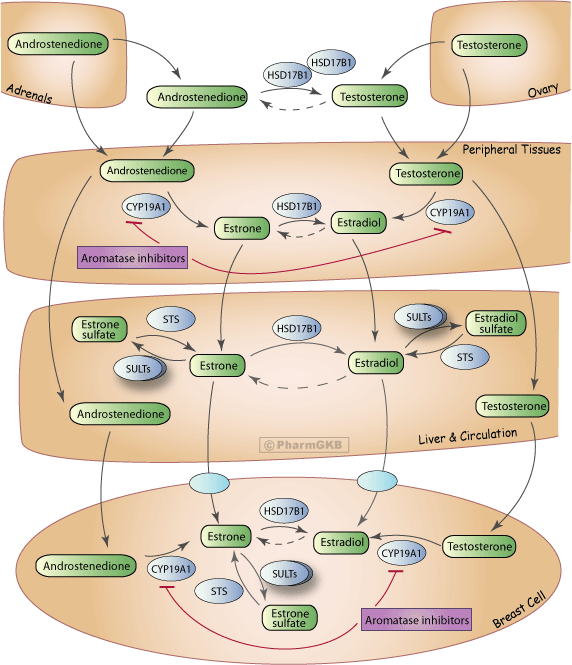
Estrogen plays an important role in initiating and promoting breast cancer (reviewed in [1]). This pathway shows the rate-limiting biosynthesis of estrogen from androgens by aromatase and its inhibition by aromatase inhibitors/inactivators in postmenopausal women. Aromatase, an enzyme of the cytochrome P450 (CYP450) subfamily and the product of the CYP19A1 gene, is highly expressed in the placenta and in the granulose cells of ovarian follicles in premenopausal women [2]. Its expression depends on cyclical gonadotropin stimulation [3]. In addition, aromatase is also present at lower levels in several nonglandular tissues that include subcutaneous fat, liver, muscle, brain, normal breast and breast cancer tissue [4]. Estrogen production after menopause is solely from nonglandular sources, particularly subcutaneous fat. In menopause, androstenedione produced in the adrenals and, to a small extent, testosterone produced in the ovaries are released to the circulation and then sequestered to nonglandular tissues (e.g., liver and breast cells), where they are converted to estrone and estradiol, respectively, by aromatase located in these tissues [5]. In the liver and in breast tissue, estrone and estradiol undergo oxidation by CYP450s to a number of hydroxylated metabolites [6]. Estrone and estradiol in these tissues also undergo conjugation by sulfotransferases (SULTs) or deconjugation by steroid sulfatase (STS) [7]. In all tissues, hydroxysteroid (17-beta) dehydrogenase (HSD17B) converts androstenedione to testosterone and estrone to estradiol [5].
Drugs that effectively inhibit the aromatase-mediated synthesis of estrogens in peripheral tissues including the breast, thus depriving the system of estrogens, are widely used in the treatment of breast cancer [4]. These drugs include the nonsteroidal triazole derivatives anastrozole and letrozole and the steroidal exemestane.
Edit history (2)
- 2007-10-15 Create
- 2008-11-25 Update