About this pathway
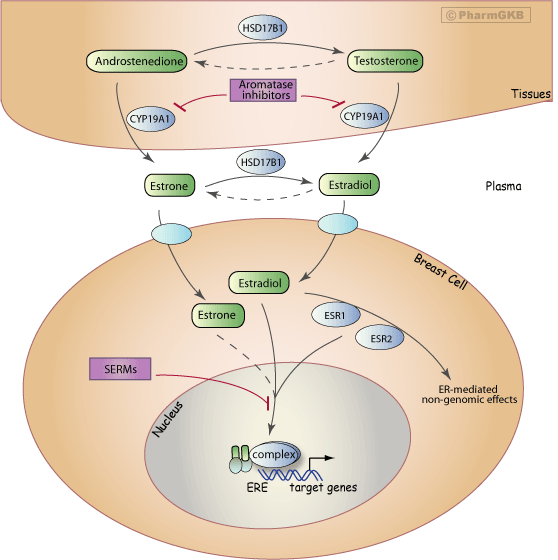
Approximately two-third of breast tumors are estrogen receptor and/or progesterone positive, and intensive research over the years has established that estrogen plays a key role in initiating and promoting breast cancer and that about 60-70% of these tumors respond to endocrine treatment that reduce the effects of estrogen. Once synthesized by the aromatase enzyme from androgens, they bind to estrogen receptors (ERb and ERa), recruit appropriate coactivators or corepressors leading to dimerization, conformational change and binding to estrogen response elements (EREs) upstream of estrogen responsive genes. This leads to increased expression of genes responsible for cell proliferation in breast tissue.
Two major pharmacologic strategies are currently used to reduce the actions of estrogens. The first strategy is to decrease the effects of estrogen in breast cancer tissues by selective estrogen receptor modulators (SERMs) such as tamoxifen and related drugs, or by drugs that facilitate the degradation and down-regulation of estrogen receptors (e.g. fulvestrant). Like estrogen, the SERMs bind to the ERs in breast cell and induce a specific conformational change that inhibits transcription of estrogen regulated genes. In other cells and tissues (e.g. liver, endometrium, cardiovascular and bone), the conformational change brought about by SERMs might activate estrogen-dependent gene expression, essentially acting as estrogenic in these tissues. The second strategy involves deprivation of breast cancer cells of estrogens altogether through inhibitors of the aromatase, a rate-limiting enzyme in the conversion of androgens such as testosterone and androstenedione to estrogens such as estradiol and estrone. Currently, the third-generation aromatase inhibitors that include the nonsteroidal triazole derivatives anastrozole and letrozole and the steroidal exemestane effectively inhibits aromatase activity in tissues including the breast and are increasingly used to treat breast cancer.
Edit history (3)
- 2006-09-06 Create
- 2007-04-06 Update
- 2025-06-19 Update fixed typos