About this pathway
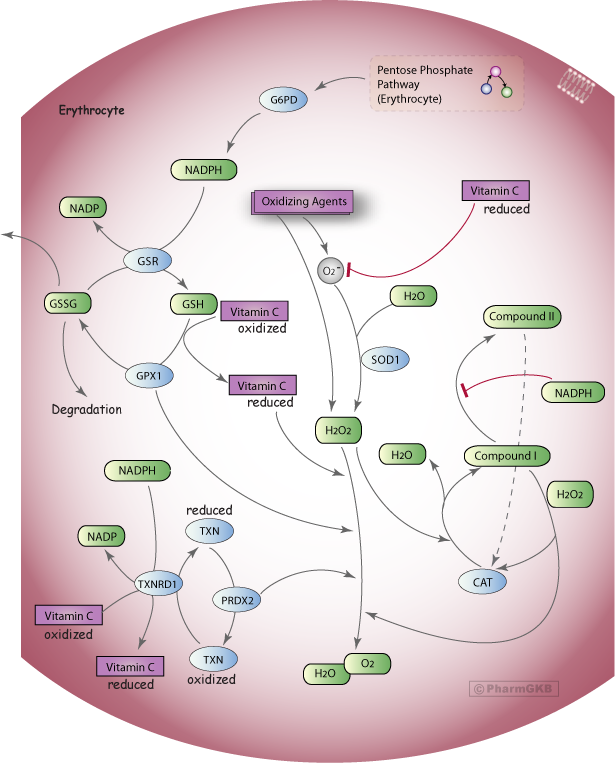
Release of reactive oxygen species (ROS) such as superoxide (O2-) and/or peroxide (e.g. hydrogen peroxide, H2O2) can be triggered by exogenous oxidizing agents such as therapeutics or their metabolites [Articles:2633878, 10533013]. For example, H2O2 is produced as a byproduct of the conversion of uric acid to allantoin by the drug rasburicase [Articles:12646938, 16597166]. Red blood cells (RBCs, erythrocytes) are constantly subjected to oxidative stress, from their role as an oxygen transporter to their exposure to xenobiotics in the circulation [Articles:15862084, 10533013]. The Oxidative Stress Regulatory Pathway focuses on some of the mechanisms requiring NADPH from the PPP to neutralize ROS such as O2- and H2O2.
O2- can be converted to H2O2 by superoxide dismutase (SOD1) [Articles:20350285, 2633878]. Glutathione reductase (GSR) utilizes NADPH to convert oxidized glutathione (GSSG) to reduced glutathione (GSH) [Articles:18177777, 16204390, 21376665, 17611006, 10657232]. GSH is then oxidized back to GSSG by glutathione peroxidase (GPX1) in a cyclical reaction to neutralize 2H2O2 into 2H20 and O2 [Articles:18177777, 16204390, 21376665, 17611006, 2633878]. GSH also protects hemoglobin by preventing and reversing oxidation that causes disulphide crosslinks between globin chains and distorts hemoglobin structure, potentially resulting in the precipitation of 'Heinz bodies' [Article:15862084]. RBCs with normal G6PD enzyme activity have higher PPP activity and levels of GSH compared to G6PD deficient RBCs, however deficient cells can cope with low levels of available NADPH under normal conditions [Articles:4154443, 2633878]. When oxidative stress occurs, G6PD 'normal' RBCs maintain GSH levels by enhancing PPP activity, whereas in G6PD deficient cells the PPP remains at minimum capacity and GSH levels decrease [Article:4154443]. Because the PPP in G6PD deficient RBCs is already close to the maximum activity rate obtainable under normal conditions, they cannot cope with oxidative stresses, and are more susceptible to lysis triggered by oxidative stress, which can lead to hemolytic anemia [Articles:4154443, 2633878].
Another key system requiring NADPH involves the conversion of oxidized thioredoxin (TXN) to a reduced form by thioredoxin reductase (TXNRD1), reduced TXN is then utilized as an electron donor by the enzyme peroxiredoxin to neutralize H2O2 [Articles:18479207, 17611006, 10657232]. In RBCs, peroxiredoxin 2 (Prx 2, PRDX2) is the most abundant isoform and also plays a protective role by binding to and stabilizing hemoglobin [Articles:18479207, 22960070]. The importance of PRDX2 is demonstrated in knockout mice who display morphological RBC defects such as Heinz bodies, and upon exposure to H2O2 blood samples from knockout mice have enhanced MetHb formation compared to wildtype samples [Article:12586629].
Both GSH and TXNRD1 can convert fully oxidized vitamin c (dehydroascorbic acid) to its reduced form (ascorbate, ascorbic acid), which can in turn donate electrons and hydrogens to O2-, H2O2 and oxygen free radicals [Articles:10657232, 9667500, 9405334, 11687303]. Because humans cannot synthesize vitamin c, recycling it from an oxidized state is important in maintaining RBC and plasma levels of the anti-oxidant form [Articles:10657232, 9667500, 9405334].
The catalase (CAT) enzyme also neutralizes H2O2, involving reaction steps that form different states of the enzyme - NADPH is not required for the functional activity of catalase, rather the prevention of forming an inactive state of the enzyme [Article:17158050]. The first reaction between resting catalase (ferricatalase) and H2O2 forms Compound I and H2O, then reaction with a further H2O2 molecule returns catalase to resting state and releases H2O and O2 [Articles:17158050, 22516655]. Reduction of Compound I can also form the inactive Compound II state that slowly spontaneously reverts back to catalase [Articles:17158050, 22516655]. Formation of Compound II can be prevented by the production of NADPH by G6PD from glucose-6-phosphate (see the Pentose Phosphate Pathway (Erythrocytes) [Articles:3805001, 8704218, 17158050]. Evidence suggests that NADPH may also function to reduce Compound I back to catalase under conditions that prolong this state of catalase, a strong oxidant (for example low H2O2) [Article:17158050].
Edit history (2)
- 2012-09-19 Create
- 2013-03-18 Update