About this pathway
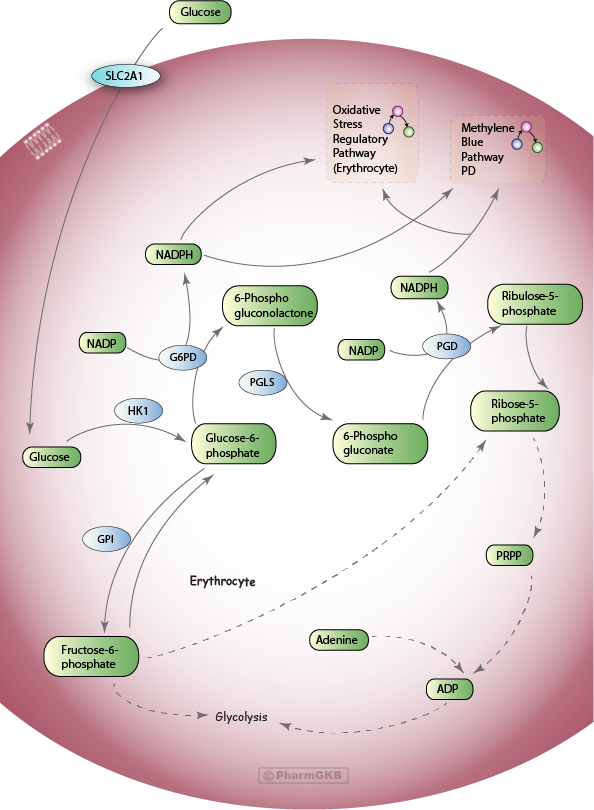
The Pentose Phosphate Pathway (PPP) and production of NADPH in red blood cells
Glucose is converted to glucose-6-phosphate by hexokinase (HK1), and then enters either the glycolysis pathway via conversion to the isomer fructose-6-phosphate, or the PPP (also known as hexose monophosphate shunt) via oxidation into 6-phosphogluconolactone [Articles:18177777, 16204390, 21376665, 18226191, 17489100, 13799836, 15862084, 9531504]. Two steps within the PPP produce NADPH; the conversion of glucose-6-phosphate to 6-phosphogluconolactone by G6PD, and 6-phosphogluconate to ribulose-5-phosphate by 6-phosphogluconate dehydrogenase (PGD, 6PGD) [Articles:18177777, 16204390, 18226191, 21376665, 20350285]. The end product of the pathway is ribose-5-phosphate, utilized for the production of nucleotides, polysaccharides and coenzymes, and used in RBCs for phosphoribosylpyrophosphate (PRPP) production to generate ADP for use in the Embden-Meyerhof glycolysis pathway [Articles:21376665, 20122995, 7713590]. NADPH is required in the RBC for the regulation of oxidative stress and within the methylene blue pathway [Articles:21376665, 7489710, 7073040]. The only source of NADPH in RBCs is via the PPP, in which G6PD is the rate-limiting step [Articles:16204390, 2633878, 18177777, 4154443, 15862084, 21376665]. As RBCs age, enzyme activities involved in glucose metabolism diminish, including G6PD, reducing energy production and ability to protect cell membrane integrity and hemoglobin from oxidation [Articles:14074568, 13799836].
Reactions & interactions (27)
-
Activation
fructose-6-phosphate → ribose phosphate
-
Biochemical Reaction
ribose phosphate → phosphoribosyl pyrophosphate
-
Biochemical Reaction
glucose → glucose-6-phosphate
-
Biochemical Reaction
6-phosphogluconate → ribulose-5-phosphate
-
Biochemical Reaction
ribulose-5-phosphate → ribose phosphate
-
Biochemical Reaction
6-phosphogluconolactone → 6-phosphogluconate
-
Biochemical Reaction
Nicotinamide adenine dinucleotide phosphate → Dihydronicotinamide adenine dinucleotide phosphate
-
Biochemical Reaction
Nicotinamide adenine dinucleotide phosphate → Dihydronicotinamide adenine dinucleotide phosphate
-
Biochemical Reaction
glucose-6-phosphate → fructose-6-phosphate
-
Biochemical Reaction
glucose-6-phosphate → 6-phosphogluconolactone
-
Biochemical Reaction
fructose-6-phosphate → glucose-6-phosphate
-
Biochemical Reaction
adenine + phosphoribosyl pyrophosphate → adenosine diphosphate
-
Catalysis
HK1 → Biochemical Reaction
-
Catalysis
PGD → Biochemical Reaction
-
Catalysis
PGLS → Biochemical Reaction
-
Catalysis
PGD → Biochemical Reaction
-
Catalysis
SLC2A1 → Transport
-
Catalysis
G6PD → Biochemical Reaction
-
Catalysis
GPI → Biochemical Reaction
-
Catalysis
G6PD → Biochemical Reaction
-
Leads To
fructose-6-phosphate → glycolysis
-
Leads To
Dihydronicotinamide adenine dinucleotide phosphate → Methylene Blue Pathway, Pharmacodynamics
-
Leads To
Dihydronicotinamide adenine dinucleotide phosphate → Methylene Blue Pathway, Pharmacodynamics
-
Leads To
Dihydronicotinamide adenine dinucleotide phosphate → Oxidative Stress Regulatory Pathway (Erythrocyte)
-
Leads To
adenosine diphosphate → glycolysis
-
Leads To
Dihydronicotinamide adenine dinucleotide phosphate → Oxidative Stress Regulatory Pathway (Erythrocyte)
-
Transport
glucose → glucose
Edit history (1)
- 2012-09-07 Create