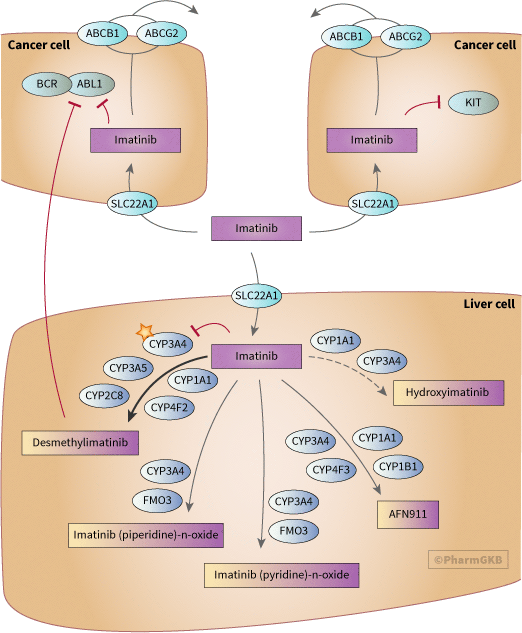
About this pathway
Imatinib Mesylate (Gleevec, Glivec) is a small molecule inhibitor of protein tyrosine kinases. It is used to treat different types of leukemia, in particular, Philadelphia chromosome positive chronic myeloid leukemia (CML), as well as gastrointestinal stromal tumors(GIST) that harbor KIT mutations, and various other types of cancer [Articles:11870247, 17385949, 13679030].
In more than 90% of patients with CML, the Philadelphia chromosome translocation (t(9;22)) results in the molecular juxtaposition of two genes, BCR and ABL1, to form BCR-ABL [Articles:12755554, 13679030, 11287972]. The chimeric BCR-ABL oncoprotein formed from the aberrant gene is a constitutively active tyrosine kinase [Articles:12755554, 13679030, 11287972, 11870247] involved in several signal transduction pathways [Article:11870247]. A host of substrates can be phosphorylated by BCR-ABL [Articles:19064740, 11071626]. The BCR-ABL tyrosine kinase is the critical pathogenetic event in CML [Article:19064740]. Imatinib binds to the BCR-ABL protein and inhibits its activity [Articles:12755554, 13679030, 16122278, 11287972]. This results in inhibition of proliferation and induction of apoptosis in BCR-ABL-positive cells, with no effect on normal cells [Article:16122278]. In the case of GIST, mutations in KIT produce ligand-independent constitutive activation of KIT [Articles:9438854, 18369405]. Imatinib interrupts KIT-mediated signal transduction in a manner analogous to its inhibition of BCR-ABL [Articles:11870247, 16122278, 17385949].
Besides BCR-ABL protein kinase and c-KIT, imatinib is also known to inhibit other protein kinases such as PDGF-R [Articles:15828850, 16122278, 11870247, 17385949]. Proteins encoded by DDR1, DDR2, CSF1R, LCK, BLK, PDGFRA, PDFRB were also found, in in vitro binding assays, to bind imatinib with Kd's less than 1uM.[Article:18183025]
Imatinib is primarily metabolized by CYP3A4 and CYP3A5 to an active metabolite, desmethylimatinib derivative (CGP 74588) [Articles:16122278, 15828850, 16006570]. CYP2C8 can also metabolize this conversion, and in patients with liver disease and impaired CYP3A4, CYP2C8 was able to maintain imatinib clearance [Articles:20977456, 29223619]. In vitro studies showed capability of CYP3A4, CYP1A1, CYP4F2 to form desmethylimatinib [Article:18188833]. CGP 74588 has a similar potency to that of the parent drug; the elimination half-lives are approximately 13 hours for the parent and 20 hours, for the metabolite, respectively [Articles:16122278, 16006570]. Other CYPs, such as CYP1A2, CYP2D6, CYP2C9 and CYP2C19 are listed in the drug label and FDA documentation as having a minor role but have not been verified in peer-reviewed studies [Article:20977456]. Two n-oxide metabolites of imatinib, imatinib pyridine n-oxide (CGP 72383) and imatinib piperdine n-oxide (CGP 71422) have also been identified in patient urine 2 hours post-dose but were not observed at 24 hours after dosing [Article:16122278]. In vitro studies demonstrated the action of CYP3A4 and FMO3 in formation of the n-oxide metabolites [Article:18188833]. AFN911 was formed in vitro by CYP3A4, CYP1A1, CYP1B1, CYP4F3 [Article:18188833]. Minor products formed by hydroxylation (M3a, b, and c) were also shown in vitro but not found in urine. These were generated by CYP3A4, CYP1A1, CYP1B1 and CYP4F2 [Article:18188833]; due to the overexpression of CYP1A1 and CYP1B1 in some cancers these products may have a role in vivo but have not been demonstrated. Imatinib is excreted mainly as its metabolites [Article:16122278].
Imatinib may interact with drugs that are inhibitors or inducers of, or substrate for, CYP3A4. [Articles:17385949, 16122278]. It is also a competitive inhibitor of CYP2C9, CYP2D6, and CYP3A5 [Articles:17385949, 16122278].
The drug is a transported by P-glycoprotein (ABCB1) [Articles:18449471, 16122278, 15828850]and Breast Cancer Resistance Protein (ABCG2) [Articles:18449471, 16122278, 19111841]. With respect to ABCB1, among the patients homozygous for allele 1236C>T (rs1128503), 85% achieve a BCR-ABL level 3 log reduction when treated with imatinib, versus 47.7% for the other genotypes. [Article:18524988] The mechanism of resistance to imatinib appears to be due a variety of factors, including BCR-ABL gene amplification [Articles:11423618, 10688835], mutations in the protein that could alter binding [Articles:14534339, 11567109], or over-expression of transporters [Article:14724652].
Many researchers have detected, in a proportion of patients who have developed resistance to imatinib, point mutations in the ABL kinase domain that lead to specific single amino acid substitutions, which could interfere with binding of the drug to the kinase (for a list see [Article:14534339]). However, in in vitro binding studies, while many of these proteins with a single mutation show an increased IC50 vs wild type protein, many other of these mutant proteins are still inhibited by imatinib [Article:12576318].
There are several crystal structures of imatinib, complexed to different proteins, in the Protein Data Bank [Article:10592235]. A crystal structures of imatinib complexed with the human ABL1 kinase domain (2hyy, resolution 2.4A [Article:17164530] ) is available in the PDB. A crystal structure of imatinib complexed with KIT tyrosine kinase (1t46, 1.6A resolution [Article:15123710] ) is also present in the repository. In addition, there is a crystal structure of the drug complexed with SYK tyrosine kinase (1xbb, resolution 1.57A, [Article:15507431]).
Reactions & interactions (35)
-
Biochemical Reaction
imatinib → imatinib (pyridine)-n-oxide
-
Biochemical Reaction
imatinib → hydroxyimatinib metabolites
-
Biochemical Reaction
imatinib → AFN911
-
Biochemical Reaction
imatinib → imatinib (piperidine)-n-oxide
-
Biochemical Reaction
imatinib → desmethylimatinib
-
Catalysis
CYP3A4 → Biochemical Reaction
-
Catalysis
FMO3 → Biochemical Reaction
-
Catalysis
CYP1A1 → Biochemical Reaction
-
Catalysis
CYP3A4 → Biochemical Reaction
-
Catalysis
CYP1A1 → Biochemical Reaction
-
Catalysis
CYP3A4 → Biochemical Reaction
-
Catalysis
CYP1B1 → Biochemical Reaction
-
Catalysis
CYP4F3 → Biochemical Reaction
-
Catalysis
CYP3A4 → Biochemical Reaction
-
Catalysis
FMO3 → Biochemical Reaction
-
Catalysis
SLC22A1 → Transport
-
Catalysis
ABCB1 → Transport
-
Catalysis
ABCG2 → Transport
-
Catalysis
SLC22A1 → Transport
-
Catalysis
CYP4F2 → Biochemical Reaction
-
Catalysis
CYP1A1 → Biochemical Reaction
-
Catalysis
CYP3A4 → Biochemical Reaction
-
Catalysis
CYP2C8 → Biochemical Reaction
-
Catalysis
CYP3A5 → Biochemical Reaction
-
Catalysis
SLC22A1 → Transport
-
Catalysis
ABCG2 → Transport
-
Catalysis
ABCB1 → Transport
-
Inhibition
imatinib → KIT
-
Inhibition
desmethylimatinib → BCR-ABL
-
Inhibition
imatinib → BCR-ABL
-
Transport
imatinib → imatinib
-
Transport
imatinib → imatinib
-
Transport
imatinib → imatinib
-
Transport
imatinib → imatinib
-
Transport
imatinib → imatinib
Edit history (2)
- 2009-02-26 Create
- 2019-03-11 Update Updated gpml and illustrator to new formatting.