About this pathway
Background
Naproxen is an NSAID non-steroidal anti-inflammatory drug used in the treatment of arthritis and pain [Article:24175972]. It acts mainly by inhibition of the COX 1 and COX2 enzymes coded for by PTGS1 and PTGS2 respectively [Article:11496855]. Side effects include risk for gastrointestinal bleeding and cardiovascular events, although recent studies comparing NSAIDs for cardiovascular risk suggested that naproxen is one of the lowest risk options [Articles:24175972, 21980265].
Metabolism
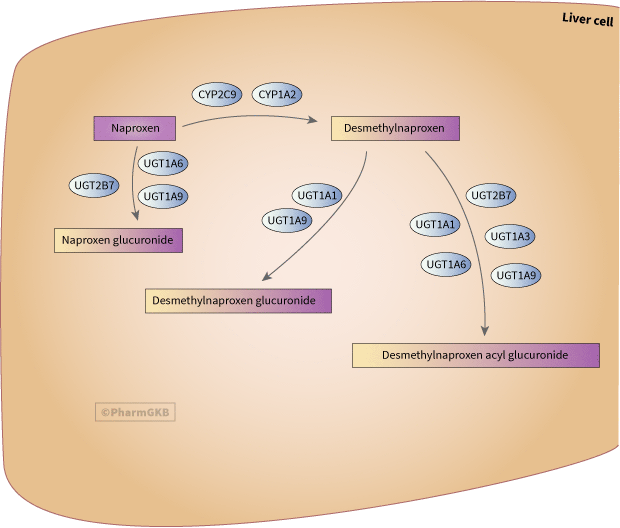
Experiments with microsomes and expressed proteins indicate that the main demethylation pathway for both stereoisomers of naproxen is catalyzed by CYP2C9 and CYP1A2 [Article:8866821]. The parent drug can be glucuronidated, mainly by UGT2B7, and the desmethyl metabolite can be glucuronidated to form either the phenolic glucuronide or the acyl glucuronide [Article:16187975].
Reactions & interactions (16)
-
Biochemical Reaction
naproxen → naproxen glucuronide
-
Biochemical Reaction
naproxen → desmethylnaproxen
-
Biochemical Reaction
desmethylnaproxen → 6-o-desmethylnaproxen iso acyl glucuronide
-
Biochemical Reaction
desmethylnaproxen → 6-o-desmethylnaproxen 6-glucuronide
-
Catalysis
UGT1A9 → Biochemical Reaction
-
Catalysis
UGT2B7 → Biochemical Reaction
-
Catalysis
UGT1A6 → Biochemical Reaction
-
Catalysis
CYP2C9 → Biochemical Reaction
-
Catalysis
CYP1A2 → Biochemical Reaction
-
Catalysis
UGT1A6 → Biochemical Reaction
-
Catalysis
UGT1A3 → Biochemical Reaction
-
Catalysis
UGT1A1 → Biochemical Reaction
-
Catalysis
UGT1A9 → Biochemical Reaction
-
Catalysis
UGT2B7 → Biochemical Reaction
-
Catalysis
UGT1A1 → Biochemical Reaction
-
Catalysis
UGT1A9 → Biochemical Reaction
Edit history (2)
- 2017-05-03 Create
- 2019-01-31 Update Updated to new illustrator formatting