About this pathway
Background
Fluvoxamine is an SSRI, selective serotonin reuptake inhibitor used in the treatment of depression, obsessive-compulsive disorder, anxiety and eating disorders [Article:7988100]. It has comparable efficacy to tricyclics in the treatment of depression but lower incidence of anticholinergic adverse effects and cardiovascular adverse effects [Article:7988100]. The most frequent side effects are nausea and gastrointestinal effects [Article:7988100].
Metabolism
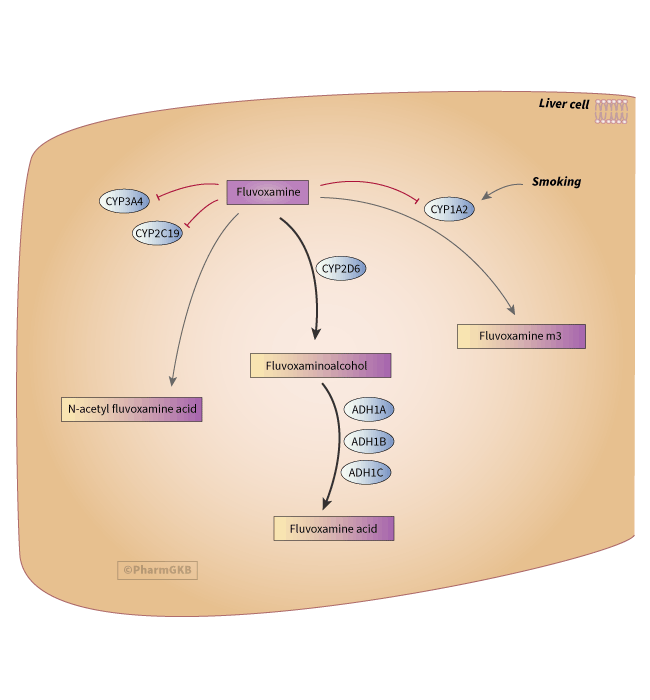
Fluvoxamine is extensively metabolized in the liver, and less than 4% of the parent drug is found in urine [Article:11791895]. Eleven metabolite have been identified in urine, and nine are documented in the literature as numbered structures [Article:7988100] but few structures were found in PubChem. None of the main metabolite have been shown to have pharmacological activity [Article:11791895]. The major metabolite fluvoxamine acid (also called m1 in PMID: 7988100), represents around 30-60% of fluvoxamine urinary metabolites [Article:11791895]. It is generated in a two step process of oxidative demethylation of the methoxy group by CYP2D6 to form the fluvoxaminoalcohol intermediate followed by alcohol dehydrogenase (coded for by ADH1A, ADH1B and ADH1C) to form fluvoxamine acid [Articles:11791895, 17484519]. In vitro experiments with microsomes, expressed CYP proteins and CYP-specific inhibitors indicated that CYP2D6 is the only CYP enzyme likely to carry out this process [Article:17484519]. Around 20-40% of urinary metabolites of fluvoxamine involve substitution or removal of the amino group by CYP1A2 [Article:11791895]. Removal of the amino branch leaves the metabolite m3 [Article:7988100]. Modification of both side chains give the m4 metabolite n-acetyl fluvoxamine acid [Article:7988100]. There is significant decrease in clearance of fluvoxamine in CYP2D6 PM as compared to CYP2D6 EM [Article:8823236]. Smoking increased clearance of fluvoxamine in CYP2D6 PM (n=1) such that it was comparable with smoking and non-smoking CYP2D6 EM [Article:8823236]. Smoking induces CYP1A2.
Reactions & interactions (13)
-
Activation
Tobacco Use Disorder → CYP1A2
-
Biochemical Reaction
fluvoxamine → n-acetyl fluvoxamine acid
-
Biochemical Reaction
fluvoxaminoalcohol → fluvoxamine acid
-
Biochemical Reaction
fluvoxamine → fluvoxamine m3
-
Biochemical Reaction
fluvoxamine → fluvoxaminoalcohol
-
Catalysis
ADH1A → Biochemical Reaction
-
Catalysis
ADH1C → Biochemical Reaction
-
Catalysis
ADH1B → Biochemical Reaction
-
Catalysis
CYP1A2 → Biochemical Reaction
-
Catalysis
CYP2D6 → Biochemical Reaction
-
Inhibition
fluvoxamine → CYP1A2
-
Inhibition
fluvoxamine → CYP2C19
-
Inhibition
fluvoxamine → CYP3A4
Edit history (4)
- 2017-05-25 Create
- 2019-01-31 Update Updated to new illustrator formatting
- 2024-08-30 Update Removed CYP3A from gpml and replaced with CYP3A4. Fixed broken links to metabolites. Updated figure.
- 2025-04-02 Update fixed typo