About this pathway
Introduction
Tropisetron is a first-generation serotonin (5-hydroxytryptamine or 5-HT) receptor antagonists which binds to the 5-HT3 receptor. It is an indole compound with carbon and nitrogen rings that give tropisetron a structural similarity to serotonin, allowing it to bind to the 5-HT3 receptor and exert its clinical effect [Articles:7507039, 12608887, 27988869].
Tropisetron can be used either alone or in combination with other antiemetics to reduce nausea and vomiting in patients who have undergone surgery or chemotherapy [Article:27988869]. It has a similar efficacy to the other 5-HT3 receptor antagonists, with the exception of granisetron, which has been shown to have a higher efficacy in some studies [Articles:9506240, 11554235, 17530482, 17205281]. The most common side effects of tropisetron administration are headache, dizziness and diarrhea in addition to reports of cardiac effects caused by tropisetron [Articles:12401905, 17530482, 27988869].
Pharmacokinetics
Tropisetron is generally available as an oral tablet, with a Tmax of around 3 hours [Article:19200686] and a plasma half-life of around 6 hours [Articles:1356742, 11736884]. Patients with liver cirrhosis had reduced metabolic clearance of tropisetron while patients with moderate or severe renal impairment had reduced non-renal clearance of tropisetron [Article:1380428]. However, tropisetron pharmacokinetics were not altered in patients with hepatitis or fatty liver disease [Article:1380428]. Equally, a patient’s age does not appear to impact pharmacokinetics [Article:1380428].
Absorption, distribution, metabolism and excretion
Oral tropisetron has a bioavailability of around 60% and is rapidly absorbed into the plasma following administration [Articles:1380428, 11736884]. Once absorbed, around 59-71% of tropisetron is found bound to plasma proteins [Article:1380428].
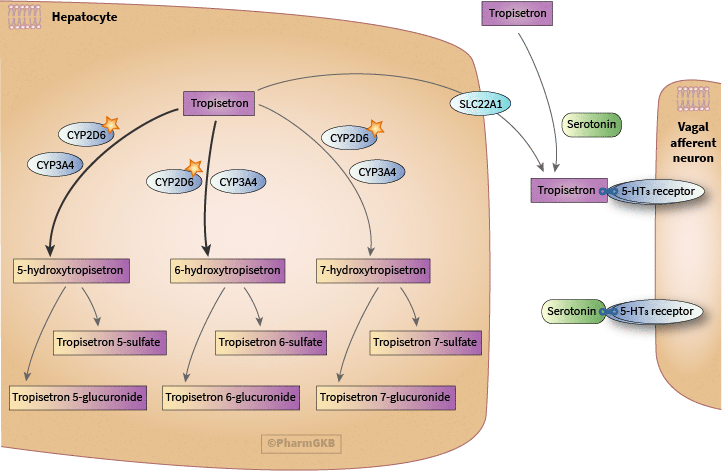
The main route of tropisetron metabolism is by hydroxylation with subsequent sulfation and glucuronidation of the hydroxylated metabolites [Articles:1380428, 1356742]. Hydroxylation of tropisetron can occur at the 5, 6 or 7 positions of the drug’s indole ring, with 5-hydroxytropisetron and 6-hydroxytroipsetron being the predominant metabolites [Articles:1380428, 7598739]. Around 91% of tropisetron metabolism is carried out by CYP2D6 with a minor contribution from CYP3A4, shown on the pathway image by the presence of a star next to CYP2D6 [Articles:8013282, 7598739, 8861656].
Work in human liver microsomes has suggested that N-demethyltropisetron may also be formed by CYP3A4 in addition to an N-oxide metabolite and several other unidentified minor metabolites. However, these metabolites have yet to be detected as a result of in vivo metabolism [Articles:8013282, 7598739].
Around 10% of the original dose of tropisetron is excreted unchanged in the urine [Articles:1380428, 1356742]. About 15% of a dose of tropisetron is excreted as metabolites in the feces, with a further 70% excreted as metabolites in the urine [Articles:1380428, 1356742].
Pharmacodynamics
Tropisetron prevents the binding of serotonin released from intestinal enterochromaffin cells to 5-HT3 receptors on adjacent vagal afferent nerves. This blockade of 5-HT3 receptors reduces nausea and vomiting by decreasing vagus nerve signaling and the subsequent release of serotonin in the brainstem [Article:11090957]. It is important to note that serotonin signaling is not the only mechanism by which nausea and vomiting can be stimulated and, as a result, tropisetron cannot be used to treat all cases of nausea and vomiting [Article:11090957].
Tropisetron has been found to occupy around 78% of 5-HT3 receptors on average [Article:19967488]. There are large interindividual differences in 5-HT3 receptors occupancy by tropisetron however, the efficacy appears to be at least partially correlated to the level of 5-HT3 receptor occupancy [Articles:15168080, 19967488].
In vitro work using a range of animal receptors suggest that tropisetron may interact with other receptors and transporters in addition to the 5-HT3 receptor [Articles:2164935, 11212100, 16115980]. However, the relevance of these findings to the actions of tropisetron in humans has yet to be determined.
Work on the effects of tropisetron on cardiac ion channels suggests that it is able to interact with the inactive state of the cardiac sodium channel Nav1.5, encoded for by the gene SCN5A. This causes the channel to become blocked [Articles:11046096, 27401036].
Pharmacogenetics
Variation in CYP2D6 activity can impact on the pharmacokinetics of tropisetron, ultimately affecting drug efficacy. CYP2D6 ultrarapid metabolizers (UMs) have decreased exposure and a reduced response to tropisetron, as measured by an increased number of vomiting episodes following treatment compared to CYP2D6 normal metabolizers (NMs) [Articles:12065557, 12728290, 15731591]. As a result, the Clinical Pharmacogenetics Implementation Consortium (CPIC) have published a clinical guideline for tropisetron, advising that CYP2D6 UMs are prescribed alternative antiemetic medication, such as dolasetron [Article:28002639].
The response of CYP2D6 intermediate and poor metabolizers (IMs and PMs) tropisetron is less clear. While some work has indicated that IMs and PMs have an increased exposure to tropisetron [Articles:12065557, 12728290], a notable effect of these phenotypes on a patient’s response has not been documented [Article:12065557].
Work on the relationship between the transporter SLC22A1 and the efficacy of tropisetron has found that patients who do not have any active SLC22A1 alleles may experience an increased efficacy of the drug [Article:20921968]. The authors of this paper suggest that a lack of active SLC22A1 alleles reduces hepatic cellular uptake and therefore metabolism and inactivation of tropisetron. Tropisetron transport appears to be unaffected by the variant rs1045642 in ABCB1 [Article:16338277].
A study into the effects of polymorphisms in the HTR3A gene, which encodes the 5-HT3A subunit of the 5-HT3 receptor, found no statistically significant effects of any variants on the efficacy of tropisetron [Article:15115912]. Tremblay et al. found that homozygotes for the del allele of rs45460698 in the promotor of HTR3B, which encodes the 5-HT3B subunit of the 5-HT3 receptor, had significantly more episodes of vomiting when treated with tropisetron compared to heterozygotes or homozygotes for the AAG allele [Article:12775740]. However, this association lost significance following multiple testing correction at one of the two timepoints assessed. The authors also noted nonsignificant trends for rs45460698 heterozygotes to have increased nausea and vomiting tropisetron therapy compared to AAG homozygotes [Article:12775740].
Conclusion
The pharmacokinetics and pharmacodynamics of tropisetron are fairly well characterized, although there is an absence of information about drug transport. While there is clinical guidance regarding the use of tropisetron in CYP2D6 UMs, further work is warranted to elucidate whether the CYP2D6 PM phenotype has an impact on a patient’s response to the drug.
Reactions & interactions (20)
-
Activation
serotonin → 5-HT3 receptor
-
Activation
serotonin → 5-HT3 receptor
-
Biochemical Reaction
7-hydroxytropisetron → tropisetron 7-sulfate
-
Biochemical Reaction
tropisetron → 6-hydroxytropisetron
-
Biochemical Reaction
5-hydroxytropisetron → tropisetron 5-sulfate
-
Biochemical Reaction
6-hydroxytropisetron → tropisetron 6-glucuronide
-
Biochemical Reaction
5-hydroxytropisetron → tropisetron 5-glucuronide
-
Biochemical Reaction
tropisetron → 5-hydroxytropisetron
-
Biochemical Reaction
tropisetron → 7-hydroxytropisetron
-
Biochemical Reaction
7-hydroxytropisetron → tropisetron 7-glucuronide
-
Biochemical Reaction
6-hydroxytropisetron → tropisetron 6-sulfate
-
Catalysis
CYP2D6 → Biochemical Reaction
-
Catalysis
CYP3A4 → Biochemical Reaction
-
Catalysis
SLC22A1 → Transport
-
Catalysis
CYP3A4 → Biochemical Reaction
-
Catalysis
CYP2D6 → Biochemical Reaction
-
Catalysis
CYP3A4 → Biochemical Reaction
-
Catalysis
CYP2D6 → Biochemical Reaction
-
Inhibition
tropisetron → 5-HT3 receptor
-
Transport
tropisetron → tropisetron
Edit history (3)
- 2018-07-18 Create
- 2018-11-30 Update Updated GPML file, pathway image and description to reflect reviewer comments from upcoming publication of this pathway.
- 2022-01-07 Update Minor edit to GPML file