About this pathway
Background
Haloperidol is a first generation typical antipsychotic used in the treatment of schizophrenia and Tourette syndrome (reviewed in [Article:10628896]). Haloperidol is lipophilic and readily absorbed. It can be administered as oral, intramuscular (IM) or intravenous (IV) formulations. It has a narrow therapeutic window and therapeutic drug monitoring is common. It undergoes extensive metabolism in the liver with less than 1% of the parent drug excreted in urine [Article:10628896].
Haloperidol acts at the dopamine D2 receptor DRD2, over occupation of DRD2 results in extrapyramidal symptoms such as muscle rigidity, dystonia, and dystonia [Article:17558307]. Haloperidol can interact with the cardiac voltage-gated rapidly-activating potassium channels leading to QT prolongation, Torsades de pointes and sometimes fatal adverse drug reactions, see the Antiarrhythmic Pathway, Pharmacodynamics [Articles:15649104, 26749342]. The risk for cardiac side effects is greater for IM and IV acute administration than oral [Article:27597919]. Other side effects include metabolic effects such as weight gain which can also lead to discontinuation of treatment [Article:22305490].
Guidelines from the Royal Dutch Pharmacists Association suggest dose modifications based on CYP2D6 genotypes [Article:21412232].
Metabolism
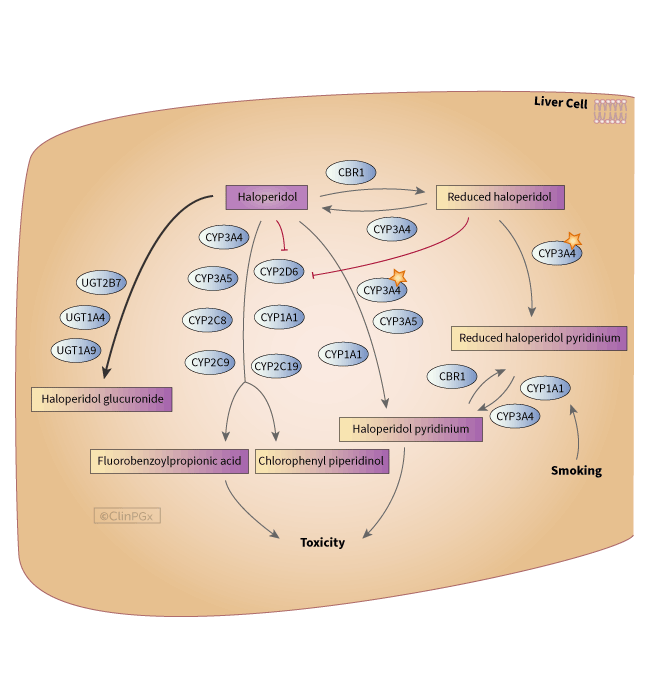
Glucuronidation is the main route of haloperidol metabolism, responsible for approximately 50-60% of metabolism in vivo [Article:10628896]. Unlike other drugs this process is not reversed by enzymes from gut bacteria and it is excreted as haloperidol glucuronide [Article:10628896]. O-glucuronidation is the major site of modification; N-glucuronidation has been shown in vitro although at much lower levels [Article:22028316]. The process is catalyzed by UGT2B7 (70%), UGT1A9 (20%), and UGT1A4 (10%) [Article:22028316].
Approximately 25% of haloperidol undergoes reduction. This is a reversible process although the reverse oxidation reaction occurs at rate of about one quarter that of reduction reaction [Article:10628896]. The two oxidative routes account for the remaining 15-30%: oxidative N-alkylation to CPHP and FBPA, and oxidation to haloperidol pyridinium. Oxidative N-alkylation breaks the bond between the piperidine two ring section and single ring with carbon backbone and essentially splits the drug into two forming CPHP and FBPA. Although CYP3A4 is the major enzyme involved in reduction of haloperidol, studies of poor metabolizers, PMs, of CYP2D6 have shown this can influence metabolism [Articles:10628896, 16805946, 17667795, 14499311, 12919180, 12784098, 10096261, 11560558, 9352580, 11595402, 12746736].
Reactions & interactions (22)
-
Activation
Tobacco Use Disorder → CYP1A1
-
Biochemical Reaction
haloperidol → 3-(4-fluorobenzoyl)propionic acid + 4-(4-chlorophenyl)piperidin-4-ol
-
Biochemical Reaction
haloperidol → haloperidol pyridinium
-
Biochemical Reaction
haloperidol → reduced haloperidol
-
Biochemical Reaction
haloperidol → haloperidol b-d-glucuronide
-
Catalysis
CYP3A4 → Biochemical Reaction
-
Catalysis
CYP2D6 → Biochemical Reaction
-
Catalysis
CYP2C8 → Biochemical Reaction
-
Catalysis
CYP2C9 → Biochemical Reaction
-
Catalysis
CYP3A5 → Biochemical Reaction
-
Catalysis
CYP1A1 → Biochemical Reaction
-
Catalysis
CYP2C19 → Biochemical Reaction
-
Catalysis
CYP3A5 → Biochemical Reaction
-
Catalysis
CYP3A4 → Biochemical Reaction
-
Catalysis
CYP1A1 → Biochemical Reaction
-
Catalysis
CYP3A4 → Biochemical Reaction
-
Catalysis
CBR1 → Biochemical Reaction
-
Catalysis
UGT2B7 → Biochemical Reaction
-
Catalysis
UGT1A4 → Biochemical Reaction
-
Catalysis
UGT1A9 → Biochemical Reaction
-
Inhibition
reduced haloperidol → CYP2D6
-
Inhibition
haloperidol → CYP2D6
Edit history (4)
- 2017-05-10 Create
- 2019-02-15 Update Updated to new illustrator formatting.
- 2021-09-01 Update Added Antipsychotics side effects pathway and Antiarrhythmic to related pathways
- 2025-07-17 Update Fixed link to Antiarrhythmic Pathway, Pharmacodynamics