About this pathway
Background
Fentanyl is a synthetic opioid originally developed for intravenous surgical analgesia but also in formulations for post-surgical and cancer pain as transdermal patch and oral forms [Article:39879556]. Illicitly manufactured fentanyl has become a major public health concern in the United States, contributing to opioid use disorder and increase in overdose deaths [Article:39879556].
Metabolism
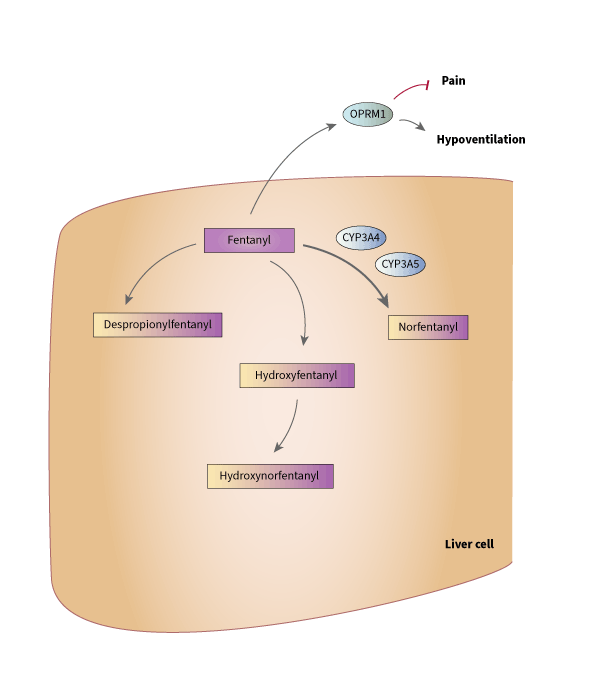
Fentanyl undergoes rapid and extensive metabolism in human intestinal mucosa and liver [Article:9311623]. The major route of metabolism is the formation of inactive norfentanyl [Article:39859160]. It is primarily excreted via the urine [Article:39859160]. Due to its high lipophilicity fentanyl can accumulate in adipose and other poorly vascularized tissues which may be a factor in toxicity [Article:39859160].
Experiments with liver microsomes, intestinal microsomes and CYP inhibitors demonstrated that CYP3A4 was the major metabolizing enzyme and with no meaningful metabolism by CYP1A2, CYP2A6, CYP2B6, CYP2C9, CYP2D6, and CYP2E1 [Article:9311623]. Other studies in vivo have shown that CYP3A5 is also involved in fentanyl metabolism [Articles:22277678, 31168770, 39859160].
Some studies have shown pharmacogenomic associations for polymorphisms in transporters including ABCB1, ABCC1, ABCC3 and [Articles:22277678, 27883323, 17192767, 39025933].
Pharmacodynamics
Fentanyl has high affinity for the mu opioid receptor, OPRM1 with a KI in the low nanomolar range compared to that for the kappa and delta opioid receptors, OPRK1 and OPRD1 (255 nM and over 1000 nM, respectively) [Article:39859160]. This specificity for the mu receptor may explain why the risk for respiratory depression is greater for fentanyl than for other opioids [Article:39859160].
The current CPIC guideline for fentanyl and OPRM1 found insufficient evidence to provide any recommendations for changes in clinical care based on genotype [Article:33387367]
Reactions & interactions (11)
-
Activation
fentanyl → OPRK1
-
Activation
fentanyl → OPRM1
-
Activation
fentanyl → OPRD1
-
Biochemical Reaction
fentanyl → norfentanyl
-
Biochemical Reaction
fentanyl → hydroxyfentanyl
-
Biochemical Reaction
fentanyl → despropionylfentanyl
-
Biochemical Reaction
hydroxyfentanyl → hydroxynorfentanyl
-
Catalysis
CYP3A5 → Biochemical Reaction
-
Catalysis
CYP3A4 → Biochemical Reaction
-
Inhibition
OPRM1 → Pain
-
Leads To
OPRM1 → Hypoventilation
Edit history (4)
- 2024-10-29 Create
- 2024-10-30 Update Added image files.
- 2025-02-20 Update Added text and updated gpml with additional candidates and some phenotypes
- 2025-03-10 Update Updates to text based on feedback from curator Katrin Sangkuhl