About this pathway
Tramadol is a centrally acting analgesic that is used to relieve moderate to moderately severe pain. Tramadol is commonly prescribed for postoperative, dental, cancer, and acute musculoskeletal pain and also as an adjuvant to NSAID therapy in patients with osteoarthritis [Article:15509185]. Tramadol is structurally related to codeine and morphine, belonging to the opiate agonist class. Tramadol exerts its analgesic activity via at least two complementary mechanisms: opioid activity through activating the µ-opioid receptor (encoded by gene OPRM1) by the parent drug and O-desmethyltramadol (metabolite M1), and monoaminergic activity through weak inhibition of norepinephrine and serotonin reuptake by the parent drug to enhance inhibitory effects on pain transmission in the spinal cord [Articles:19180260, 15509185, 19496778]. Both the parent drug and especially the M1 metabolite contribute to the overall analgesic activity of tramadol.
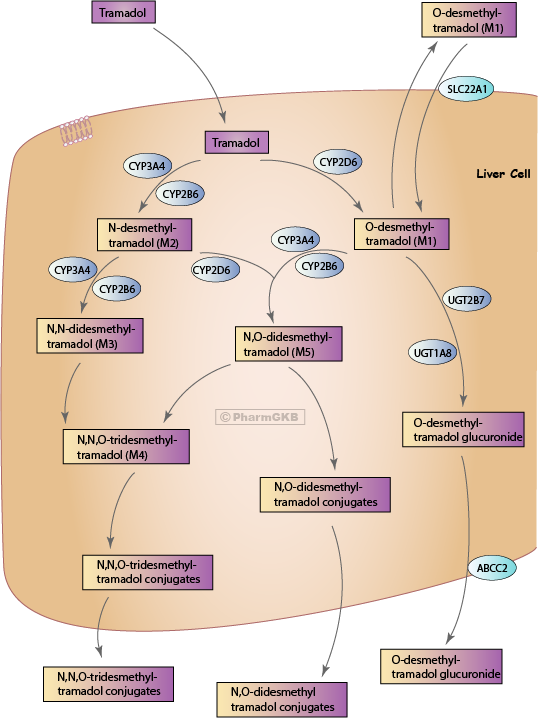
Tramadol is administered as a racemic mixture of (+) and (-) tramadol (also known as R, R and S, S tramadol, respectively). Both of which contribute to the analgesic activity, yet via different mechanisms. After oral administration, tramadol is rapidly and almost completely absorbed [Article:15509185]. Tramadol is extensively metabolized in the liver by O - and N-demethylation and by conjugation reactions to form glucuronides and sulfates. Elimination of Tramadol and its metabolites is predominantly via the kidneys. The O-demethylation of tramadol to its main analgesic effective metabolite, O-desmethyltramadol (M1), is catalyzed by cytochrome P450 (CYP) 2D6 [Articles:11454734, 1392452, 9476037]. The N-demethylation to N-desmethyltramadol (M2) is catalyzed by CYP2B6 and CYP3A4 [Articles:11454734, 1392452, 9476037]. M1 and M2 may then be further metabolized to secondary metabolites, N,N-didesmethytramadol (M3) and N,O-didesmethyltramadol (M5), and then to N,N,O-tridesmethyltramadol (M3) [Article:11454734]. In the phase II metabolism, O-desmethyltramadol is inactivated by glucuronidation in the liver, mostly via UGT2B7 and UGT1A8 [Article:20797434]. Among all its metabolites, only O-desmethyltramadol (M1) and to a lesser extent N,O-didesmethyltramadol (M5), are pharmacologically active. O-desmethyltramadol (M1) has a significantly higher affinity for opioid receptors (Ki=0.0034µM) than the parent drug (Ki=2.4µM) and is more potent in producing analgesia [Article:10961373].
Edit history (2)
- 2011-10-12 Create
- 2024-06-27 Update fixed typo