About this pathway
Background
Thiordiazine is a phenothiazine neuroleptic that acts on positive and negative symptoms of schizophrenia [Article:16272405]. Due to the risk of cardiac side effects, QT-prolongation and ventricular arrhythmia thioridazine tends to only be used for treatment-resistant schizophrenia, where multiple other therapeutic approaches have failed [Article:28520378]. Thioridazine is contraindicated in CYP2D6 poor metabolizers or people taking CYP2D6 inhibitors [Article:28520378] see also FDA drug label annotation for thioridazine and CYP2D6.
Pharmacokinetics
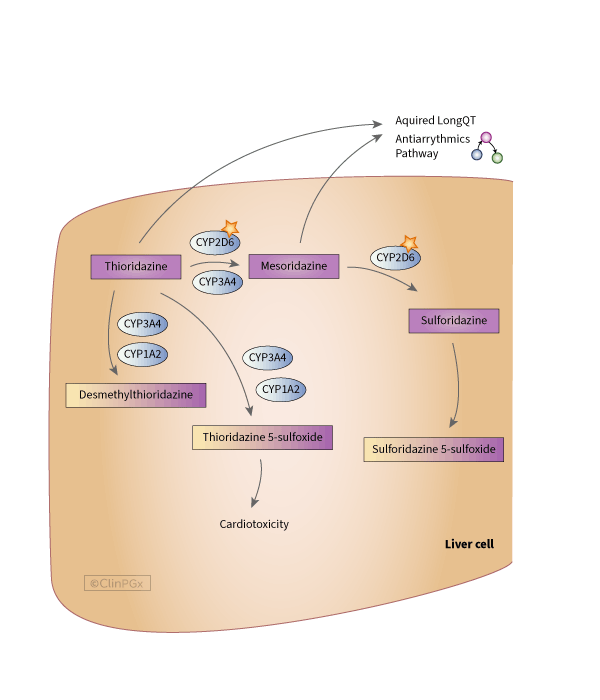
The metabolism of Thioridazine involves sulfoxidation at the 2 and 5 loci and demethylation. Thioridazine is first oxidized to mesoridazine (thioridazine 2-sulfoxide) [Article:16272405]. Mesoridazine can be further oxidized to sulforidazine (thioridazine 2-sulfone) [Article:16272405]. CYP2D6 is the key enzyme responsible for mono-2- and di-2-sulfoxidation of thioridazine in human liver, with CYP3A4 also responsible for the first step [Articles:16272405, 8259689]. Thioridazine N-demethylation was mediated by CYP1A2 (44%) and CYP3A4 (52%) [Articles:16272405, 20615392]. CYP1A2 and CYP3A4 are also the main enzymes responsible for production of thioridazine 5-sulfoxide [Articles:16272405, 20615392].
Cardiotoxicity
Both thioridazine and mesoridazine have similar effects on the QT interval and may contribute to arrythmic cardiac adverse effects [Article:28520378] see the Antiarrythmic Pathway. Other papers report that while the thioridazine 5-sulfoxide is not pharmacologically active at dopaminergic or noradrenergic receptors, it is associated with cardiotoxic effects [Article:16272405].
Reactions & interactions (18)
-
Biochemical Reaction
thioridazine → thioridazine 5-sulfoxide
-
Biochemical Reaction
thioridazine → mesoridazine
-
Biochemical Reaction
mesoridazine → sulforidazine
-
Biochemical Reaction
sulforidazine → sulforidazine-5-sulfoxide
-
Biochemical Reaction
thioridazine → desmethylthioridazine
-
Catalysis
CYP1A2 → Biochemical Reaction
-
Catalysis
CYP3A4 → Biochemical Reaction
-
Catalysis
CYP3A4 → Biochemical Reaction
-
Catalysis
CYP2D6 → Biochemical Reaction
-
Catalysis
CYP2D6 → Biochemical Reaction
-
Catalysis
CYP1A2 → Biochemical Reaction
-
Catalysis
CYP3A4 → Biochemical Reaction
-
Leads To
mesoridazine → Antiarrhythmic Pathway, Pharmacodynamics
-
Leads To
Acquired Long QT Syndrome (aLQTS) → Torsades de Pointes
-
Leads To
thioridazine → Antiarrhythmic Pathway, Pharmacodynamics
-
Leads To
thioridazine 5-sulfoxide → Cardiotoxicity
-
Leads To
mesoridazine → Acquired Long QT Syndrome (aLQTS)
-
Leads To
thioridazine → Acquired Long QT Syndrome (aLQTS)
Edit history (2)
- 2025-06-10 Create
- 2026-02-12 Update Added new illustrator files and image map