About this pathway
Background
Risperidone is an atypical or second-generation antipsychotic drug, that is classified chemically as a benzisoxazole derivative. It is effective in treating both positive and negative symptoms experienced by patients with schizophrenia, and bipolar disorder, as well as managing irritability associated with autism in children and adolescents [Articles:34335273, 32519344, 31359271, 26944100, 26129906, 24329187, 24026091, 16833023, 10639689, 40704440]. Risperidone acts through antagonism at the dopamine D2 receptor (DRD2), the serotonin 2A receptor (HTR2A) and the serotonin 1C receptor (HTR1C) [Articles:19562274, 19339912, 18448784, 34335273, 31359271, 16833023, 10639689]. It also is a moderate antagonist at histaminergic H1 (HRH1) and adrenergic alpha1 and alpha2 receptors [Articles:19562274, 34335273]. Risperidone is metabolized in the liver via 9-hydroxylation, resulting in the formation of 9-hydroxyrisperidone. 9-hydroxyrisperidone is a major metabolite of risperidone that is also approved and marketed as the drug paliperidone [Articles:34335273, 24329187]. Risperidone and its active metabolite, 9-hydroxyrisperidone, have similar pharmacodynamic properties, which is why the sum of their plasma concentrations is referred to as the "active moiety" [Articles:34335273, 31359271, 16833023, 10639689, 26129906].
Pharmacokinetics
Risperidone has an oral bioavailability of 70%, and its plasma concentrations are dose-proportional for doses ranging from 0.5 to 8 mg taken twice daily. The maximum plasma concentration (C max) is reached approximately 1 hour after administration. In contrast, the time to reach maximum concentration (T max) for 9-hydroxyrisperidone varies by CYP2D6 phenotype; 3 hours for normal metabolizers (NM) and 13 hours for poor metabolizers (PM) [Article:34335273]. It's important to highlight that the drug label for risperidone indicates that CYP2D6 inhibitors, such as fluoxetine and paroxetine, can significantly increase risperidone plasma concentrations. Specifically, fluoxetine can raise levels by 2.5 to 2.8 times, while paroxetine can increase them by 3 to 9 times. Therefore, it's necessary to re-evaluate the dosing of risperidone after discontinuing the interacting medication [Article:32519344].
Both risperidone and 9-hydroxyrisperidone are primarily eliminated through urine. The pharmacokinetics of risperidone and 9-hydroxyrisperidone are similar in both NM and PM, with an average elimination half-life (T 1/2) of approximately 20 hours [Article:34335273].
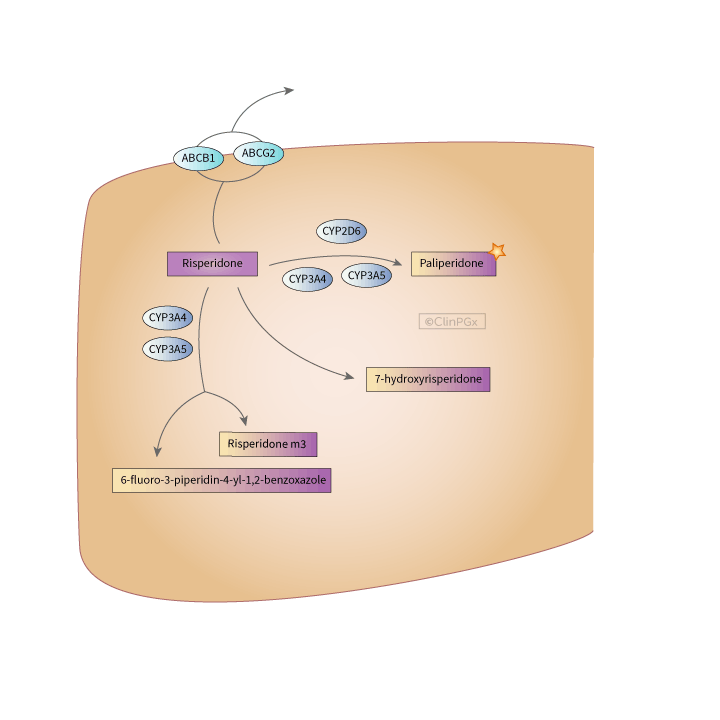
The hydroxylation of risperidone is catalyzed by CYP2D6, CYP3A4, and CYP3A5 [Articles:34335273, 32519344, 31359271, 26129906, 24026091, 10639689]. In vitro studies using recombinant human cytochrome P450 (CYP) enzymes have shown that CYP2D6 is the major enzyme involved in the metabolism of risperidone to its major metabolite, 9-hydroxyrisperidone [Articles:10048600, 7507814, 32519344, 31359271, 24329187, 16833023]. CYP3A4 and CYP3A5 are also found to be capable of metabolizing risperidone to 9-hydroxyrisperidone [Article:10048600]. Additionally, a minor metabolic pathway involves N-dealkylation via CYP3A4 and CYP3A5, as well as 7-hydroxylation, resulting in another less abundant metabolite of risperidone, 7-hydroxyrisperidone [Articles:20071055, 34335273, 31359271, 10639689]. Both reactions produce inactive metabolites of risperidone [Article:34335273]. A chiral center is introduced when risperidone is metabolized to 9-hydroxyrisperidone, resulting in formation of enatiomers. An in vivo study has demonstrated that CYP2D6 plays a predominant role in the formation of (+)-9-hydroxyrisperidone, while CYP3A4 appears to be primarily involved in formation of (-)-9-hydroxyrisperidone [Article:11560868]. Risperidone is a relatively weak inhibitor of CYP2D6 [Article:19562274]. Risperidone and 9-hydroxyrisperidone have moderate to strong affinity for P-glycoprotein 1 (ABCB1) and are inhibitors of this protein [Articles:18537577, 18718676, 18708991, 17054409, 34335273, 29443543].
Pharmacogenomics
The most common adverse events associated with risperidone treatment (occurring in over 10% of cases) include insomnia, anxiety, headache, upper respiratory tract infections, Parkinsonism, depression, and akathisia. Less common events, reported in 1–10% of cases, include pneumonia, bronchitis, sinusitis, urinary tract infections, and various other symptoms such as dizziness, sedation, abdominal pain, and dry mouth, among others [Articles:34335273, 26129906, 24329187, 16833023].
Pharmacogenetics of risperidone can be beneficial in clinical practice, particularly for reducing adverse drug reactions and enhancing treatment adherence [Articles:34335273, 32519344, 26944100, 26129906]. While much of the existing research has primarily concentrated on European populations, Kehinde et al. (2025) created the largest real-world group of 208 African patients treated with risperidone. Their research sought to investigate how the sub-Saharan African-specific CYP2D6*17 and *29 alleles influence the metabolism of risperidone. The results indicated that the CYP2D6 activity for the *17 allele was double that of the normal function alleles, while the *29 allele exhibited activity levels similar to those of no-function alleles. These results challenge earlier values assigned to *17 and *29 based on guidelines that lack an evidence-based foundation regarding risperidone. This implies a potential specificity of substrate for these alleles [Article:40704440].
The Dutch Pharmacogenetics Working Group (DPWG) recommends reducing the dose of risperidone for CYP2D6 PMs, while for UMs, it suggests switching to an alternative medication or adjusting the dose to the maximum concentration of the active metabolite. Additionally, it is important to consider the administration comedications that may interact with risperidone, including inducers of CYP3A4 and ABCB1, as well as inhibitors of CYP2D6, or ABCB1 [Article:34335273].
Reactions & interactions (11)
-
Biochemical Reaction
risperidone → 7-hydroxyrisperidone
-
Biochemical Reaction
risperidone → paliperidone
-
Biochemical Reaction
risperidone → 6-fluoro-3-piperidin-4-yl-1,2-benzoxazole + risperidone m3
-
Catalysis
ABCB1 → Transport
-
Catalysis
ABCG2 → Transport
-
Catalysis
CYP2D6 → Biochemical Reaction
-
Catalysis
CYP3A4 → Biochemical Reaction
-
Catalysis
CYP3A5 → Biochemical Reaction
-
Catalysis
CYP3A4 → Biochemical Reaction
-
Catalysis
CYP3A5 → Biochemical Reaction
-
Transport
risperidone → risperidone
Edit history (1)
- 2022-03-28 Create