About this pathway
Background
Iloperidone is a second-generation (atypical) antipsychotic medication classified as a benzisoxazole (IUPAC name: 1-(4-(3-(4-(6-fluoro-1,2-benzoxazol-3-yl)piperidin-1-yl)propoxy)-3-methoxyphenyl)ethenone) [Articles:11999907, 27665949, 18095919, 26417330, 24600226, 21034370, 19624791, 21289324, 9732390]. It has been FDA-approved since 2009 for the acute treatment of schizophrenia in adult patients [Articles:27665849, 26417330, 24600226, 21034370, 19624791, 21289324]. It is important to note that when the FDA approved the new drug application in 2009, they did not require pediatric studies for children aged 0 to 12. However, they did mention that studies on the effects of iloperidone in teenagers aged 13 to 17 would be submitted at a later date [Article:21034370]. As a piperidinyl-benzisoxazole derivative, iloperidone is structurally related to other antipsychotics, including risperidone, paliperidone, and ziprasidone [Articles:34943983, 20388862, 18095919, 11093363, 20368905] and is effective in reducing both the positive and negative symptoms of this mental health disorder [Articles:18095919, 24600226, 21034370, 20388862, 20368905, 19624791, 21289324] and is associated with a relatively low risk of extrapyramidal symptoms [Articles:27665849, 18095919, 20388862, 20368905]. The development of iloperidone as a serotonin/dopamine antagonist (HTR2A/DRD2) [Articles:11093363, 18095919, 20368905] was grounded in in vitro experiments conducted on rats, which demonstrated iloperidone's high affinity for 5-HT2 receptors and D2 receptors [Articles:11999907, 24600226, 21034370, 19624791, 9732390]. Research indicates that iloperidone has a greater affinity for HTR2A receptors (Ki < 10 nM) compared to DRD2 receptors (Ki = 10-100 nM) [Articles:18095919, 20388862, 20368905]. Additionally, iloperidone acts as an antagonist for various other receptors, including serotonin, dopamine, epinephrine, norepinephrine, histaminergic, and cholinergic muscarinic receptors [Articles:21289324, 19624791, 20368905, 34943983, 11999907, 26417330, 11093363, 18095919, 21034370, 24600226].
Pharmacokinetics
Pharmacokinetic studies indicate that iloperidone is well absorbed when administered orally, with a bioavailability of approximately 96%. The peak plasma concentration (Cmax) of iloperidone is typically reached 2 to 4 hours after administering a single oral dose [Articles:26417330, 24600226, 21034370, 20368905, 19624791, 21289324].
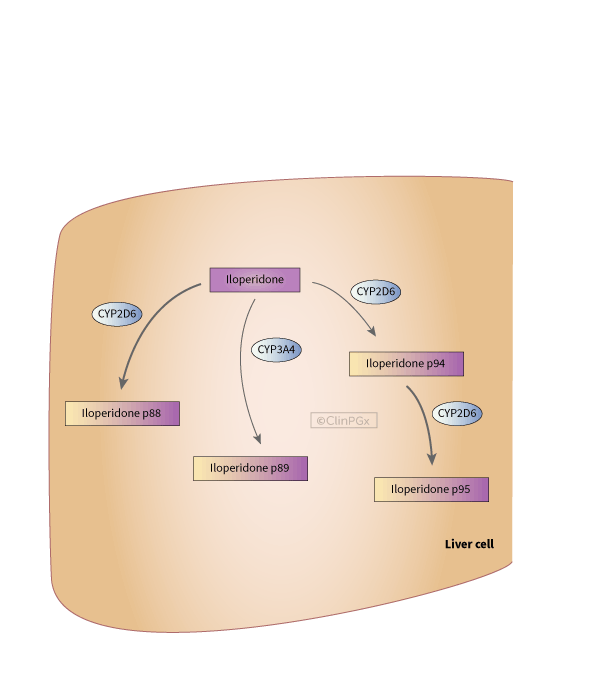
Three metabolic pathways are involved in the biological degradation of iloperidone [Articles:11999907, 27665849, 21034370]. The first pathway involves a reversible reductive biological reaction, in which the ketone group of iloperidone is reduced to form the hydroxy-metabolite P88. The IUPAC name for P88 is 1-(4-(3-(4-(6-fluoro-1,2-benzoxazol-3-yl)piperidin-1-yl]propoxy)-3-methoxyphenyl)ethanol. The second pathway involves the cleavage of the aromatic methoxy-ether, leading to the formation of the phenol metabolite P89. The IUPAC name for P89 is 1-(4-(3-(4-(6-fluoro-1,2-benzoxazol-3-yl)piperidin-1-yl)propoxy)-3-hydroxyphenyl)ethanone. The third pathway involves the oxidation of the ethenone part of iloperidone, initially producing P94, an α-hydroxy ketone. The IUPAC name for P94 is 1-(4-(3-(4-(6-fluoro-1,2-benzoxazol-3-yl)piperidin-1-yl]propoxy)-3-methoxyphenyl)-2-hydroxyethanone. This metabolic process eventually leads to the formation of P95, which is created through further oxidation and decarboxylation of the α-hydroxy keto metabolite. The IUPAC name for P95 is 4-(3-(4-(6-fluoro-1,2-benzoxazol-3-yl)piperidin-1-yl)propoxy)-3-methoxybenzoic acid [Articles:11999907, 27665849, 11093363, 21034370, 20368905, 21289324, 9732390]. P88 and P95 are the primary metabolites detected in the plasma after the ingestion of iloperidone [Articles:11999907, 26417330, 24600226, 21034370, 20388862, 21289324].
Iloperidone is primarily metabolized by the enzymes CYP2D6, CYP3A4, and cytosolic enzymes [Article:27665849]. P95, a hydroxylation metabolite of iloperidone produced by CYP2D6, has a similar receptor affinity profile as iloperidone. However, because the P95 metabolite is only found in peripheral circulation and does not readily cross the blood-brain barrier, it cannot exert antipsychotic effects in the central nervous system. Instead, it likely contributes to the adverse effect profile of iloperidone [Article:21289324]. P89 is an O-demethylation metabolite produced by CYP3A4 [Articles:27665849, 21034370, 19624791]. It is a significant metabolite in rodents but is only a minor one in humans [Articles:11999907, 34943983].
Pharmacogenomics
Genetic variability in the CYP2D6 and CYP3A4 enzymes influences a patient's ability to metabolize iloperidone [Article:24600226], leading to different pharmacokinetic parameters, such as plasma concentrations [Article:20388862]. In normal CYP2D6 metabolizers (NMs), the P95 and P88 metabolites account for 48% and 20% of the area under the curve (AUC) of iloperidone in plasma at steady state, respectively [Articles:21034370, 20388862]. In contrast, in poor metabolizers (PMs), the P95 and P88 metabolites represent 25% and 34% of total plasma exposure, respectively [Articles:21034370, 20388862]. Furthermore, plasma concentrations of iloperidone and its metabolites—especially P88 and P95—are higher in PMs than in NMs of CYP2D6. The elimination half-life of iloperidone is also extended in PMs, averaging 33 hours, compared to 18 hours in NMs [Articles:27665849, 26417330, 24600226, 20368905, 19624791, 21289324]. Additionally, the CYP2D6*10 (rs1065852) TT genotype is associated with significantly higher concentrations of iloperidone and the metabolite P88, along with lower concentrations of the metabolite P95, when compared to patients with CC or CT genotypes [Article:27665849].
Reactions & interactions (8)
-
Biochemical Reaction
iloperidone metabolite p94 → iloperidone metabolite p95
-
Biochemical Reaction
iloperidone → iloperidone metabolite p94
-
Biochemical Reaction
iloperidone → iloperidone metabolite p88
-
Biochemical Reaction
iloperidone → iloperidone metabolite p89
-
Catalysis
CYP2D6 → Biochemical Reaction
-
Catalysis
CYP2D6 → Biochemical Reaction
-
Catalysis
CYP2D6 → Biochemical Reaction
-
Catalysis
CYP3A4 → Biochemical Reaction
Edit history (1)
- 2025-06-23 Create