About this pathway
Background
Cariprazine is an antipsychotic drug approved by the US Food and Drug Administration (FDA) for the treatment of acute exacerbation of schizophrenia and acute mania or mixed episodes of mania and depression associated with bipolar I disorder [Articles:26834462, 40286877, 31571826, 33141308, 39427282]. The European Medicines Agency (EMA) has also approved cariprazine for the treatment of schizophrenia [Articles:31571826, 39427282]. Additionally, studies have shown that cariprazine can be effective as monotherapy for bipolar depression and may serve as an adjunctive therapy in major depressive disorder [Article:31571826].
Pharmacodynamics
Cariprazine is a piperazine derivative and a potent dopamine D3-preferring DRD3/DRD2 receptor partial agonist [Articles:26834462, 40286877, 31571826, 33141308, 39427282] and a serotonin HTR1A receptor partial agonist [Articles:31571826, 33141308, 39427282]. Cariprazine has a 6- to 8-fold greater affinity for DRD3 receptors compared to DRD2 receptors in vitro, showing high and balanced occupancy of both receptor subtypes in rats, nonhuman primates and humans at effective pharmacological doses [Articles:26834462, 31571826]. In animal models, cariprazine has been linked to DRD3 receptor-dependent effects that improve cognitive function and exhibit antidepressant-like properties, indicating potential benefits for treating these symptom domains in schizophrenia. Cariprazine also functions as a partial agonist at serotonin HTR1A receptors, while also acting as an antagonist at HTR2B receptors. Additionally, it has moderate to low binding affinity for HTR2A, HTR2C, HTR7, and histamine H1 receptors HRH1, while its affinity for adrenergic and muscarinic receptors is low to negligible [Articles:31571826, 39427282]. Cariprazine has shown effectiveness, safety, and tolerability in positive Phase II/III randomized, placebo-controlled trials involving patients experiencing acute exacerbations of schizophrenia [Articles:26834462, 31571826]. Its ability to bind to the DRD3 receptor provides a distinctive treatment option for patients who face persistent and predominant negative symptoms [Articles:26834462, 31571826]. Clinical evidence supports cariprazine's potential in addressing these negative symptoms, as demonstrated in a prospectively defined study of patients dealing with these specific challenges [Articles:26834462, 31571826]. In addition, patients with schizophrenia who were administered cariprazine had significantly prolonged relapse time in comparison to the placebo group [Article:31571826].
Pharmacokinetics
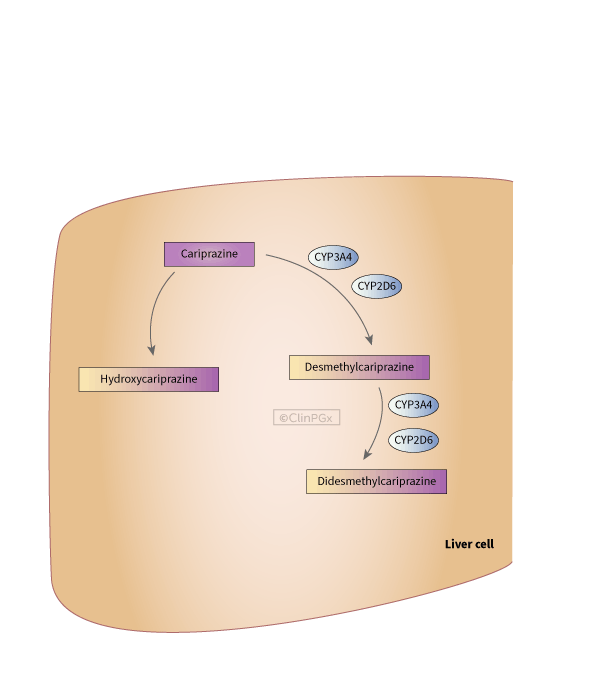
Cariprazine is metabolized by hydroxylation and dealkylation primarily through the CYP3A4 pathway, with a lesser contribution from the CYP2D6 pathway [Articles:26834462, 40286877, 31571826, 33141308, 39427282]. After demethylation of cariprazine, two clinically relevant metabolites of cariprazine desmethyl cariprazine (DCAR) and didesmethyl cariprazine (DDCAR)—are produced [Articles:26834462, 40286877, 31571826, 33141308], which can be further converted into hydroxyl compounds for excretion [Article:40286877]. More specifically, DCAR metabolite is formed by demethylation of cariprazine, while DDCAR is formed after demethylation of DCAR [Article:31571826]. These metabolites have pharmacological profiles similar to the parent compound, as demonstrated by both in vivo and in vitro studies, thereby contributing significantly to the clinical efficacy of the drug [Articles:26834462, 40286877, 31571826, 33141308, 39427282]. However, DDCAR has a significantly longer terminal half-life. The prolonged half-life of cariprazine and DDCAR, which is approximately two to three weeks, causes a delayed recurrence of the disease after discontinuing cariprazine treatment. This characteristic sets cariprazine apart from other antipsychotic drugs. Additionally, cariprazine, DCAR, and DDCAR show high levels of plasma protein binding, which likely contributes to their prolonged half-lives. As a result, using CYP3A4 inhibitors in combination with these drugs may increase plasma levels and further extend the half-lives of cariprazine and its metabolites [Articles:40286877, 39427282] Research involving healthy volunteers and patients with schizophrenia has shown that cariprazine and its metabolites provide dose-proportional systemic exposure for up to one month of treatment. The findings of Nakamura et al. verified that drug exposure is dose-proportional within the range of 3–9 mg per day and demonstrated that cariprazine and its active metabolites reach a steady state within four weeks [Article:26834462]. Cariprazine is also metabolized through hydroxylation, resulting in hydroxy cariprazine [Article:39427282]. Furthermore, the DDCAR metabolite undergoes further metabolism by CYP3A4 to produce hydroxy-DDCAR (not pictured due to a lack of chemical database cross-reference) [Articles:39427282, 33012874].
Pharmacogenomics
Periclou et al. assessed the population pharmacokinetic profile of cariprazine, DCAR and DDCAR, while also conducting a post hoc analysis to assess the impact of CYP2D6 metabolizer status on exposure levels of the drug and its metabolites. According to their findings, CYP2D6 phenotypes were not significantly associated with differences in PK model-predicted cariprazine, DCAR, and DDCAR clearance, Cmin,ss, Cmax,ss, or AUC 0–24,ss (PK model) [Article:33141308]. Szabo et al. also investigated the role of CYP2D6 in cariprazine metabolism, by comparing the cariprazine exposure of different CYP2D6 phenotypes but found no substantial effect of CYP2D6 phenotypes on the pharmacokinetics of cariprazine.
Reactions & interactions (7)
-
Biochemical Reaction
cariprazine → desmethyl cariprazine
-
Biochemical Reaction
cariprazine → hydroxy cariprazine
-
Biochemical Reaction
desmethyl cariprazine → didesmethyl cariprazine
-
Catalysis
CYP3A4 → Biochemical Reaction
-
Catalysis
CYP2D6 → Biochemical Reaction
-
Catalysis
CYP3A4 → Biochemical Reaction
-
Catalysis
CYP2D6 → Biochemical Reaction
Edit history (2)
- 2024-10-29 Create
- 2024-11-14 Update Added summary and drug class code