About this pathway
Background
Incretins are endogenous hormones that regulate glucose metabolism and activities of the gastrointestinal tract; these are glucose-dependent insulinotropic polypeptide, GIP and glucagon-like peptide-1, GLP-1, coded for by GCG [Article:39114288]. Their receptors are expressed on a range of tissues involved in regulating glucose and lipid metabolism, with GIP receptors (GIPR), expressed in pancreas, brain, and adipocytes express while GLP-1 receptors (GLP1R) are in pancreas, brain, and gastrointestinal tract [Article:39114288].
Semaglutide is FDA approved for treatment of type 2 diabetes and obesity in adults and children over 12 years old to improve glucose control, cardiovascular risk and kidney function (see Wegovy label for pediatric indication). GLP-1 receptor agonists are contraindicated in people with medullary thyroid carcinoma (MTC) or Multiple Endocrine Neoplasia syndrome type 2 (MEN 2). MTC and MEN2 are hereditary forms of cancer. The genetic mutations responsible for these cancers occur in the RET oncogene although this is not discussed in the drug label [Article:33812987].
There is considerable interest in application of these drug classes to other indications including substance use disorders, tobacco use disorder, cocaine dependence and alcohol abuse [Articles:38639975, 39865816]
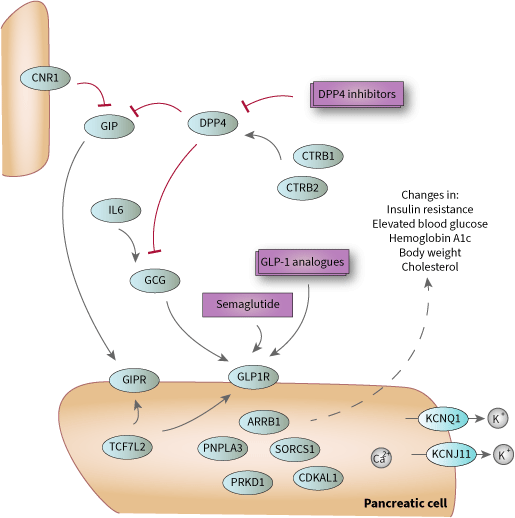
This pathway represents candidate pharmacogenes that are reported to be involved in the response to GLP-1 analogues and DPP4 inhibitors rather than direct protein protein interactions.
Pharmacodynamics
GLP-1 analogues, such as semaglutide, act directly at the GLP-1 receptor. Semaglutide has 94% sequence homology with endogenous human GLP-1 but is modified to reduce degradation by DPP4 [Article:33964002]. GLP-1 analogues reduce blood glucose via stimulation of insulin secretion and lowering glucagon secretion [Article:33964002]. Blood glucose is also lowered via a delay in gastric emptying in the early postprandial phase [Article:33964002]. DPP4 inhibitors act to delay the degradation of endogenous GLP-1 (GCG) and GIP.
Response measures in patients include fasting blood glucose, glucose tolerance test, fasting proinsulin/insulin, BMI or weight change and hemoglobin glycosylation HbA1c.
Pharmacogenomics
There is clear evidence for involvement of the GLP1R and TCF7LR genes in responses to GLP1 receptor agonists and DPP4 inhibitors but evidence at the variant level is less consistent.
Twelve studies of GLP1R reported pharmacogenomics of GLP1 receptor agonists and DPP4 inhibitors [Articles:25825013, 27160388, 25991051, 32308134, 36528349, 35079845, 35034150, 30883264, 27858848, 29488276, 39792745, 25785276]. These have mostly focused on three non-synonymous variants rs6923761 G>A p.Gly168Ser, rs3765467 G>A p.Arg131Gln, rs10305420 C>T p.Pro7Leu but lack robust replication. Interestingly, a variant in GLP1R was associated with weight gain in people treated with antipsychotics [Article:24624910].
TCF7L2 variants have been associated with increased risk of diabetes. Studies have shown impact of TCF7L2 variants on response to DPP4 inhibitors and GLP-1 agonists and also with other antidiabetes drugs such as metformin and sulfonylureas [Articles:17519421, 29326107, 24906949, 38453649, 20054294, 30700996, 29488276].
Two calcium channel genes,KCNJ11 [Articles:27249660, 39792745] and KCNQ1 [Articles:39792745, 28624668, 32308134] show impact on response to GLP1 receptor agonists and DPP4 inhibitors.
There are a number of other candidate genes that have been found in one or two studies, see variant annotations for details.
Reactions & interactions (31)
-
Activation
CTRB2 → DPP4
-
Activation
GCG → GLP1R
-
Activation
IL6 → GCG
-
Activation
TCF7L2 → GIPR
-
Activation
GIP → GIPR
-
Activation
TCF7L2 → GLP1R
-
Activation
<i>Glucagon-like peptide-1 (GLP-1) analogues</i> → GLP1R
-
Activation
semaglutide → GLP1R
-
Activation
CTRB1 → DPP4
-
Inhibition
<i>Dipeptidyl peptidase 4 (DPP-4) inhibitors</i> → DPP4
-
Inhibition
DPP4 → GCG
-
Inhibition
DPP4 → GIP
-
Inhibition
CNR1 → GIP
-
Leads To
ARRB1 → Elevated hemoglobin a1c
-
Leads To
<i>Dipeptidyl peptidase 4 (DPP-4) inhibitors</i> → PNPLA3
-
Leads To
GLP1R → Insulin Resistance
-
Leads To
<i>Glucagon-like peptide-1 (GLP-1) analogues</i> → SORCS1
-
Leads To
<i>Glucagon-like peptide-1 (GLP-1) analogues</i> → ARRB1
-
Leads To
PNPLA3 → weight loss
-
Leads To
PNPLA3 → Elevated hemoglobin a1c
-
Leads To
<i>Dipeptidyl peptidase 4 (DPP-4) inhibitors</i> → KCNQ1
-
Leads To
PRKD1 → Elevated hemoglobin a1c
-
Leads To
KCNJ11 → Elevated hemoglobin a1c
-
Leads To
SORCS1 → Insulin Resistance
-
Leads To
<i>Dipeptidyl peptidase 4 (DPP-4) inhibitors</i> → PRKD1
-
Leads To
CDKAL1 → Elevated hemoglobin a1c
-
Leads To
<i>Dipeptidyl peptidase 4 (DPP-4) inhibitors</i> → CTRB1
-
Leads To
KCNQ1 → Elevated hemoglobin a1c
-
Leads To
<i>Dipeptidyl peptidase 4 (DPP-4) inhibitors</i> → KCNJ11
-
Leads To
<i>Dipeptidyl peptidase 4 (DPP-4) inhibitors</i> → CDKAL1
-
Leads To
<i>Dipeptidyl peptidase 4 (DPP-4) inhibitors</i> → CTRB2
Edit history (3)
- 2024-09-03 Create
- 2024-09-12 Update Added more candidate genes.
- 2025-06-18 Update Added text and updated figure and gpml with more candidates.