About this pathway
Background
Quetiapine is an oral atypical antipsychotic medication used to treat schizophrenia, acute episodes of mania, and depression associated with bipolar disorder. It is also utilized for the maintenance treatment of bipolar disorder and as an adjunct treatment for major depressive disorders [Articles:33199804, 11510628, 22688609]. It was approved by the US Food and Drug Administration (FDA) in 1997, and controlled clinical trials have shown that quetiapine has a low propensity to cause extrapyramidal symptoms [Article:11510628]. As a dibenzodiazepine derivative, quetiapine has a unique receptor-binding profile. It interacts with various neurotransmitter receptors, including serotonin, dopamine, histamine, and adrenergic receptors [Articles:33199804, 11510628, 22688609]. Specifically, quetiapine has moderate affinity for serotonin (5-hydroxytryptamine; 5HT) HTR2A receptors, adrenergic ADRA1A receptors, muscarinic receptors, and histaminergic receptors. It shows only a minor affinity for DRD2 and HTR1A receptors and a very low affinity for HTR2C, ADRA2A, and DRD1 receptors. Its binding characteristics at the dopamine DRD2 receptor are similar to those of clozapine [Article:33199804].
Pharmacokinetics
Pharmacokinetic studies in humans reveal that quetiapine is rapidly absorbed after oral administration, with a median time to maximum observed plasma concentration (tmax) of 1 to 2 hours [Article:11510628]. Following the administration of 25 mg, mean maximum concentrations (Cmax) ranged from 53 to 117 μg/L. For lower doses (10 to 25 mg), plasma quetiapine concentrations decreased with a mean apparent terminal elimination half-life (t1/2β) of approximately 3.1 to 5.5 hours. However, at doses of 250 mg or higher, the mean t1/2β increased to about 6 hours [Article:11510628]. After administering multiple doses of quetiapine for 16 days to male and female patients with schizophrenia, researchers found a linear pharmacokinetic profile. This was evident across dose ranges of 100 to 375 mg taken twice daily and 75 to 250 mg taken three times daily. The apparent oral clearance (CL/F), time to reach maximum concentration (t max), and dose-normalized area under the concentration-time curve (AUC) did not show statistically significant differences across doses. Steady-state levels were reached within 48 hours of starting the treatment. These findings indicate that the pharmacokinetic characteristics of quetiapine are not significantly affected by the timing or dosage when administered multiple times [Article:11510628].
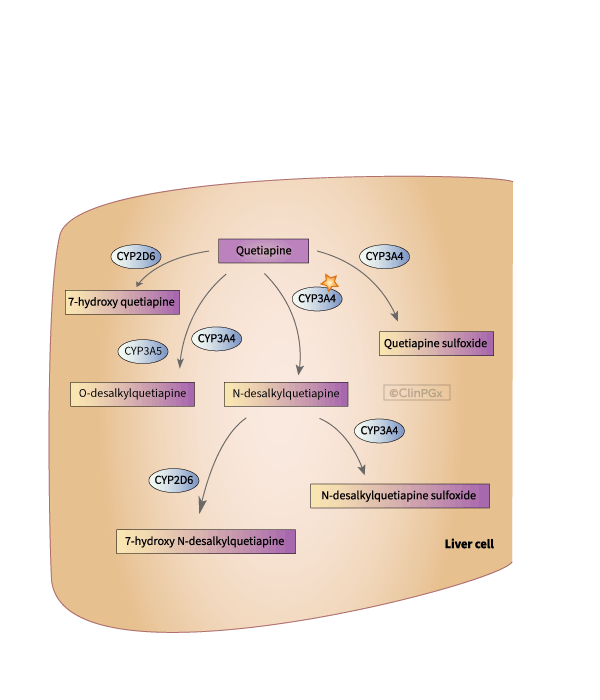
Quetiapine is predominantly metabolized in the liver through extensive hepatic processes, primarily involving cytochrome P450 enzymes (CYPs) and uridine 5'-diphospho-glucuronosyltransferases (UGTs) [Articles:33199804, 11510628]. The major metabolic pathways include the oxidation of the alkyl side chain, oxidation of the terminal alcohol to produce the corresponding carboxylic acid, hydroxylation of the dibenzothiazepine ring, sulfoxidation, and phase II conjugation [Articles:11510628, 22688609]. In vitro studies using human liver microsomes and specific recombinant cytochrome P450 isozymes have identified the key enzymes responsible for quetiapine metabolism [Articles:33199804, 11510628]. The primary enzyme involved is CYP3A4, which is responsible for sulfoxidation, N- and O-dealkylation, and partially for 7-hydroxylation. This enzyme produces quetiapine sulfoxide, N-desalkylquetiapine (also known as norquetiapine, which is the major active metabolite suggested to be responsible for the antidepressant effect), O-desalkylquetiapine (often described as 7‑desalkyl / hydroxyethoxy side‑chain O‑dealkylated metabolite, depending on naming conventions), and 7-hydroxyquetiapine [Articles:33199804, 11510628, 22688609]. Although CYP2D6 also contributes to the 7-hydroxy pathway, it plays a minimal role in the formation of 7-hydroxyquetiapine and 7-hydroxy-N-desalkylquetiapine and is therefore of minor importance for the overall clearance of quetiapine [Articles:33199804, 11510628, 22688609].
Since the 7-hydroxy metabolite comprises a very small fraction of the circulating metabolic products, it is anticipated that the genetic variations of CYP2D6 will have little impact on the overall disposition of quetiapine. Moreover, drug interactions affecting quetiapine metabolism and pharmacokinetics are likely to occur with drugs that inhibit or induce CYP3A4 rather than those affecting CYP2D6 [Article:11510628]. Additionally, there is minor CYP3A5-mediated metabolism that produces O-desalkylquetiapine [Article:33199804].
Animal studies and drug-drug interactions suggest that UGTs are involved in glucuronidation of quetiapine however the specific pharmacogenes are not yet known [Articles:21651616, 32952511].
Reactions & interactions (13)
-
Biochemical Reaction
quetiapine → quetiapine sulfoxide
-
Biochemical Reaction
quetiapine → o-desalkylquetiapine
-
Biochemical Reaction
quetiapine → 7-hydroxy quetiapine
-
Biochemical Reaction
norquetiapine → 7-hydroxy N-desalkylquetiapine
-
Biochemical Reaction
norquetiapine → N-desalkylquetiapine sulfoxide
-
Biochemical Reaction
quetiapine → norquetiapine
-
Catalysis
CYP3A4 → Biochemical Reaction
-
Catalysis
CYP3A5 → Biochemical Reaction
-
Catalysis
CYP3A4 → Biochemical Reaction
-
Catalysis
CYP2D6 → Biochemical Reaction
-
Catalysis
CYP2D6 → Biochemical Reaction
-
Catalysis
CYP3A4 → Biochemical Reaction
-
Catalysis
CYP3A4 → Biochemical Reaction
Edit history (3)
- 2023-07-17 Create
- 2026-02-19 Update Updated gpml with o-desalkyl metabolite and CYP3A5. Added text about UGTs.
- 2026-02-23 Update Updated image map