About this pathway
Background
Warfarin is one of the most widely used anticoagulant drugs worldwide and well known as an example of pharmacogenomics (PGx) (reviewed in [Article:16960144]). It is highly effective at antagonising the vitamin K dependent clotting pathway and is used for a wide range of diseases and conditions including atrial fibrillation and heart valve replacement [Article:16960144]. Warfarin has a narrow therapeutic window and wide inter-individual variability making dosing problematic. Under-anticoagulation can result in thrombosis but over-anticoagulation can result in dangerous bleeding episodes. When dosing is determined empirically, it is based on age, body surface area or weight and underlying condition with adjustments made until the target International Normalized ratio (INR) for clotting is achieved [Article:9822057]. PGx dosing algorithms for warfarin started being proposed in the early 2000s, beginning with just variants in CYP2C9, the key pharmacokinetic gene, and then incorporating PD genes VKORC1 and later CYP4F2 [Articles:14691573, 19228618, 22534826, 22349464, 24251361, 28160278]. The International Warfarin Pharmacogenomics Consortium was the first large multinational consortium for collaborative work on PGx [Articles:19228618, 20203262]. Building from this work, the Clinical Pharmacogenomics Implementation Consortium, CPIC, warfarin guidelines were developed in 2011 [Article:21900891] and updated in 2017 [Article:28198005]. Annotations on guidelines from CPIC, DPWG and others, and on published dosing algorithms can be found under the Prescribing Info tab for warfarin. The FDA label for warfarin gives some information on CYP2C9 and VKORC1 variants, but not CYP4F2, and does not require PGx testing. The link for the highlighted label can be found within the drug label annotation on ClinPGx. The FDA table of Pharmacogenetic Associations lists associations for warfarin with CYP2C9 intermediate or poor metabolizers, CYP4F2 V433M variant carriers and VKORC1 -1639G>A variant carriers. For pharmacokinetic candidates of warfarin see the Warfarin Pathway, Pharmacokinetics.
Pharmacodynamics
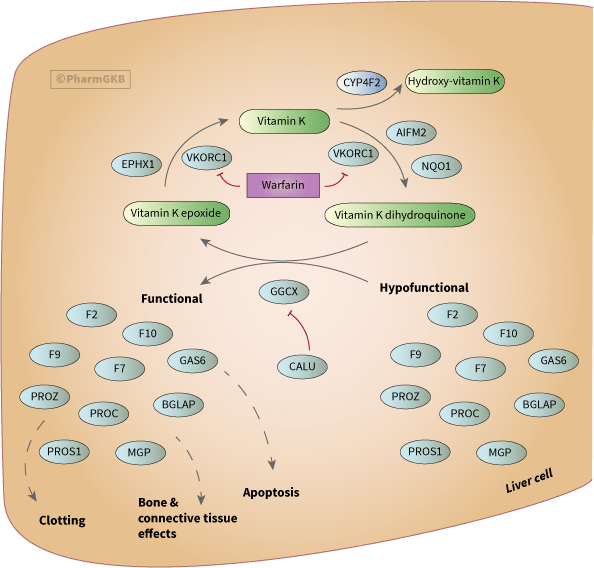
Warfarin is an inhibitor of VKORC1, the vitamin K epoxide reductase a key component in the vitamin K cycle. It is a competitive inhibitor when VKORC1 is in the partially oxidized state, but when in the oxidized state warfarin binding is essentially irreversible [Article:35748323]. There are variants of VKORC1 that can increase its sensitivity to warfarin and those that decrease its sensitivity to warfarin. The most well know variant in VKORC1 is rs9923231C>T (on plus chromosomal strand) or -1639 G>A (the VKORC1 gene is on the minus strand). The T allele of rs9923231 is associated with decreased dose compared to the C allele, for details on the large corpus of evidence on this variant and dosing see the Clinical Annotations on rs9923231 and warfarin.
Vitamin K typically enters the cycle from dietary vitamin K as a quinone form and is reduced to the dihydroquinone. A side pathway via CYP4F2 converts vitamin K to to hydroxy-vitamin K [Article:19297519]. Vitamin K1 dihydroquinone (VKH2) is the essential cofactor to γ-glutamyl carboxylase. Vitamin K dihydroquinone is oxidized to vitamin K epoxide during this process and GGXC carboxylates the various proteins involved in the clotting cascade including FII, FVII, FIX, FX, PROC, PROS1 and PROZ, proteins involved in bone and tissue modulation BGLAP (also known as osteocalcin) and MGP and apoptosis-related GAS6 [Article:18495950]. Carboxylation of proteins by GGXC can be inhibited by calumenin, CALU [Article:16493479].
There are warfarin resistant parts of the vitamin K cycle [Article:35922516]. Their existence has been known for a long time but components were unclear. AIFM2 (also known as FSP1, Ferroptosis Suppressor Protein 1) was identified recently as mediating warfarin-resistant vitamin K reduction [Article:35922516]. Variants in EPHX1 have been shown to influence phenotype and it has been proposed to reduce vitamin K epoxide to vitamin K [Article:15900282]. NQO1 is also a putative candidate for conversion of vitamin K to the dihydroquinone [Article:19297519].
Reactions & interactions (31)
-
Activation
GGCX → GAS6
-
Activation
GGCX → F9
-
Activation
GGCX → F10
-
Activation
GGCX → MGP
-
Activation
GGCX → F7
-
Activation
GGCX → PROZ
-
Activation
GGCX → F2
-
Activation
GGCX → PROC
-
Activation
GGCX → PROS1
-
Activation
GGCX → BGLAP
-
Biochemical Reaction
vitamin K epoxide → vitamin K
-
Biochemical Reaction
vitamin K → hydroxy-vitamin K
-
Biochemical Reaction
vitamin K → vitamin K dihydroquinone
-
Biochemical Reaction
vitamin K dihydroquinone → vitamin K epoxide
-
Catalysis
EPHX1 → Biochemical Reaction
-
Catalysis
VKORC1 → Biochemical Reaction
-
Catalysis
CYP4F2 → Biochemical Reaction
-
Catalysis
NQO1 → Biochemical Reaction
-
Catalysis
VKORC1 → Biochemical Reaction
-
Catalysis
AIFM2 → Biochemical Reaction
-
Catalysis
GGCX → Biochemical Reaction
-
Inhibition
CALU → GGCX
-
Inhibition
warfarin → VKORC1
-
Leads To
F2 → clotting cascade
-
Leads To
F10 → clotting cascade
-
Leads To
GAS6 → apoptosis
-
Leads To
PROS1 → clotting cascade
-
Leads To
F9 → clotting cascade
-
Leads To
PROZ → clotting cascade
-
Leads To
PROC → clotting cascade
-
Leads To
F7 → clotting cascade
Edit history (11)
- 2006-04-27 Create
- 2011-05-23 Update
- 2022-09-14 Update Updated figure and image map
- 2022-09-15 Update Updated gpml.
- 2022-09-19 Update Updated text
- 2023-04-25 Update Removed highlight of "updated" from summary.
- 2023-07-13 Update Added related pathways
- 2024-01-25 Update Updated gpml to fix broken links to biological intermediates. Updated image file to match names to drug/biological intermediate pages.
- 2024-08-28 Note This pathway is published in the CYP4F2 Gene Focus paper [PMID: 39135485].
- 2024-08-28 Update Added Gene Focus paper as citation.
- 2025-07-17 Update Replaced PharmGKB in text with ClinPGx