About this pathway
Lamivudine (2'-deoxy-3'-thiacytidine, 3TC) is a pyrimidine analog reverse transcriptase enzyme inhibitor active against human immunodeficiency virus type I (HIV1), HIV2, Hepatitis B virus, in vitro and in vivo. Intracellularly it is metabolized to its active triphosphate form by multiple kinases. The triphosphate form competes with deoxycytidine triphosphate for binding to reverse transcriptase, and the incorporation of this 3TC-triphosphate (3TC-TP) form in viral DNA results in chain termination.
It is FDA approved for treatment of HIV infections in children and adults in a three drug regimen along with other nucleoside analogs, protease inhibitors and non-nucleoside reverse transcriptase inhibitors.
Pharmacokinetics
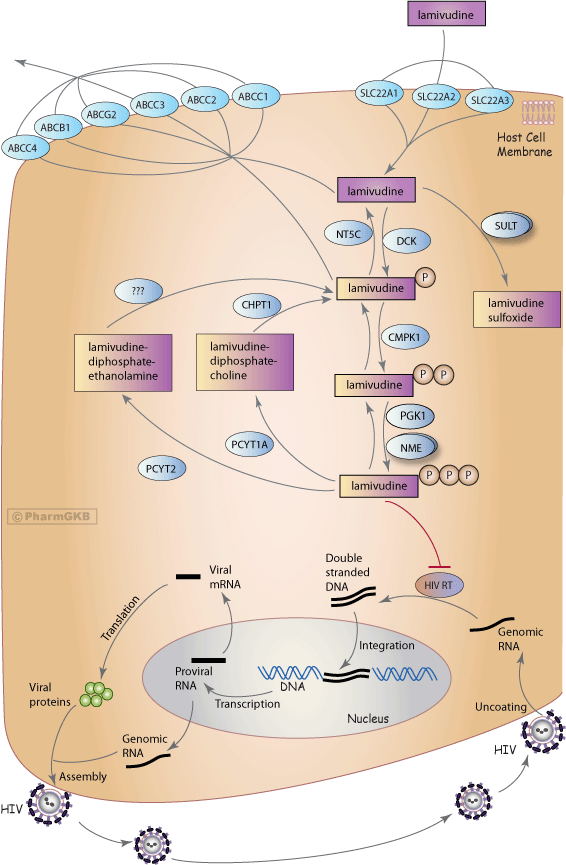
Lamivudine has a high oral bioavailability and is distributed widely into the body. Lamivudine either enters the cells by passive diffusion or is actively transported by uptake transporters (SLC22A1, SLC22A2, and SLC22A3) [Articles:19141712, 20504255]. Intracellularly, it is phosphorylated to its active triphosphate from [Articles:16870759, 11008000, 1318048]. Phosphorylation of 3TC to 3TC-monophosphate (3TC-MP) is catalyzed by deoxycytidine kinase. Phosphorylation of 3TC-MP to 3TC-DP is catalyzed by cytidine monophosphate/deoxycytidine monophosphate kinase while 3TC-DP is phosphorylated to 3TC-TP by 3'-phosphoglycerate kinase or nucleoside diphosphate kinase. Dephosphorylation of 3TC-MP to 3TC is catalyzed by 5'-nucleosidase or phosphatases [Articles:15963349, 19887088]. The rate-limiting step is the conversion of the 3TC-DP to 3TC-TP, which is a saturable enzymatic process. 3TC-TP is converted to 3TC-MP by two salvage pathways [Articles:16870759, 13673002]. 3TC-TP is converted to 3TC-DP-choline by choline cytidyl transferase, which is converted to 3TC-MP by p-choline glyceride transferase. 3TC-TP is converted to 3TC-DP-ethanolamine by p-ethanolamine cytidyl transferase, which is then converted to 3TC-MP.
Lamivudine is actively transported out of cell by efflux transporters ABCB1, ABCC1, ABCC2, ABCC3, ABCC4 and ABCG2 [Articles:17509035, 16791115, 17172311, 12488537, 19472342, 20504255]. However, lamivudine in its monophosphate form is transported out of the cell by ABCC4 [Article:10470083].
Lamivudine is primarily (70 % of the drug) excreted unchanged in urine. However 5-10 % of the drug is excreted as inactive trans-sulfoxide metabolite [Articles:9690945, 9989342].
Pharmacodynamics
Lamivudine triphosphate competes with deoxycytidine triphosphate for binding to reverse transcriptase, and the incorporation of this 3TC-triphosphate (3TC-TP) form in viral DNA results in chain termination. Lamivudine when administered orally (150 mg every 12 hours) reaches plasma concentrations which are consistently above its IC50 values.
Pharmacogenetics
Genetic polymorphisms in genes coding for transporters and metabolizing enzymes have been known to alter the pharmacokinetics of various therapeutics agents. However, very few studies have been reported that associate polymorphism in genes with variability seen in population pharmacokinetics of lamivudine. Of the few, Anderson et al have reported association between MRP4 (T4131G) polymorphism with elevated lamivudine triphosphate concentrations [Article:16791115], while Ho-Sook Kim et al found no significant association between ABCG2 polymorphism and lamivudine disposition [Article:17509035].
Edit history (1)
- 2011-05-12 Create