About this pathway
Disulfiram pharmacodynamics in dopaminergic and noradrenergic neurons
In noradrenergic neurons, tyrosine hydroxylase (TH) first converts tyrosine into 3,4-dihydroxy-L-phenylalanine (also known as L-DOPA or levodopa) see Sympathetic Nerve Pathway (Neuroeffector Junction. Levodopa undergoes a decarboxylation reaction, by the action of aromatic amino acid decarboxylase (HGNC symbol: DDC), which results in the synthesis of dopamine. Dopamine is then hydrolyzed into norepinephrine or noradrenaline by the oxidoreductase enzyme DBH. Upon neurotransmitter release, norepinephrine then binds to 1, 2, and noradrenergic receptors. By inhibiting DBH, disulfiram reduces dopamine’s conversion to norepinephrine and directly affects the ratio of dopamine to norepinephrine molecules [Articles:8685891, 2700602]. Specifically, it reduces the concentration of norepinephrine and increases the synaptic dopamine pool. As a result, disulfiram is thought to alleviate cocaine addiction by acting as a “dopamine replacement therapy” drug—that is, replicating the effects of cocaine on the levels of dopamine and therefore, reducing its rewarding effects [Article:19720750].
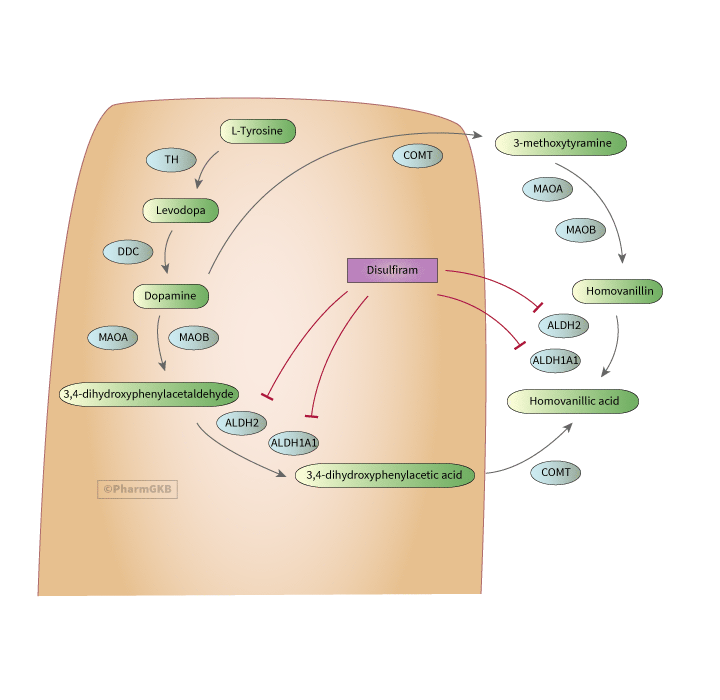
ALDH is a ubiquitously-expressed enzyme that is not only active in the metabolism of ethanol. In fact, it is also expressed by both serotonergic dopaminergic neurons, resulting in disulfiram’s broad impact on different tissues. In dopaminergic neurons dopamine can be metabolized intracellularly by monoamine oxidase (MAO), resulting in 3,4 dihydroxyphenylacetaldehyde (DOPAL), or extracellularly by catechol-o-methyl-transferase (COMT), producing 3-methoxytyramine [Article:434246]. Inside the cell, DOPAL is broken down into 3,4-dihydroxypenylacetic acid (DOPAC) by ALDH, or metabolized into 3-methoxy-4-hydroxyphenylacetaldehyde (Homovanillin, MHPA) by MAO in the extracellular environment. Both metabolic pathways produce extracellular homovanillic acid (HVA) as the final metabolite, however, the extracellular pathway uses ALDH to metabolize MHPA while the intracellular pathway converts DOPAC into HVA by COMT [Article:30702845]. Disulfiram acts on these pathways at multiple sites: it either inhibits the conversion of DOPAL into DOPAC or, in the final step of the extracellular metabolic pathway, the conversion of MHPA into HVA. As a result, there is elevated concentrations of DOPAL and MHPA, the latter being a reactive electrophile and toxic to dopaminergic neurons [Article:19720750]. Importantly, increases in the concentration of DOPAL decreases the reuptake of dopamine into synaptic vesicles, thus resulting in neuronal toxicity [Article:19720750]. As a result, disulfiram can be predicted to dampen dopamine neurotransmission and lessen the euphoric or stimulant effects of cocaine [Article:19720750].
Reactions & interactions (22)
-
Biochemical Reaction
3,4-dihydroxyphenylacetaldehyde → 3,4-dihydroxyphenylacetic acid
-
Biochemical Reaction
levodopa → dopamine
-
Biochemical Reaction
dopamine → 3,4-dihydroxyphenylacetaldehyde
-
Biochemical Reaction
dopamine → 3-methoxytyramine
-
Biochemical Reaction
homovanillin → homovanillic acid
-
Biochemical Reaction
3-methoxytyramine → homovanillin
-
Biochemical Reaction
3,4-dihydroxyphenylacetic acid → homovanillic acid
-
Biochemical Reaction
l-tyrosine → levodopa
-
Catalysis
ALDH2 → Biochemical Reaction
-
Catalysis
ALDH1A1 → Biochemical Reaction
-
Catalysis
DDC → Biochemical Reaction
-
Catalysis
MAOA → Biochemical Reaction
-
Catalysis
MAOB → Biochemical Reaction
-
Catalysis
COMT → Biochemical Reaction
-
Catalysis
ALDH1A1 → Biochemical Reaction
-
Catalysis
ALDH2 → Biochemical Reaction
-
Catalysis
MAOA → Biochemical Reaction
-
Catalysis
MAOB → Biochemical Reaction
-
Catalysis
COMT → Biochemical Reaction
-
Catalysis
TH → Biochemical Reaction
-
Inhibition
disulfiram → ALDH1A1
-
Inhibition
disulfiram → ALDH2
Edit history (5)
- 2023-01-31 Create
- 2023-07-21 Update Updated text and image for publication.
- 2023-07-21 Update Updated text and links.
- 2023-09-22 Update Added citation
- 2023-09-25 Update Linked related pathway