About this pathway
The mechanism by which disulfiram is successful in treating both alcohol and cocaine dependence is thought to be by creating a strong aversive response to alcohol or cocaine use. That is, if disulfiram is ingested with either cocaine or alcohol, the patient experiences severe physical reactions that include nausea, vomiting, headache, and chest pain. These aversive reactions contribute to an unpleasant experience that gets reinforced over long-term treatment with disulfiram, resulting in a voluntary decrease in alcohol or cocaine consumption.
The mechanism by which disulfiram triggers these aversive physical reactions is, in part, understood. However, new studies suggest novel pharmacodynamic roles for disulfiram; including the treatment of opioid use disorder and therapy resistance [Article:10723850], preventing sepsis and tumor growth [Article:36518588], and in regulating macrophage-elicited immune response [Article:36614177].
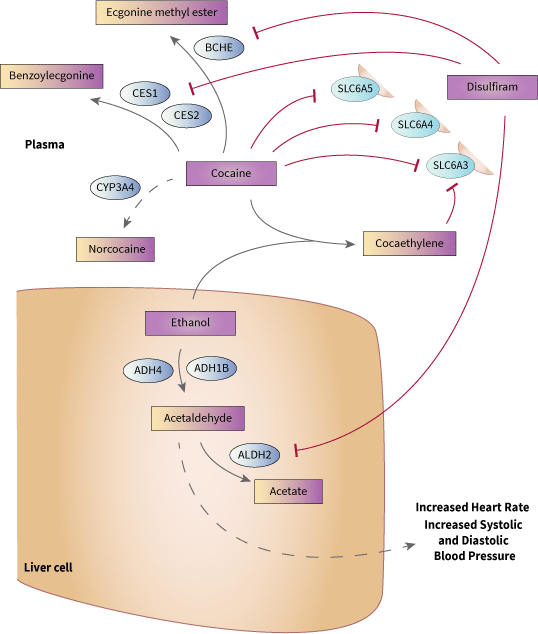
Disulfiram blocks both neural [Article:4288308] and liver [Articles:707135, 6340807] isoforms of aldehyde dehydrogenase (ALDH). Alcohol, or ethanol, is metabolized primarily in hepatocytes, but can also be metabolized in extrahepatic sites, including the brain [Article:17718403]. In the cytosol, ethanol is metabolized into acetaldehyde by alcohol dehydrogenases (ADH); in peroxisomes, this reaction is facilitated by the action of catalase (CAT); and in microsomes by P450 2E1 (CYP2E1) [Article:17718403]. Acetaldehyde is a highly toxic byproduct that can contribute to tissue damage and oxidative stress [Article:6340807]. As result, it is quickly broken down into acetate and nicotinamide adenine dinucleotide (NADH) by ALDH2, primarily [Article:17718403]. Acetate is further metabolized to carbon dioxide (CO2), by the heart, muscle, and brain [Article:17718403]. Disulfiram inhibits classes of ALDH, therefore affecting the acetaldehyde to acetate conversion. This results in an increase of acetaldehyde and a corresponding decrease in the concentration of acetate. The accumulation of acetaldehyde likely results in the adverse response patients have, including increased pulse and respiration, tachycardia, nausea, and vomiting. These adverse effects in turn discourage alcohol consumption in patients who wish to remain abstinent.
Disulfiram also inhibits multiple enzymes in the metabolism of cocaine. Between 60-90% of cocaine is metabolized into ecgonine methyl ester by plasma butyrylcholinesterase (BCHE) or benzoylecgonine by human carboxylesterase 1or 2 (CES1, CES2)—both of which have no reported neurological effect [Articles:22300096, 27224254, 428191, 8441738]. A small fraction of cocaine is metabolized into norcocaine by CYP3A4 [Article:27224254]. Disulfiram inhibits plasma cholinesterase (BCHE) and microsomal carboxylesterase (CES1, CES2) activity, resulting in a three to sixfold increase in the concentration of plasma cocaine following intranasal administration of disulfiram [Articles:9788003, 9547934, 7619981]. Cocaine inhibits a variety of neurotransmitter transporters, including the dopamine transporter DAT (SLC6A3), the serotonin transporter SERT (SLC6A4), and the norepinephrine transporter NET (SLC6A5) [Articles:2820058, 2899326, 8925277, 8592125, 6499924, 14612135, 8104483, 9716932]. As a result, drastic increases in plasma cocaine levels is hypothesized to increase patient’s rewarding response, but also aversive side effects, suggesting a possible mechanism by which disulfiram may contribute to abstinent behaviors [Article:19720750].
Reactions & interactions (24)
-
Biochemical Reaction
acetaldehyde → acetic acid
-
Biochemical Reaction
cocaine → norcocaine
-
Biochemical Reaction
cocaine + ethanol → cocaethylene
-
Biochemical Reaction
cocaine → ecgonine methyl ester
-
Biochemical Reaction
ethanol → acetaldehyde
-
Biochemical Reaction
cocaine → benzoylecgonine
-
Catalysis
ALDH2 → Biochemical Reaction
-
Catalysis
CYP3A4 → Biochemical Reaction
-
Catalysis
BCHE → Biochemical Reaction
-
Catalysis
ADH4 → Biochemical Reaction
-
Catalysis
ADH1B → Biochemical Reaction
-
Catalysis
CES1 → Biochemical Reaction
-
Catalysis
CES2 → Biochemical Reaction
-
Inhibition
disulfiram → BCHE
-
Inhibition
cocaethylene → SLC6A3
-
Inhibition
disulfiram → CES2
-
Inhibition
cocaine → SLC6A4
-
Inhibition
disulfiram → ALDH2
-
Inhibition
cocaine → SLC6A5
-
Inhibition
cocaine → SLC6A3
-
Inhibition
disulfiram → CES1
-
Leads To
acetaldehyde → systolic blood pressure
-
Leads To
acetaldehyde → heart rate
-
Leads To
acetaldehyde → diastolic blood pressure
Edit history (5)
- 2023-01-26 Create
- 2023-07-21 Update Updated image files and gpml to remove in progress designation.
- 2023-07-21 Update Updated text.
- 2023-07-21 Update Updated text and links.
- 2023-09-22 Update Added citation