About this pathway
Background
Hydralazine is a direct arteriolar vasodilator that is indicated for the treatment of essential hypertension and, in combination with isosorbide dinitrate, as an adjunct therapy for heart failure. The injectable form of hydralazine is used to rapidly control severe hypertension in pregnancy [Article:38103508]. The mechanism of action of hydralazine is incompletely understood; however, it appears to alter cellular calcium metabolism, interfering with vascular smooth muscle contractibility. Cellular targets of hydralazine include prolyl 4-hydroxylase (aka protocollagen proline hydroxylase) [Articles:4338937, 2994564] and hypoxia-inducible factor (HIF)-regulating oxygen-dependent prolyl hydroxylase domain enzymes [Article:15192023].
Metabolism
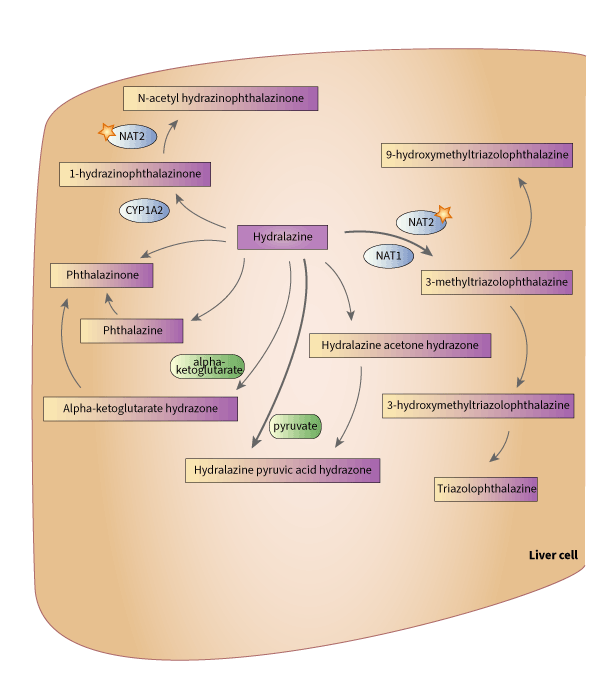
Hydralazine undergoes extensive hepatic metabolism and metabolites are mainly excreted in urine [Articles:7047041, 7050561, 7438689]. Hydralazine can react with endogenous acids such as alpha ketoglutarate or pyruvate to form hydrazone metabolites. It can also be acetylated [Article:7050561].
When given intravenously, the major plasma metabolites are hydralazine pyruvic acid hydrazone and 3-methyltriazolophthalazine, with no significant differences between slow and fast acetylator genotypes [Articles:7047041, 7050561, 7438689]. However, when given orally there are differences between the predominant metabolites between slow and fast acetylators; with slow acetylators, the major plasma metabolite is hydralazine pyruvic acid hydrazone, whereas the major metabolite in the fast acetylators is 3-methyltriazolophthalazine [Article:7050561].
Experiments with expressed proteins of NAT1 and NAT2 demonstrated a 20-fold lower affinity for NAT1 compared to NAT2, confirming NAT2 as the major metabolizing enzyme for hydralazine particularly at lower doses [Article:29018032].
Pharmacogenomics
Hydralazine and Nonspecific (NAT) is listed on the FDA Table of Pharmacogenomic Biomarkers in Drug Labeling. The FDA label for hydralazine discusses acetylator status and that it impacts plasma drug levels and dose requirements see link to annotation page. A large number of studies have shown that NAT2 genotype and/or acetylation phenotype is associated with pharmacokinetics of hydralazine [Articles:445966, 7471604, 31257615, 1396201, 7284051, 5026380, 7438695, 7408395, 24702251, 21781652, 7259927, 17183730, 7298112, 1136859, 21781652, 29018032]. Some studies have associated NAT2 genotype and/or acetylation phenotype with adverse effects ranging from mild side effects such as headache [Articles:318493, 21781652] to drug-induced lupus erythematosus [Articles:28932614, 6103441, 6432120, 24444407].
Reactions & interactions (18)
-
Biochemical Reaction
hydralazine → 3-methyltriazolophthalazine
-
Biochemical Reaction
hydralazine → hydralazine acetone hydrazone
-
Biochemical Reaction
3-hydroxymethyltriazolophthalazine → triazolophthalazine
-
Biochemical Reaction
phthalazine → phthalazinone
-
Biochemical Reaction
alpha-ketoglutarate + hydralazine → alpha-ketoglutarate hydrazone
-
Biochemical Reaction
3-methyltriazolophthalazine → 3-hydroxymethyltriazolophthalazine
-
Biochemical Reaction
hydralazine + pyruvate → hydralazine pyruvic acid hydrazone
-
Biochemical Reaction
hydralazine → 1-hydrazinophthalazinone
-
Biochemical Reaction
alpha-ketoglutarate hydrazone → phthalazinone
-
Biochemical Reaction
hydralazine acetone hydrazone → hydralazine pyruvic acid hydrazone
-
Biochemical Reaction
1-hydrazinophthalazinone → N-acetyl hydrazinophthalazinone
-
Biochemical Reaction
3-methyltriazolophthalazine → 9-hydroxy-methyltriazolophthalazine
-
Biochemical Reaction
hydralazine → phthalazine
-
Biochemical Reaction
hydralazine → phthalazinone
-
Catalysis
NAT1 → Biochemical Reaction
-
Catalysis
NAT2 → Biochemical Reaction
-
Catalysis
CYP1A2 → Biochemical Reaction
-
Catalysis
NAT2 → Biochemical Reaction
Edit history (3)
- 2022-06-09 Create
- 2024-10-24 Update Added image files, updated authors
- 2025-02-24 Update Made bolder arrows for the 2 main metabolites. Added text.