About this pathway
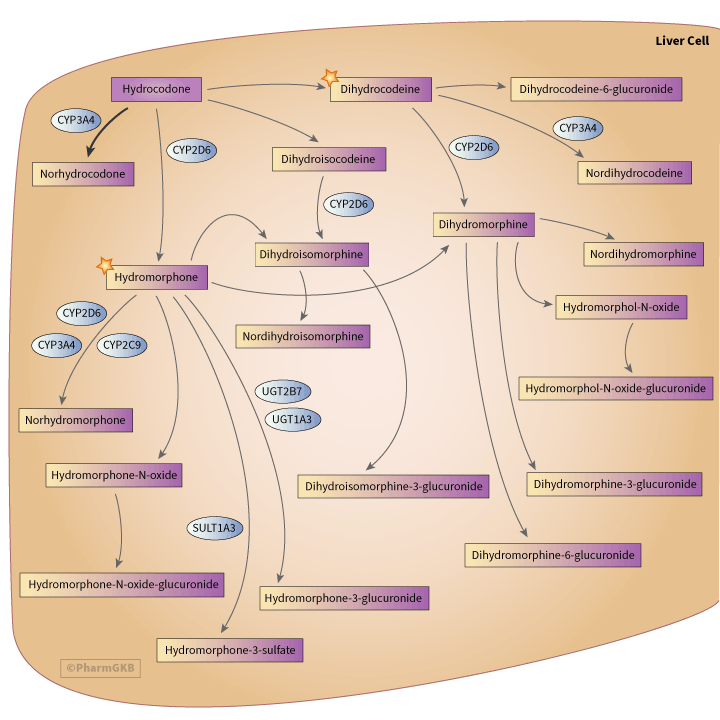
Hydrocodone is a commonly prescribed opioid for the treatment of pain. It is extensively metabolized in the liver, firstly by N-demethylation to norhydrocodone by CYP3A4, O-demethylation to hydromorphone by CYP2D6 or 6-keto reduction to dihydrocodeine and dihydroisocodeine [Articles:28931, 14998425, 19134999, 24836897]. Hydromorphone and dihydrocodeine are themselves used clinically as analgesics; a status indicated on the pathway figure by the star icon.
Inhibition of CYP2D6, for example by paroxetine, duloxetine, sertraline or bupropion, decreases the production of hydromorphone from hydrocodone and shifts metabolism towards the formation of norhydrocodone [Articles:24836897, 26350273]. Similarly, inhibition of CYP3A4 decreases plasma concentrations of norhydrocodone [Article:24836897].
Both hydromorphone and dihydrocodeine can be metabolized to form dihydromorphine, as shown in the figure above [Article:16718649]. In addition to dihydromorphine, hydromorphone can be N-demethylated to norhydromorphone by CYP3A4, CYP2D6 and CYP2C9 [Articles:15268978, 15488893], oxidized to form an N-oxide, sulfated by SULT1A3 [Article:24832963] or glucuronidated by UGT1A3 and UGT2B7 [Articles:7538514, 9443856, 9616184, 16718649]. The majority of excreted hydromorphone is detected in the form of Hydromorphone-3-glucuronide and glucuronides of many hydromorphone metabolites have also been found [Articles:12065064, 16718649, 23946451, 27405368].
The major metabolic pathway of dihydrocodeine is N-demethylation to nordihydrocodeine by CYP3A4 [Article:9431830]. O-demethylation of dihydrocodeine to dihydromorphine is catalyzed by CYP2D6 [Articles:7550973, 9431830]. Dihydrocodeine and dihydromorphine are mostly excreted in conjugated form, including as glucuronides [Articles:7586928, 7550973, 12665158, 22580524]. By contrast, nordihydrocodeine and nordihydromorphine undergo little conjugation prior to excretion [Article:7550973]
Pharmacogenomics
The majority of pharmacogenomic studies on hydrocodone have focused on the effect of genetic variation on the pharmacokinetics of the drug. The CYP2D6 poor metabolizer (PM) phenotype is associated with reduced formation of hydromorphone from hydrocodone [Articles:7693389, 14998425, 24269714], while CYP2D6 ultrarapid metabolizers (UMs) have increased hydromorphone plasma concentrations compared to CYP2D6 normal metabolizers (NMs) [Article:24269714]. No effect of CYP2D6 or CYP2C19 phenotype on metabolism of hydrocodone to norhydrocodone has been found [Article:14998425]. Similar to hydrocodone, the CYP2D6 PM phenotype has been found to reduce the formation of dihydromorphine from dihydrocodeine [Articles:7586928, 9431830].
The effect of CYP2D6 phenotype on clinical outcomes of hydrocodone therapy is less clear, with conflicting evidence on the association of CYP2D6 phenotype with the incidence of hydrocodone-induced side effects, such as dysphoria and drug toxicity. [Articles:9103485, 12920424, 16631290, 17986163, 20837591].
Reactions & interactions (33)
-
Biochemical Reaction
dihydroisomorphine → dihydroisomorphine-3-glucuronide
-
Biochemical Reaction
dihydrocodeine → dihydromorphine
-
Biochemical Reaction
dihydromorphine → nordihydromorphine
-
Biochemical Reaction
hydrocodone → norhydrocodone
-
Biochemical Reaction
dihydromorphine → hydromorphol n-oxide
-
Biochemical Reaction
dihydromorphine → dihydromorphine-6-glucuronide
-
Biochemical Reaction
hydromorphone → dihydroisomorphine
-
Biochemical Reaction
dihydromorphine → dihydromorphine-3-glucuronide
-
Biochemical Reaction
dihydrocodeine → nordihydrocodeine
-
Biochemical Reaction
hydromorphone → hydromorphone-3-sulfate
-
Biochemical Reaction
hydromorphone → norhydromorphone
-
Biochemical Reaction
hydromorphone n-oxide → hydromorphone-N-oxide-glucuronide
-
Biochemical Reaction
hydromorphone → dihydromorphine
-
Biochemical Reaction
hydromorphone → Hydromorphone-3-glucuronide
-
Biochemical Reaction
dihydroisocodeine → dihydroisomorphine
-
Biochemical Reaction
dihydrocodeine → dihydrocodeine-6-glucuronide
-
Biochemical Reaction
hydrocodone → dihydrocodeine
-
Biochemical Reaction
dihydroisomorphine → nordihydroisomorphine
-
Biochemical Reaction
hydrocodone → dihydroisocodeine
-
Biochemical Reaction
hydromorphol n-oxide → hydromorphol-N-oxide-glucuronide
-
Biochemical Reaction
hydromorphone → hydromorphone n-oxide
-
Biochemical Reaction
hydrocodone → hydromorphone
-
Catalysis
CYP2D6 → Biochemical Reaction
-
Catalysis
CYP3A4 → Biochemical Reaction
-
Catalysis
CYP3A4 → Biochemical Reaction
-
Catalysis
SULT1A3 → Biochemical Reaction
-
Catalysis
CYP2C9 → Biochemical Reaction
-
Catalysis
CYP2D6 → Biochemical Reaction
-
Catalysis
CYP3A4 → Biochemical Reaction
-
Catalysis
UGT1A3 → Biochemical Reaction
-
Catalysis
UGT2B7 → Biochemical Reaction
-
Catalysis
CYP2D6 → Biochemical Reaction
-
Catalysis
CYP2D6 → Biochemical Reaction
Edit history (5)
- 2020-08-10 Create
- 2024-08-28 Update fixed typo
- 2024-08-30 Update Updated figure to remove CYP3A and replace with CYP3A4.
- 2024-09-06 Update Updated gpml to remove obsolete CYP3A.
- 2024-09-06 Update Removed obsolete CYP3A from text.