About this pathway
Background
Simvastatin is an HMG-CoA reductase inhibitor (statin) used to lower the blood levels of low-density lipoprotein (LDL) and total cholesterol, indicated for the treatment of hyperlipidemia, reduction in risk of cardiovascular events and mortality of coronary heart disease patients. Simvastatin inhibits endogenous cholesterol production by competitive inhibition of 3-hydroxy-3-methylglutaryl coenzyme A reductase (HMGCR), the enzyme that catalyzes conversion of HMG-CoA to mevalonate depicted in the Statin Pathway, Pharmacodynamics. .
Guidelines regarding the use of pharmacogenomic information in dosing for simvastatin were published by drug label and professional societies such as Clinical Pharmacogenetic Implementation Consortium, CPIC, and the Dutch Pharmacogenetics Working Group, DPWG. Given the strong evidence linking statin-induced myopathy and SLCO1B1 genotype, both CPIC and DPWG recommends alternative statin for patients with SLCO1B1 rs4149056 CC or TC genotype, or patients with SLCO1B1 decreased function or poor function phenotype.
Metabolism
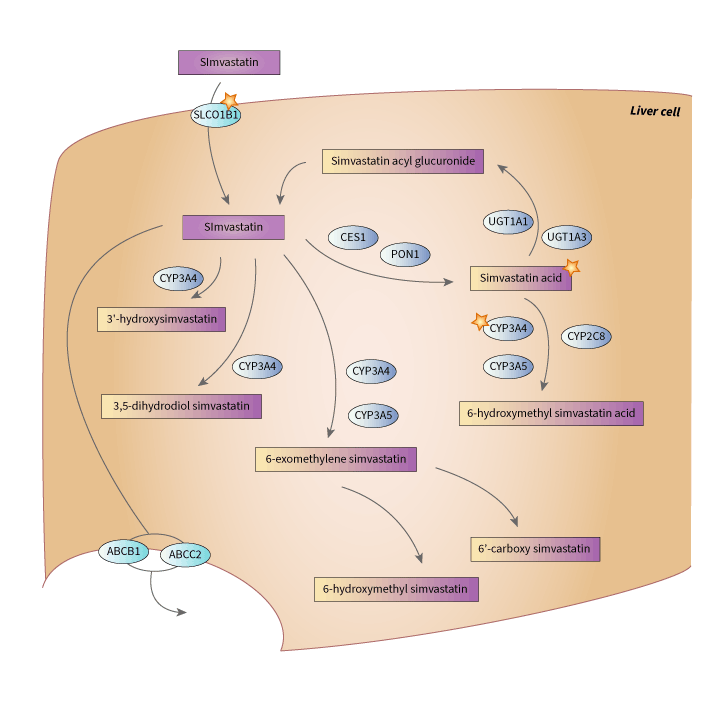
Simvastatin is administered as an inactive lactone, and hydrolyzed to the active simvastatin acid by carboxyesterase and paraoxonase such as CES1 and PON1 [Articles:34045219, 31172248]. Simvastatin acid is a potent inhibitor of HMG-CoA reductase. Simvastatin acid can also be converted back to simvastatin via glucuronidation catalyzed by UGT1A1 or UGT1A3 [Article:34045219], [Article:11950779]. Both simvastatin and simvastatin acid are extensively metabolized by CYP3A4/5 to form 3-hydroxysimvastatin and 6-hydroxymethyl-simvastatin and -simvastatin acid [Articles:34045219, 9321523, 31172248].
Transport
Simvastatin is a substrate of the transport protein OATP1B1 (encoded by gene SLCO1B1) [Articles:15564882, 15970799, 34045219]. Simvastatin transported may also be affected by efflux transporters ABCB1 and ABCC2 [Articles:30024814, 22186618, 19238649, 16321621]. Genetic variation in SLCO1B1 rs4149056 (c.521T>C) has been reported to markedly increase systemic exposure of simvastatin acid [Articles:17108811, 23469684], [Article:31172248], [Article:29469964], [Article:26164721] and has been identified repeatedly as a risk factor for statin-induced muscle toxicity [Articles:21243006, 18650507, 31220337, 29242847, 30250148].
Reactions & interactions (32)
-
Biochemical Reaction
simvastatin acid → simvastatin acyl glucuronide
-
Biochemical Reaction
6-exomethylenesimvastatin → 6-hydroxymethyl simvastatin
-
Biochemical Reaction
simvastatin → simvastatin acid
-
Biochemical Reaction
simvastatin acyl glucuronide → simvastatin
-
Biochemical Reaction
simvastatin → 3,5-dihydrodiol simvastatin
-
Biochemical Reaction
6-exomethylenesimvastatin → 6'-carboxy simvastatin
-
Biochemical Reaction
simvastatin → 6-exomethylenesimvastatin
-
Biochemical Reaction
simvastatin acid → 6-hydroxymethyl simvastatin acid
-
Biochemical Reaction
simvastatin → simvastatin acid
-
Biochemical Reaction
simvastatin → 3'-hydroxysimvastatin
-
Catalysis
UGT1A1 → Biochemical Reaction
-
Catalysis
UGT1A3 → Biochemical Reaction
-
Catalysis
CES1 → Biochemical Reaction
-
Catalysis
PON1 → Biochemical Reaction
-
Catalysis
ABCB1 → Transport
-
Catalysis
ABCC2 → Transport
-
Catalysis
CYP3A4 → Biochemical Reaction
-
Catalysis
SLCO1B1 → Transport
-
Catalysis
CYP3A5 → Biochemical Reaction
-
Catalysis
CYP3A4 → Biochemical Reaction
-
Catalysis
CYP3A4 → Biochemical Reaction
-
Catalysis
CYP3A5 → Biochemical Reaction
-
Catalysis
CYP2C8 → Biochemical Reaction
-
Catalysis
PON1 → Biochemical Reaction
-
Catalysis
CES1 → Biochemical Reaction
-
Catalysis
CYP3A4 → Biochemical Reaction
-
Inhibition
6-exomethylenesimvastatin → HMGCR
-
Inhibition
6'-carboxy simvastatin → HMGCR
-
Inhibition
6-hydroxymethyl simvastatin acid → HMGCR
-
Inhibition
simvastatin acid → HMGCR
-
Transport
simvastatin → simvastatin
-
Transport
simvastatin → simvastatin
Edit history (5)
- 2021-11-01 Create
- 2022-02-03 Update Updated image and image map.
- 2022-02-20 Update Pathway updated to be specific for simvastatin and its metabolites, new gpml, new figure and text.
- 2022-02-20 Update Linked related statin pathways.
- 2024-08-30 Update Removed CYP3A from gpml and replaced with CYP3A4 and updated figure.