About this pathway
Metabolism
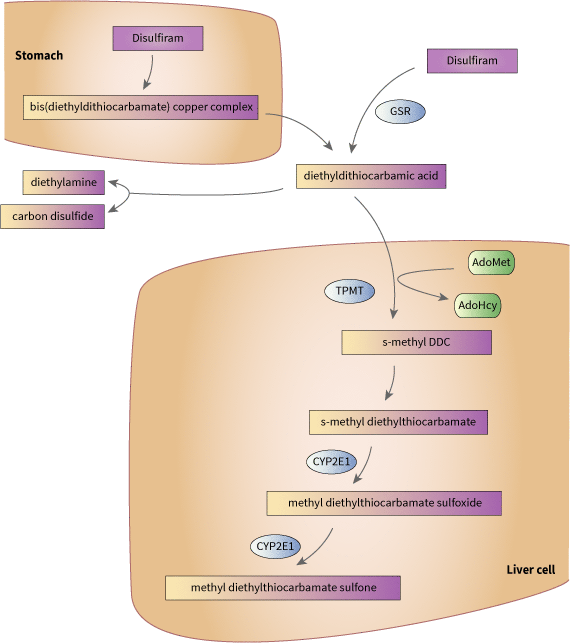
Upon ingestion, disulfiram is converted into diethyldithiocarbamic acid (DDC) under the acidic conditions of the stomach. Due to its instability, DDC can decompose into carbon disulphide and diethylamine, or form a bis(diethyldithiocarbamate) copper complex (Cu(DDC)2) [Article:1471547]. Cu(DDC)2 is more stable under acidic conditions and highly hydrophobic, thus facilitating its absorption by the upper gastrointestinal tract. Both Cu(DDC)2 and intact disulfiram can be distributed across the gastrointestinal mucosa, however. If disulfiram is ingested in its native form, it is rapidly reduced to DDC by endogenous thiols and erythrocytic glutathione reductases—both of which have genetic variations that contribute to differences in disulfiram metabolism [Article:1471547]. Another metabolite of disulfiram, diethylthiomethylcarbamate, has been found to be an inhibitor of the FDA-approved drug target alcohol dehydrogenase [Article:1471547].
DDC can undergo methyl conjugation to form S-methyl-DDC in a AdoMet-dependent methyl transfer reaction. This reaction is catalyzed by thiopurine methyltransferase (TPMT), a cytoplasmic enzyme found in liver cells [Article:8392551]. s-methyl DDC is subsequentially converted into s-methyl diethylthiocarbamate, which in turn gets converted into methyl diethylthiocarbamate sulfoxide by the monooxygenase CYP2E1 and further, into methyl diethylthiocarbamate sulfone by the same enzyme [Article:11159801].
All of the disulfiram metabolites are excreted by the kidney, in feces, or by the lungs. In the kidney, disulfiram is mainly excreted as a glucuronide of DDC or as inorganic sulphate; while the lung releases carbon disulphide, and about 20% of the intact drug is eliminated in feces [Article:1471547].
Reactions & interactions (13)
-
Biochemical Reaction
disulfiram → bis(diethyldithiocarbamate) copper complex
-
Biochemical Reaction
s-methyl diethylthiocarbamate → methyl diethylthiocarbamate sulfoxide
-
Biochemical Reaction
diethyldithiocarbamic acid → carbon disulfide + diethylamine
-
Biochemical Reaction
s-methyl DDC → s-methyl diethylthiocarbamate
-
Biochemical Reaction
disulfiram → diethyldithiocarbamic acid
-
Biochemical Reaction
diethyldithiocarbamic acid + s-adenosylmethionine → s-adenosylhomocysteine + s-methyl DDC
-
Biochemical Reaction
methyl diethylthiocarbamate sulfoxide → methyl diethylthiocarbamate sulfone
-
Biochemical Reaction
bis(diethyldithiocarbamate) copper complex → diethyldithiocarbamic acid
-
Catalysis
CYP2E1 → Biochemical Reaction
-
Catalysis
GSR → Biochemical Reaction
-
Catalysis
TPMT → Biochemical Reaction
-
Catalysis
CYP2E1 → Biochemical Reaction
-
Inhibition
disulfiram → CYP2E1
Edit history (5)
- 2023-01-25 Create
- 2023-07-21 Update Updated to add Illustrator image and text description and removed "in progress" designation.
- 2023-07-21 Update Updated text and links.
- 2023-09-22 Update Added citation
- 2023-09-25 Update Fixed typo in description text.