About this pathway
Rosiglitazone is an insulin-sensitizing hypoglycemic agent and agonist of peroxisome proliferator-activated receptor gamma, which is a nuclear transcription factor involved in glucose regulation and kidney function [Article:15762051]. It is a member of thiazolidinedione drug class. An FDA warning was released on 09/23/2010 that urged careful selection of patients for whom rosiglitazone is prescribed because of concerns about cardiovascular safety.
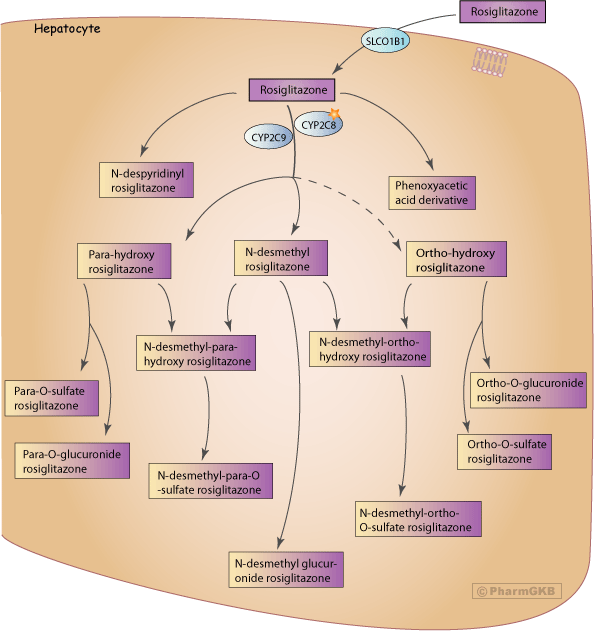
It is primarily metabolized in liver microsomes by cytochrome p450 2C8 (CYP2C8), and to a lesser extent by CYP2C9 [Article:10510156]. The major metabolites of rosiglitazone are para- or ortho-hydroxy rosiglitazone and N-desmethyl rosiglitazone by CYP2C8 [Article:10510156]. The major routes of metabolism are N-demethylation and hydroxylation and subsequent conjugation, however the contribution of CYP2C8 and CYP2C9 has been shown to be active in N-demethylation and hydroxylation, precisely which enzymes are responsible for conjugation and other sequential steps in the metabolic pathway are not well described in the literature [Articles:10510156, 10859151]. N-desmethyl rosiglitazone is the main metabolite in plasma and is further hydroxylated before entering phase 2 metabolism in the liver. Para hydroxyrosiglitazone is detectable in plasma only as conjugated metabolite (rosiglitazone-para-O-sulfate), and both metabolites are excreted as sulfated or glucuronidated metabolites [Article:10859151]. The enzymatic activity of CYP2C8 is approximately four-fold higher for rosiglitazone than the enzymatic activity of CYP2C9 for rosiglitazone [Article:10510156]. Rosiglitazone uptake from sinusoidal blood into hepatocytes is mediated by the organic anion transporting polypeptide 1B1 transporter, which is present at the basolateral membrane of hepatocytes [Articles:14579113, 19129086].
There have been a limited number of pharmacogenetic investigations of rosiglitazone or other thiazolidinedione drugs, most of which have been in vivo pharmacokinetic studies. CYP2C8 *3 alleles may confer higher in vivo metabolic capacity for rosiglitazone than *1 but results have been mixed [Articles:17178266, 15606443]. The organic anion transporting polypeptide gene (SLCO1B1) encodes the organic anion transporting polypeptide 1B1 transporter, which is present at the basolateral membrane of hepatocytes and mediates uptake of its substrates from sinusoidal blood [Article:14579113]. There have been conflicting results regarding whether or not the SLCO1B1 gene influences rosiglitazone pharmacokinetics [Articles:17635496, 19129086, 20406215]. There is some evidence that rosiglitazone response may also be moderated by the lipin 1 protein (LPIN1) gene [Article:18693052].
Edit history (1)
- 2011-02-08 Create