About this pathway
Background
Bupropion is an antidepressant that acts at noradrenergic and dopaminergic neurons. It is also approved as non-nicotine pharmacotherapy for the treatment of nicotine dependence [Article:16939383].
Metabolism
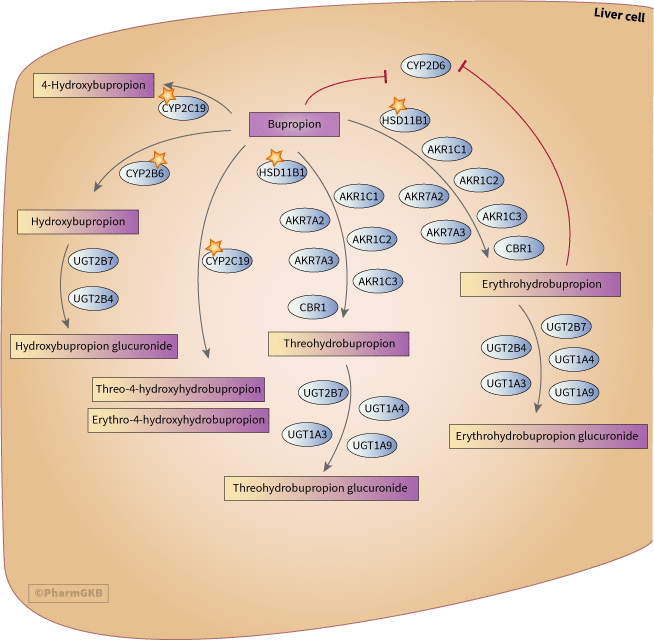
Bupropion is extensively metabolized in humans and forms three active metabolites: hydroxybupropion, threohydrobupropion and erythrohydrobupropion [Articles:24088726, 27255113]. Bupropion is used as a probe drug for CYP2B6, which is the major enzyme involved in formation of hydroxybupropion [Article:26802129]. Recently additional metabolites were identified: 4-hydroxybupropion, erythro-4-hydroxyhydrobupropion and threo-4-hydroxyhydrobupropion, formed by CYP2C19 [Article:27660681]. Bupropion is metabolized by two major carbonyl reductases HSD11B1 in the liver and AKR7 in the intestine to form threohydrobupropion and erythrohydrobupropion [Article:25904761]. In vitro this could be catalyzed by HSD11B1, AKR1C1, AKR1C2, AKR1C3 and CBR1 but not AKR1A1, AKR1B1, AKR1B10, AKR1C4 or CBR3 [Article:24088726]
There are also glucuronidated metabolites excreted in the urine [Article:27723114]. While there is some discrepancy in the literature about the different chiral forms of the glucuronides (due to incorrect labeling of commercial standards [Article:27758826]), these are formed from all three active metabolites by various UGT enzymes. The main enzyme responsible for glucuronidation of hydroxybupropion in vitro is UGT2B7 with minor contribution from UGT2B4 [Article:26802129](not in gpml). UGT2B7 is also the predominant enzyme in the formation of erythrohydrobupropion glucuronide with minor roles for UGT1A4, UGT1A3, UGT1A9 and UGT2B4 [Article:26802129]. In vitro UGT1A9 was responsible for greater formation of threohydrobupropion glucuronide with UGT2B7, UGT1A3 and UGT1A4 also having minor roles [Article:26802129].
Transport
In vitro studies using an ATPase assay in membranes expressing human P-glycoprotein 1 (ABCB1) found that bupropion, hydroxybupropion, threohydrobupropion, and erythrohydrobupropion have only very weak affinity for P-glycoprotein [Article:18239278].
Reactions & interactions (39)
-
Biochemical Reaction
bupropion → hydroxybupropion
-
Biochemical Reaction
bupropion → erythrohydrobupropion
-
Biochemical Reaction
bupropion → threohydrobupropion
-
Biochemical Reaction
bupropion → erythro-4-hydroxyhydrobupropion
-
Biochemical Reaction
threohydrobupropion → threohydrobupropion glucuronide
-
Biochemical Reaction
bupropion → threo-4-hydroxyhydrobupropion
-
Biochemical Reaction
bupropion → 4-hydroxybupropion
-
Biochemical Reaction
erythrohydrobupropion → erythrohydrobupropion glucuronide
-
Catalysis
CYP2B6 → Biochemical Reaction
-
Catalysis
CBR1 → Biochemical Reaction
-
Catalysis
HSD11B1 → Biochemical Reaction
-
Catalysis
AKR1C3 → Biochemical Reaction
-
Catalysis
AKR7A3 → Biochemical Reaction
-
Catalysis
AKR7A2 → Biochemical Reaction
-
Catalysis
AKR1C2 → Biochemical Reaction
-
Catalysis
AKR1C1 → Biochemical Reaction
-
Catalysis
AKR1C3 → Biochemical Reaction
-
Catalysis
CBR1 → Biochemical Reaction
-
Catalysis
AKR7A3 → Biochemical Reaction
-
Catalysis
AKR1C1 → Biochemical Reaction
-
Catalysis
HSD11B1 → Biochemical Reaction
-
Catalysis
AKR7A2 → Biochemical Reaction
-
Catalysis
AKR1C2 → Biochemical Reaction
-
Catalysis
CYP2C19 → Biochemical Reaction
-
Catalysis
UGT1A9 → Biochemical Reaction
-
Catalysis
UGT1A4 → Biochemical Reaction
-
Catalysis
UGT1A3 → Biochemical Reaction
-
Catalysis
UGT2B7 → Biochemical Reaction
-
Catalysis
CYP2C19 → Biochemical Reaction
-
Catalysis
CYP2C19 → Biochemical Reaction
-
Catalysis
UGT2B4 → Biochemical Reaction
-
Catalysis
UGT1A3 → Biochemical Reaction
-
Catalysis
UGT1A9 → Biochemical Reaction
-
Catalysis
UGT2B7 → Biochemical Reaction
-
Catalysis
UGT1A4 → Biochemical Reaction
-
Inhibition
hydroxybupropion → CYP2D6
-
Inhibition
threohydrobupropion → CYP2D6
-
Inhibition
bupropion → CYP2D6
-
Inhibition
erythrohydrobupropion → CYP2D6
Edit history (6)
- 2017-09-19 Create
- 2019-02-13 Update Updated illustrator files to new format.
- 2021-03-11 Update Updated gpml to add 4-hydroxybupropion metabolite and correct location of CYP2B6.
- 2021-03-12 Update Updated figures and image map to align with corrected gpml.
- 2023-02-03 Update Upadted gpml and image files to include threo/erythro-4-hydroxyhydrobupropion
- 2023-02-03 Update Updated text to mention new metabolites formed by CYP2C19.