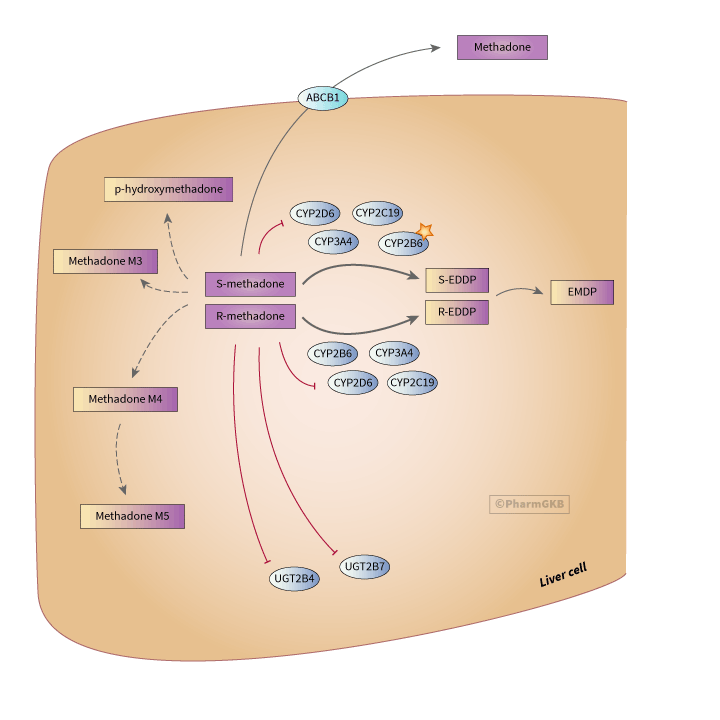
About this pathway
Background
Methadone is an opioid analgesic used in the treatment of pain or for opioid dependence. It is given as a racemic mixture with R-methadone considered the active stereoisomer [Article:20825389]. The different stereoisomers are also considered to be differentially responsible for side effects with R-methadone involved more with respiratory depression and withdrawal and S-methadone interactions involved in QT prolongation [Article:20825389].
The Clinical Pharmacogenomics Implementation Consortium has issued a 'no recommendation' for dosing of methadone by CYP2D6, OPRM1 and/or COMT genotypes.
Metabolism
Methadone can be metabolized into multiple products although most are minor (eight are depicted in [Article:1120392]). The main route for both R-methadone and S-methadone is demethylation to EDDP, also referred to as M1 [Article:1120392]. There is wide interindividual variation in metabolism; with amounts of EDDP varying tenfold in group of people with addiction receiving maintenance methadone for 1 month [Article:1120392]. While CYP3A4 is equally capable of metabolism of R and S methadone in vitro, CYP2C19, CYP3A7, and CYP2C8 preferentially metabolize R-methadone, and CYP2B6, CYP2D6, and CYP2C18 primarily metabolize S-methadone [Article:29458047]. In vitro, approximately 63-74% of methadone is metabolized by CYP3A4, around 12-32% by CYP2B6 and 1-14% by CYP2C19 [Article:20825389]. However there is contradictory evidence for what occurs in vivo and is relevant clinically. Drug-drug interaction studies in healthy volunteers strongly suggest that CYP2B6 is the major drug metabolizing enzyme for methadone [Articles:28263461, 27128829, 31044453].
Transport
Methadone is transported by ABCB1 with slight preference for S-methadone. EDDP is also a substrate for ABCB1 but less transport of EDDP than methadone and other transporter/s of EDDP are likely [Article:17178267].
Reactions & interactions (23)
-
Biochemical Reaction
S-EDDP → EMDP
-
Biochemical Reaction
methadone → p-hydroxymethadone
-
Biochemical Reaction
methadone → methadone M4
-
Biochemical Reaction
methadone M4 → methadone M5
-
Biochemical Reaction
methadone → methadone M3
-
Biochemical Reaction
(S)-methadone → S-EDDP
-
Biochemical Reaction
R-EDDP → EMDP
-
Biochemical Reaction
(R)-methadone → R-EDDP
-
Catalysis
ABCB1 → Transport
-
Catalysis
CYP2C19 → Biochemical Reaction
-
Catalysis
CYP3A4 → Biochemical Reaction
-
Catalysis
CYP2B6 → Biochemical Reaction
-
Catalysis
CYP2D6 → Biochemical Reaction
-
Catalysis
CYP3A4 → Biochemical Reaction
-
Catalysis
CYP2C19 → Biochemical Reaction
-
Catalysis
CYP2B6 → Biochemical Reaction
-
Catalysis
CYP2D6 → Biochemical Reaction
-
Inhibition
methadone → UGT2B7
-
Inhibition
methadone → CYP2D6
-
Inhibition
methadone → UGT2B4
-
Leads To
methadone → (R)-methadone
-
Leads To
methadone → (S)-methadone
-
Transport
methadone → methadone
Edit history (4)
- 2021-08-06 Create
- 2022-05-25 Update Approved
- 2023-01-30 Update Updated gpml
- 2023-01-30 Update Updated text to emphasize role of CYP2B6 per communications from CPIC