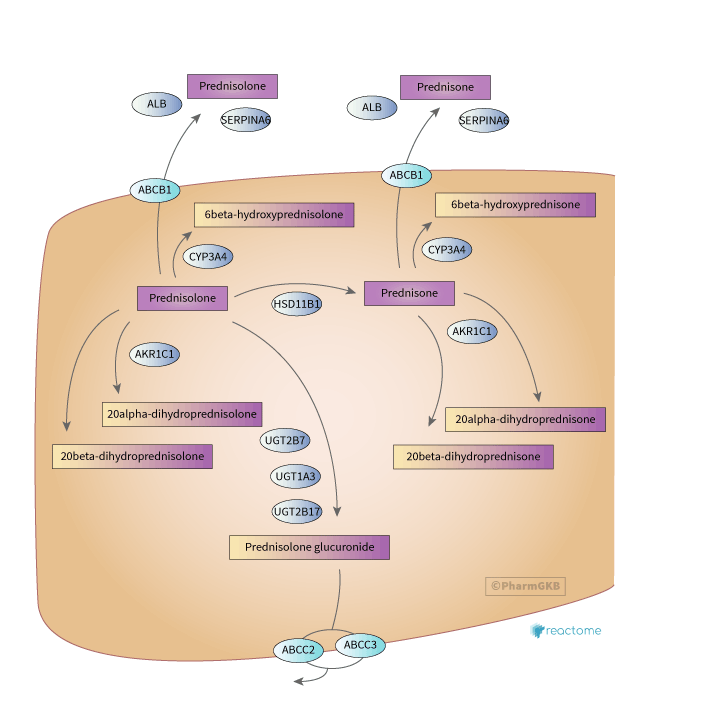
About this pathway
Background
Prednisone and prednisolone are anti-inflammatory glucocorticoids used in the treatment of endocrine disorders, rheumatic diseases, allergic states, hematological disorders, cancer and other conditions.
Prednisone (PREDN) is a prodrug of prednisolone (PREDL), and is rapidly absorbed. To achieve high uptake of the near water-insoluble molecule the highest dose 50 mg has to be dissolved in 250 ml water. Its conversion to the highly active prednisolone (PREDL) in liver cells is reversible but represents the favored reaction direction [Article:378499]. Prednisone and prednisolone are considered to be fully therapeutically equivalent. The theoretical advantage of avoiding high GI concentrations of prednisone by administering prednisolone directly has never been shown to be clinically relevant [Article:17387693]
Metabolism
Prednisone is extensively metabolized; only 2–5% of a given dose of prednisone is excreted unchanged in urine. After hydrogenation to prednisolone at least 20 metabolites and their conjugates are formed and excreted. The main metabolites both after systemic and topical use are 20alpha- and 20beta-dihydro-prednisone, as well as 20alpha- and 20beta-dihydro-prednisolone (20AH-PREDN, 20BH-PREDN, 20AH-PREDL, 20BH-PREDL), in addition to the 6beta-hydroxy compounds 6B-OH-PREDN and 6B-OH-PREDL [Articles:25800201, 31701669].
Hydrogenation of PREDN and dehydrogenation of PREDL are complementary reactions that are dominant in different cell types. While liver and fat cells convert PREDN to PREDL, colon and kidney cells partly convert PREDL back to PREDN [Articles:7588203, 9543163, 12466373]. Prednisolone (PREDL) strongly induces the expression of cytochrome P450 3A4 (CYP3A4) in hepatic cells [Articles:10673364, 12673034]. Co-application of the CYP3A4 inhibitor ketoconazole with prednisolone decreased urinary output of the metabolite 6beta-hydroxyprednisolone (6βOH-PREDL) significantly [Article:2639662]. As CYP3A4 also hydroxylates cortisol to the 6betaOH-product [Article:21490593] it is probable that CYP3A4 oxidizes PREDN to 6βOH-PREDN, and PREDL to 6βOH-PREDL. Phase I metabolic reactions of prednisone (PREDN) and prednisolone (PREDL) include oxidation of the hydroxyl group in C11, reduction of ketone in C20, hydroxylation in C6, or a combination of some of them. Probably one or more of the AKR1C family enzymes reduce PREDN, PREDL to their 20alpha- and beta forms which are detected in urine. The enzymatic mechanism has not been exhaustively explored [Articles:31701669, 30137266].
UDP-glucuronosyltransferase 2B7 (UGT2B7) was found in vitro to be the main enzyme glucuronidating prednisone (PREDN) with UGT2B17 and UGT1A3 having weak activity Innocenti et al, 2005. It is probable that these glucuronosyltransferases are responsible for glucuronidation of other PREDN metabolites that show up in urinary output [Articles:25800201, 31701669].
Transport
As highly hydrophobic compounds prednisone and prednisolone move along their concentration gradients into cells by simple diffusion, passing through membrane bilayers [Article:182169]. Plasma protein binding is therefore important for preventing diffusion. Albumin (ALB) binds prednisone (PREDN) in a linear fashion. The binding is weak but, due to albumin availability, ALB bound PREDN represents a significant part of plasma protein bound PREDN at any point in time. Around 5% of total cortisol is known to be present in unbound form in plasma, and it is likely the number for PREDN is similar [Article:15904907]. Prednisone and prednisolone do not displace each other at the albumin binding site [Articles:6492791, 359390]. Albumin (ALB) binds prednisolone (PREDL) weakly, but with an affinity 300 times greater than that of cortisol [Article:7073761]. Due to ALB availability, ALB bound PREDL represents a significant part of plasma protein bound PREDL at any point in time. Prednisone (PREDN) and PREDL do not displace each other at the albumin binding site [Articles:6492791, 3593903]. Prednisone (PREDN) reversibly binds to transcortin (corticosteroid-binding globulin, CBG, SERPINA6) [Article:7195405]. The affinity of prednisolone (PREDL) to SERPINA6 is higher than that of PREDN, and PREDN is displaced by PREDL in concentrations above 5:1 excess of PREDL [Articles:6492791, 3593903]. The binding sites for PREDN and PREDL are different (Legler and Benet, 1986). With therapeutic PREDN doses, PREDL plasma concentrations exceed those of PREDN by four to tenfold [Article:7310640]. The capacity of SERPINA6 to bind PREDN and PREDL is limited, with albumin (ALB) weakly binding the excess. Steroids bound to SERPINA6 are released when local conditions, like the proteolytic milieu of inflamed tissue, change the allosteric configuration of SERPINA6 [Articles:18513745, 27411675].
The ABCB1 (also known as multi-drug resistance protein 1, MDR1, P-glycoprotein, or PGP) is the best characterized xenobiotic transporter of the ABC transporter family [Article:2900833]. The presence of 11-, 17-, and 21-hydroxyl groups appears to be a critical determinant for transport efficiency of steroids by ABCB1. Prednisone (PREDN) contains the 17-, and prednisolone (PREDL) both the 17- and 21-hydroxy group, and both molecules are effectively exported out of cells expressing ABCB1 with reduced intracellular accumulation and toxicity [Article:14661924].
Since glucuronide conjugates are hydrophilic, efflux transporters mediate their excretion from tissues. It is not known which transporter is responsible for hepatic efflux of glucuronidated prednisone (PREDN) metabolites. The possible candidates are ABCC2 and ABCC3 which also export steroid hormone glucuronides from liver cells [Articles:29175180, 31704245].
The interactive Reactome pathway is found at https://www.reactome.org/
Reactions & interactions (31)
-
Biochemical Reaction
prednisolone → 20alpha-dihydroprednisolone
-
Biochemical Reaction
prednisone → 20alpha-dihydroprednisone
-
Biochemical Reaction
prednisone → 6beta-hydroxyprednisone
-
Biochemical Reaction
prednisolone → 6beta-hydroxyprednisolone
-
Biochemical Reaction
prednisone → prednisolone
-
Biochemical Reaction
prednisolone → 20beta-dihydroprednisolone
-
Biochemical Reaction
prednisone → 20beta-dihydroprednisone
-
Biochemical Reaction
prednisolone → prednisolone glucuronide
-
Catalysis
ABCB1 → Transport
-
Catalysis
AKR1C1 → Biochemical Reaction
-
Catalysis
AKR1C1 → Biochemical Reaction
-
Catalysis
CYP3A4 → Biochemical Reaction
-
Catalysis
ABCB1 → Transport
-
Catalysis
CYP3A4 → Biochemical Reaction
-
Catalysis
HSD11B1 → Biochemical Reaction
-
Catalysis
AKR1C1 → Biochemical Reaction
-
Catalysis
ABCC3 → Transport
-
Catalysis
ABCC2 → Transport
-
Catalysis
AKR1C1 → Biochemical Reaction
-
Catalysis
UGT2B17 → Biochemical Reaction
-
Catalysis
UGT2B7 → Biochemical Reaction
-
Catalysis
UGT1A3 → Biochemical Reaction
-
Inhibition
ALB → prednisolone
-
Inhibition
SERPINA6 → prednisolone
-
Inhibition
SERPINA6 → prednisone
-
Inhibition
ALB → prednisone
-
Transport
prednisone → prednisone
-
Transport
prednisolone → prednisolone
-
Transport
prednisolone → prednisolone
-
Transport
prednisone → prednisone
-
Transport
prednisolone glucuronide → prednisolone glucuronide
Edit history (2)
- 2022-07-21 Create
- 2025-03-24 Update fixed typo