About this pathway
Background
Ribavirin (RBV) is a synthetic nucleoside analog structurally related to guanine. It is given orally as part of the treatment of HCV infection, and by inhalation for the treatment of RSV infection. According to the WHO, ribavirin can also be used for the treatment of viral hemorrhagic fevers WHO list.
RBV is administered orally in doses of 400 to 600 mg. It is highly soluble in water and a typical dose is dissolved completely over a wide range of acidities. RBV is rapidly absorbed into the circulation. After the oral administration of 600 mg radiolabeled ribavirin, approximately 61% of the drug was detected in the urine and 12% was detected in the feces. 17% of an administered dose was in unchanged form. RBV accumulates in human erythrocytes and remains in the body for weeks, with a halflife of >100 hours [Article:26952879]. A consequence of the accumulation in erythrocytes is the well known side effect of hemolytic anemia, which is reversible by cessation of administration (FDA label Rebetol, 2013). Ribavirin is a prodrug. It is metabolized through two different paths: phosphorylation, yielding the active triphosphate (RBV TP), and degradation via de ribosylation and hydrolysis of the amide group. The GI tract, and not the liver, appears to be the major site of first pass elimination [Article:16501888]
Transport
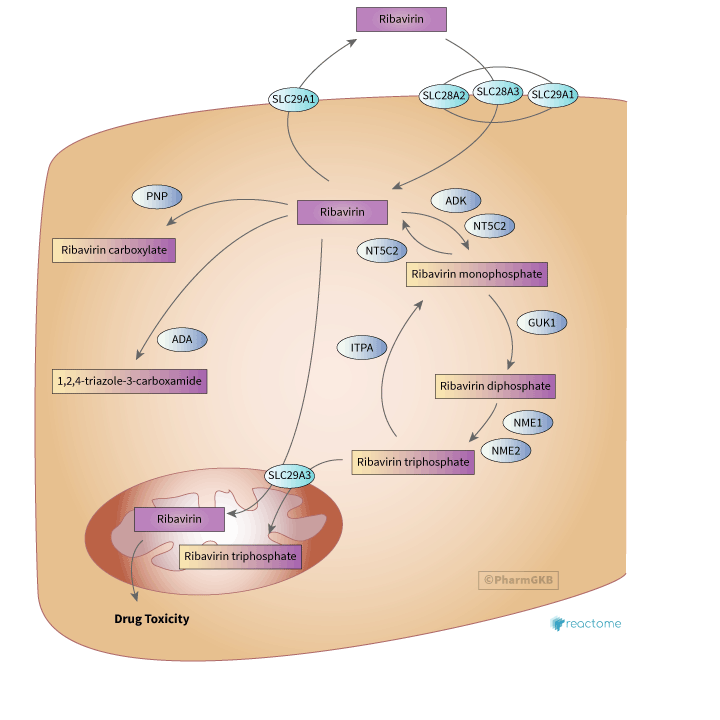
The concentrative sodium/nucleoside cotransporters 2 and 3 (CNT2, SLC28A2 and CNT3, SLC28C3) import ribavirin (RBV) together with sodium ions (Na+) into cells. As the transporters are expressed on the plasma membranes of many cell types, RBV may be absorbed extensively [Articles:9605565, 17412768, 16265592]. Kinetic studies in Xenopus laevis oocytes point to a possible interaction of SLC29A1 with the SLC28A3 transport process [Article:20096989]. Presence of interferon alpha (IFNA) enhances uptake by apparent promotion of SLC28A2 translocation to the plasma membrane (probably by upregulation of SLC28A2 expression), which explains synergistic effects in treatment with both drugs [Article:24957263].
The equilibrative nucleoside transporter 1 (ENT1, SLC29A1) is directly involved in the transport of ribavirin (RBV) into cells, although a molecular mechanism has not been defined. It is possible that the observed dependency of RBV uptake on the presence of SLC29A1 is mediated by its binding to SLC28C2,3 [Article:20096989]. The role of equilibrative nucleoside transporter 2 (ENT2, SLC29A2) seems to be minor, at least in placental cells [Articles:15861032, 18635603, 31520644]. As both concentrative and equilibrative transporters are ubiquitously expressed, RBV may be absorbed extensively [Article:20504255].
Metabolism
Adenosine kinase (ADK) takes part in phosphorylation of ribavirin (RBV) in erythrocytes [Article:2159925]. While 5′ nucleotidase (NT5C2) has a catalytic efficiency much better than that of adenosine kinase (ADK), the actual contribution of ADK to RBV phosphorylation depends on the physiological concentrations of enzymes and other effectors, which are unknown PMID: 15917509]. Phosphorylation to ribavirin monophosphate (RBV MP) appears to be the rate limiting step in the intracellular ribavirin metabolism resulting in the triphosphate [Articles:2159925, 21396942]
Ribavirin (RBV) phosphorylation to ribavirin monophosphate (RBV MP) can be catalyzed by the 5′ nucleotidase NT5C2, with a catalytic efficiency much better than that by adenosine kinase (ADK) [Article:15917509]. This appears to be the rate limiting step in the intracellular ribavirin metabolism resulting in the triphosphate [Articles:2159925, 21396942]. Ribavirin diphosphate (RBV DP) is the intermediate of ribavirin (RBV) activation by phosphorylation, and it is found in cells treated with RBV [Articles:280136, 10349689]. The enzyme responsible for phosphorylation of the monophosphate is not known. A probable candidate would be cytosolic guanylate kinase 1 (GUK1) which is known to activate carbovir, 6 mercaptopurine and other drugs [Articles:1383219, 197968]. Both nucleoside diphosphate kinases A and B (NME1, NME2) hexamers phosphorylate ribavirin diphosphate (RBV DP) to the triphosphate (RBV TP) [Articles:8626464, 12606760].
Equilibrative nucleoside transporters are located on both sides of epithelial cells and are essential to the export of ribavirin (RBV) out of cells. They cannot transport the phosphorylated RBV analogs RBV MP, RBV DP, and RBV TP [Articles:16265592, 17412768]. Efflux pumps are not involved in RBV export [Article:30716294] Ribavirin triphosphate (RBV TP) was dephosphorylated in vitro by recombinant ITP triphosphatase (ITPAse, ITPA) to a similar extent as its naturally occurring substrate ITP. Reduced ITPase activity in one third of humans causes increased intracellular levels of RBV TP, leading to increased treatment efficacy [Articles:30045981, 29580856]. Polymorphisms in the gene encoding ITPase (ITPA) have been associated with protection against ribavirin induced anemia [Article:20173735]. Nucleate cell types can hydrolyze ribavirin monophosphate (RBV MP) to ribavirin (RBV). The enzymes possibly responsible for the reaction are cytosolic purine 5' nucleotidase (NT5C2) and alkaline phosphatases [Article:2159925].
Significant amounts of ribavirin (RBV) are phosphorolyzed to 1,2,4 triazole 3 carboxamide (T CONH2), already in the first pass through intestinal cells. The responsible enzyme purine nucleoside phosphorylase (PNP) is expressed in higher amounts in the small intestine than in the liver, which also correlates with higher cytosolic phosphorolysis activity in intestinal cells. The amount of conversion to T CONH2 in the liver is additionally reduced by phosphorylation of RBV to RBV MP. T CONH2 from this reaction is the major metabolite detectable in urine [Articles:2737800, 24107682].
Ribavirin (RBV) undergoes hydrolytic deamination to its carboxylic acid derivative (RBV COOH, ICN3297), which does not possess any antiviral activity. The reaction is catalyzed by adenosine deaminase (ADA). As the amount of detectable RBV COOH is low, deamination is not important in RBV catabolism [Articles:280136, 12499231].
Equilibrative nucleoside transporter 3 (ENT3, SLC29A3) is an intracellular transporter involved in mitochondrial import of ribavirin (RBV) and RBV TP [Articles:16446384, 18635603]. Mitochondrial import of RBV appears to be a factor contributing to mitochondrial toxicity in patients treated with both RBV and highly active antiretrovirals (HAART) [Article:20486858].
The interactive Reactome pathway is found at https://www.reactome.org/
Pharmacogenomics
Most of the studies of ribavirin pharmacogenomics have occurred in patients treated with regimens that included interferons as well as ribavirin. There are two candidate variants in ITPA that have been associated with anemia in multiple studies: The ITPA rs1127354 CC genotype has been associated with an increased risk of anemia as compared to patients with the AA or AC genotype when treated with peginterferon alfa-2b and ribavirin. The ITPA rs7270101 AA genotype has been associated with an increased risk of anemia when treated with peg interferon alfa-2b and ribavirin as compared to patients with the AC and CC genotype. However, conflicting evidence has been reported for both of these variants. Candidate variants in SLC28A2 and SLC29A1 have also been observed to impact ribavirin responses and side effects and need further examination. See the clinical annotations and variant annotations pages for ribavirin for the latest supporting evidence.
Reactions & interactions (29)
-
Biochemical Reaction
ribavirin triphosphate → ribavirin monophosphate
-
Biochemical Reaction
ribavirin → ribavirin monophosphate
-
Biochemical Reaction
ribavirin → ribavirin carboxylate
-
Biochemical Reaction
ribavirin monophosphate → ribavirin
-
Biochemical Reaction
ribavirin diphosphate → ribavirin triphosphate
-
Biochemical Reaction
ribavirin → 1,2,4-triazole-3-carboxamide
-
Biochemical Reaction
viramidine → ribavirin
-
Biochemical Reaction
ribavirin monophosphate → ribavirin diphosphate
-
Catalysis
ITPA → Biochemical Reaction
-
Catalysis
SLC29A3 → Transport
-
Catalysis
NT5C2 → Biochemical Reaction
-
Catalysis
ADK → Biochemical Reaction
-
Catalysis
SLC28A3 → Transport
-
Catalysis
SLC28A2 → Transport
-
Catalysis
SLC29A1 → Transport
-
Catalysis
SLC29A1 → Transport
-
Catalysis
ADA → Biochemical Reaction
-
Catalysis
SLC29A3 → Transport
-
Catalysis
NT5C2 → Biochemical Reaction
-
Catalysis
NME2 → Biochemical Reaction
-
Catalysis
NME1 → Biochemical Reaction
-
Catalysis
PNP → Biochemical Reaction
-
Catalysis
ADA → Biochemical Reaction
-
Catalysis
GUK1 → Biochemical Reaction
-
Leads To
ribavirin → Drug Toxicity
-
Transport
ribavirin triphosphate → ribavirin triphosphate
-
Transport
ribavirin → ribavirin
-
Transport
ribavirin → ribavirin
-
Transport
ribavirin → ribavirin
Edit history (1)
- 2022-06-24 Create