About this pathway
Background
Vortioxetine is a dual serotonin and norepinephrine reuptake inhibitor approved for the treatment of major depressive disorder in adults. It has not been evaluated for pediatric use. The FDA label for vortioxetine has a black box warning for risk of suicidal ideation in adolescents, children and young adults. There is pharmacogenomic information on the FDA label that gives a recommended maximum dose for known CYP2D6 poor metabolizers and dose reductions for use in combination with CYP2D6 inhibitors.
Metabolism
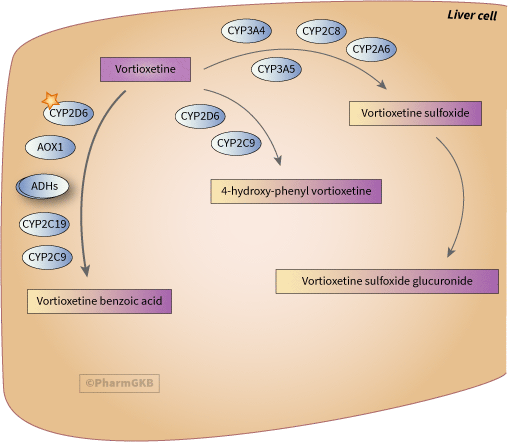
Vortioxetine undergoes extensive metabolism, via oxidation and subsequent glucuronic acid conjugation with the main metabolite being the clinically inactive vortioxetine benzoic acid [Articles:24766668, 22448783, 22496396]. Several enzymes are capable of metabolizing vortioxetine in vitro including CYP2D6, CYP3A4/5, CYP2C9, CYP2C19, CYP2A6, CYP2C8 and CYP2B6 although the major enzyme in vivo is CYP2D6 [Articles:24766668, 22448783, 22496396]. Clearance of vortioxetine in CYP2D6 poor metabolizers was approximately 50% of that seen in CYP2D6 extensive metabolizers [Article:24766668]. The benzoic acid metabolite is formed in two steps, the first is generation of a benzylic alcohol mainly by CYP2D6 but CYP2C9 and CYP2C19 may be capable [Article:22496396]. The second step is formation of the benzoic acid metabolite and the major enzymes are most likely alcohol dehydrogenase and aldehyde dehydrogenases, CYP2D6 is the only CYP capable of this step in vitro [Article:22496396].
Transport
There is limited evidence in the literature about transporters of vortioxetine. Vortioxetine is a substrate for the mouse abcb1 transporter [Article:30476727], although the authors did not test the human ABCB1.
Reactions & interactions (15)
-
Biochemical Reaction
vortioxetine sulfoxide → vortioxetine sulfoxide glucuronide
-
Biochemical Reaction
vortioxetine → vortioxetine sulfoxide
-
Biochemical Reaction
vortioxetine → vortioxetine benzoic acid
-
Biochemical Reaction
vortioxetine → 4-hydroxy-phenyl vortioxetine
-
Catalysis
CYP3A4 → Biochemical Reaction
-
Catalysis
CYP2A6 → Biochemical Reaction
-
Catalysis
CYP2C8 → Biochemical Reaction
-
Catalysis
CYP3A5 → Biochemical Reaction
-
Catalysis
alcohol and aldehyde dehydrogenases → Biochemical Reaction
-
Catalysis
AOX1 → Biochemical Reaction
-
Catalysis
CYP2D6 → Biochemical Reaction
-
Catalysis
CYP2C9 → Biochemical Reaction
-
Catalysis
CYP2C19 → Biochemical Reaction
-
Catalysis
CYP2C9 → Biochemical Reaction
-
Catalysis
CYP2D6 → Biochemical Reaction
Edit history (2)
- 2021-11-30 Create
- 2022-03-23 Note Released to live website.