About this pathway
Background
Duloxetine is a dual serotonin and norepinephrine reuptake inhibitor approved for the treatment of major depressive disorder, anxiety, and diabetic neuropathic pain [Article:21366359]. It is approved for pediatric use for general anxiety disorder in children 7-17 years old see Medicaid dosing charts. The FDA label for duloxetine has a black box warning for risk of suicidal ideation in adolescents, children and young adults.
Metabolism
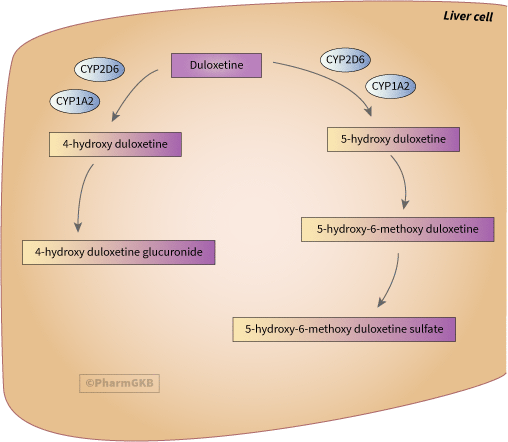
Duloxetine is extensively metabolized in the liver by oxidation, methylation and conjugation [Article:21366359]. The two major circulating metabolites of duloxetine are the glucuronide conjugate of 4-hydroxy duloxetine and the sulfate conjugate of 5-hydroxy-6-methoxy duloxetine, both of which are inactive at serotonin and norepinephrine transporters [Article:21366359]. Studies in human liver microsomes identified that CYP2D6 and CYP1A2 enzymes are capable of formation of 4-OH, 5-OH and 6-OH duloxetine [Articles:12920170, 18307373]. However, in vivo experiments with inhibitors of CYP1A2 and CYP2D6 and CYP2D6 poor metabolizers suggest that CYP1A2 is the major enzyme involved [Article:12621382]. Clinically significant increases in duloxetine exposure are observed in the presence of fluvoxamine, a CYP1A2 inhibitor [Article:18307373]. As well as being a substrate of CYP2D6, duloxetine is also a moderate inhibitor so drug-drug interactions (DDIs) should be considered when duloxetine is prescribed with other drugs [Articles:19480470, 18691982, 12621382, 15057659]. Duloxetine is considered unlikely to have a clinically significant effect on the metabolism of drugs that are substrates of CYP1A2 [Article:18307373]. The FDA label for duloxetine lists both CYP1A2 and CYP2D6 as involved in metabolism, but gives no specific guidance for pharmacogenomics. The FDA label recommends avoidance of potent CYP1A2 inhibitors and provides information that strong CYP2D6 inhibitors may alter concentrations of duloxetine. Duloxetine plasma concentrations are higher in non-smokers compared to smokers and in women compared to men although there are no changes in dosing recommendations based on smoking or gender [Article:21366359]. Both of these may be explained by differences in CYP1A2 expression or activity levels.
Transport
Duloxetine is not a substrate of ABCB1 [Article:23931269]. Evidence of involvement of other drug transporters in the PK of duloxetine was not found in the literature (as per 2011) [Article:21366359] nor during a recent literature search.
Reactions & interactions (9)
-
Biochemical Reaction
5-hydroxy duloxetine → 5-hydroxy-6-methoxy duloxetine
-
Biochemical Reaction
4-hydroxy duloxetine → 4-hydroxy duloxetine glucuronide
-
Biochemical Reaction
5-hydroxy-6-methoxy duloxetine → 5-hydroxy, 6-methoxy duloxetine sulfate
-
Biochemical Reaction
duloxetine → 5-hydroxy duloxetine
-
Biochemical Reaction
duloxetine → 4-hydroxy duloxetine
-
Catalysis
CYP1A2 → Biochemical Reaction
-
Catalysis
CYP2D6 → Biochemical Reaction
-
Catalysis
CYP2D6 → Biochemical Reaction
-
Catalysis
CYP1A2 → Biochemical Reaction
Edit history (2)
- 2021-11-30 Create
- 2022-03-23 Note Released to live site.