About this pathway
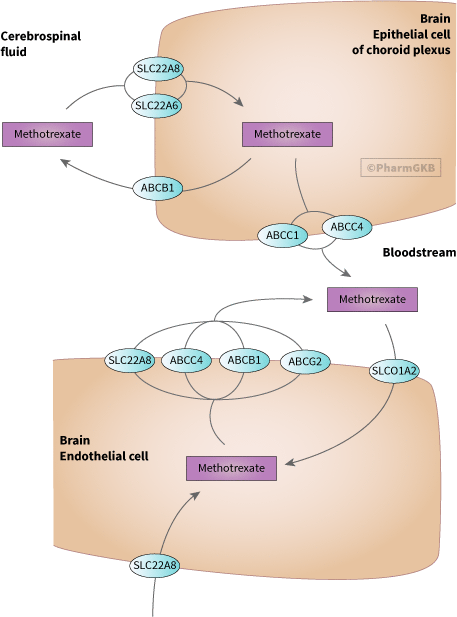
MTX-based regimens are widely used for tumors of the central nervous system (CNS) [Article:15987831][Article:10563431]. However, the prognosis for CNS tumors is still very poor likely due to two reasons: low availability of drug at the site of action and intrinsic or acquired resistance the tumor has against the antitumor agents [Article:15987831]. This pathway depicts candidate genes involved in the transport of methotrexate in the brain, showing blood vessel endothelial cells and exchange between the bloodstream, epithelial brain cells in the choroid plexus and cerebrospinal fluid. The transporter genes depicted are polymorphic and several have been studied for their association with methotrexate efficacy and toxicity. For further discussion of methotrexate pharmacogenomics see [Article:21317831] and methotrexate pathway and for details of individual studies see methotrexate variant annotations.
Reactions & interactions (16)
-
Catalysis
SLC22A6 → Transport
-
Catalysis
SLC22A8 → Transport
-
Catalysis
ABCB1 → Transport
-
Catalysis
ABCC1 → Transport
-
Catalysis
ABCC4 → Transport
-
Catalysis
ABCB1 → Transport
-
Catalysis
ABCG2 → Transport
-
Catalysis
ABCC4 → Transport
-
Catalysis
SLC22A8 → Transport
-
Catalysis
SLC22A8 → Transport
-
Catalysis
SLCO1A2 → Transport
-
Transport
methotrexate → methotrexate
-
Transport
methotrexate → methotrexate
-
Transport
methotrexate → methotrexate
-
Transport
methotrexate → methotrexate
-
Transport
methotrexate → methotrexate
Edit history (3)
- 2010-12-12 Create
- 2011-12-12 Update
- 2019-02-25 Update Updated to new illustrator formatting.