About this pathway
Aminoglycoside antibiotics are broad-spectrum antibiotics used to treat Gram-negative bacterial infections. Use of aminoglycosides has been linked to several adverse effects, including nephrotoxicity and ototoxicity leading to aminoglycoside-induced hearing loss (AIHL). This pathway provides an overview of some underlying causes of AIHL. A more in-depth review has been published by Kros and Steyger [PMID: 30559254}.
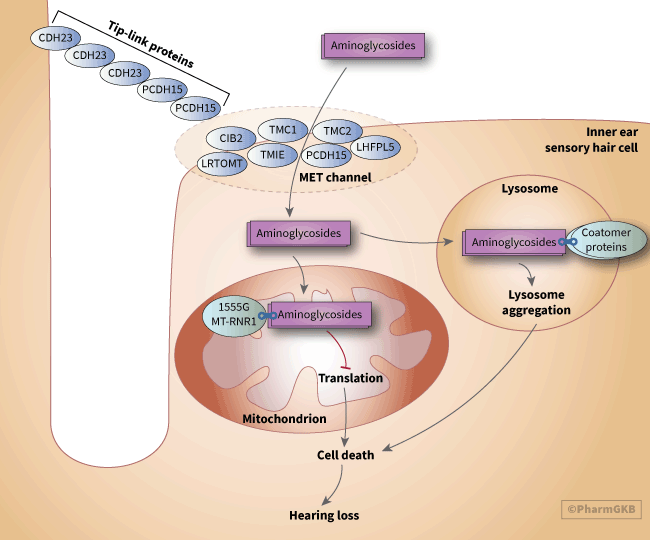
AIHL is caused by the death of hair cells in the inner ear following exposure to aminoglycosides. Aminoglycosides cross the blood-labyrinth barrier in the inner ear and enter the endolymph [Article:22355674]. They then selectively enter sensory hair cells through mechanoelectrical transduction (MET) channels in a calcium-dependent manner [Articles:21818312, 23359017]. The exact composition of the MET channel has not been definitively ascertained but is known to contain the TMC1 protein [Article:30138589]. This pathway displays the MET channel components proposed by Corey et al. [Article:30291150].
Tip-link protein chains consisting of cadherin 23 (CDH23) and protocadherin 15 (PCDH15) regulate MET channel gating [Articles:23359017, 17805295, 24987009]. Gentamicin uptake and subsequent cell death was found to be prevented in hair cells derived from CDH23 knockout mice [Article:23359017].
Aminoglycosides have been found to accumulate in lysosomes within hair cells, leading to enlarged lysosomes with the potential to rupture [Article:11134593]. This enlargement is thought to be due to either increasing amounts of aminoglycosides accumulating in the lysosome or aggregation of lysosomes mediated by cross-linking of coatomer proteins with aminoglycosides [Articles:9348532, 11134593]. It is thought that lysosomal rupture contributes to hair cell death in AIHL, but this has yet to be conclusively demonstrated.
The most well-documented cause of AIHL is aminoglycoside binding to certain alleles of the 12S mitochondrial ribosomal subunit, encoded by MT-RNR1. The 12S subunit is a homolog of the prokaryotic 16S ribosomal subunit, which is the therapeutic target of aminoglycosides. By binding to the 16S subunit in bacterial cells, aminoglycosides disrupt protein synthesis, which leads to cell death [Article:27252397]. Certain variants in the human MT-RNR1 gene cause a change in the structure of the 12S mitochondrial subunit so that it more closely resembles the structure of the bacterial 16S subunit. The 1555G allele is used in this pathway as an example of such an allele. This altered structure allows aminoglycosides to bind the 12S subunit, leading to the same events of disruption of protein synthesis and eventual cell death [Articles:18308926, 19687236].
The Clinical Pharmacogenetic Implementation Consortium (CPIC) has published a guideline recommending that aminoglycosides should be avoided by patients carrying the MT-RNR1 1095T>C, 1494C>T or 1555A>G alleles which increase their risk of AIHL [Article:34032273].
Reactions & interactions (7)
-
Activation
Tip-link proteins → MET channel
-
Catalysis
MET channel → Transport
-
Complex Assembly
Aminoglycoside antibiotics + MT-RNR1 → MT-RNR1/aminoglycoside complex
-
Complex Assembly
Aminoglycoside antibiotics + Coatomer complex → Aminoglyside/coatomer complex
-
Leads To
MT-RNR1/aminoglycoside complex → negative regulation of translational fidelity
-
Transport
Aminoglycoside antibiotics → Aminoglycoside antibiotics
-
Transport
Aminoglycoside antibiotics → Aminoglycoside antibiotics
Edit history (2)
- 2021-10-26 Create
- 2025-07-17 Update Uppdated link to guideline