About this pathway
Background
Phenprocoumon is an anticoagulant commonly used in many European countries and is administered as a racemic mixture. Like other coumarins, phenprocoumon exerts its clinical effect by inhibiting vitamin K epoxide reductase (VKORC1).
Metabolism
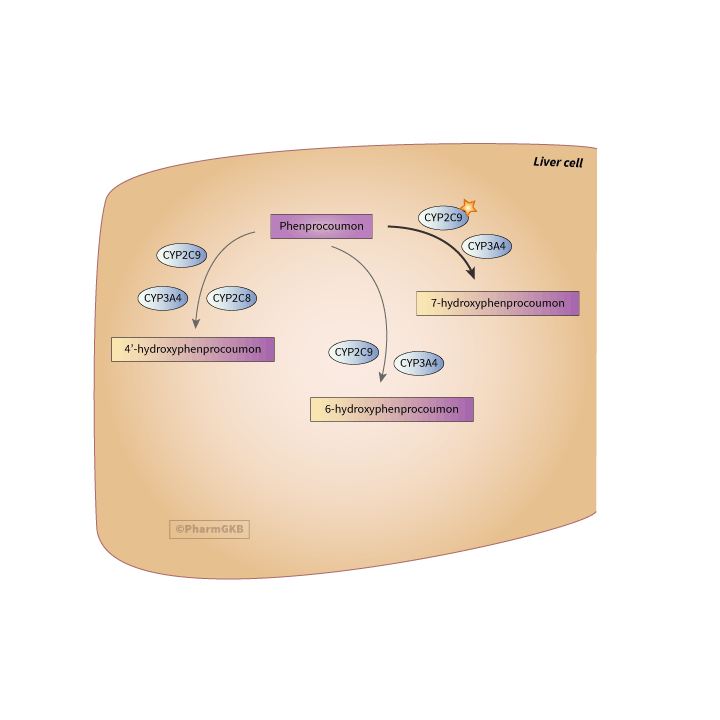
The main route of metabolism of phenprocoumon is hydroxylation with approximately 60% forming 7-hydroxyphenprocoumon, 25% 6-hydroxyphenprocoumon and the remainder 4’-hydroxyphenprocoumon [Article:16372822]. This pathway does not show the R and S enantiomers for each metabolite as the individual stereoisomer structures were not available in PubChem. In general clearance is higher for the S enantiomers than the R enantiomers and is driven more by CYP2C9 [Articles:16372822, 15128047].
| Metabolite | Enzymes (relative percentage involvement) |
|---|---|
| S-4′-OH | CYP2C9 (30) CYP3A4 (30) CYP2C8 (30) |
| S-6-OH | CYP2C9 (60) CYP3A4 (40) |
| S-7-OH | CYP2C9 (65) CYP3A4 (35) |
| R-4′-OH | CYP3A4 (100) |
| R-6-OH | CYP2C9 (50) CYP3A4 (50) |
| R-7-OH | CYP2C9 (50) CYP3A4 (50) |
Table adapted from Ufer [Article:16372822]
An 8’-hydroxy metabolite of phenprocoumon has been identified in vitro [Article:10562412] but was not detected in an in vivo study of phenprocoumon metabolism in humans [Article:4078699].
Pharmacogenomics
Phenprocoumon metabolism appears to be decreased in the presence of the CYP2C9*2 or *3 alleles [Articles:21110013, 15128047, 15742978]. However, the evidence base regarding an association between phenprocoumon dose requirements and variation in CYP2C9 is extremely mixed [Articles:15536456, 24224579, 20376629, 21110013, 20833980]. As a result, the Dutch Pharmacogenomics Working Group (DPWG) has issued a ‘no recommendation’ for phenprocoumon and CYP2C9 and state that variation in CYP2C9 is not considered to cause problems with standard initiation of phenprocoumon therapy (i.e. frequent INR monitoring).
Reactions & interactions (10)
-
Biochemical Reaction
phenprocoumon → 7-hydroxyphenprocoumon
-
Biochemical Reaction
phenprocoumon → 4'-hydroxyphenprocoumon
-
Biochemical Reaction
phenprocoumon → 6-hydroxyphenprocoumon
-
Catalysis
CYP2C9 → Biochemical Reaction
-
Catalysis
CYP3A4 → Biochemical Reaction
-
Catalysis
CYP2C8 → Biochemical Reaction
-
Catalysis
CYP3A4 → Biochemical Reaction
-
Catalysis
CYP2C9 → Biochemical Reaction
-
Catalysis
CYP3A4 → Biochemical Reaction
-
Catalysis
CYP2C9 → Biochemical Reaction
Edit history (2)
- 2021-07-29 Create
- 2022-09-29 Update fixed typo