About this pathway
Background
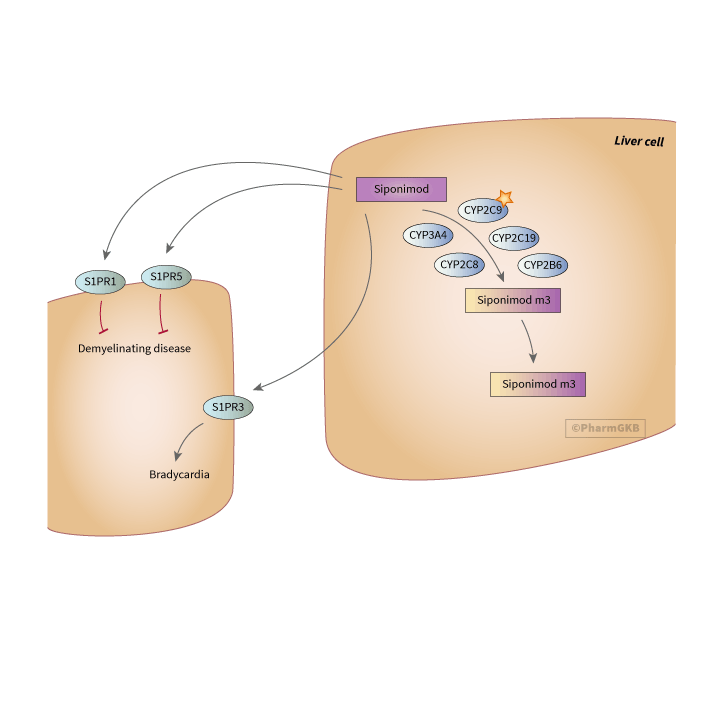
Siponimod is a dual agonist of spingosine-1-phosphate receptor1, S1PR1 and S1PR5 developed for treatment of multiple sclerosis. [Article:26856814]. Siponimod also has some low level off target activity at S1PR3 that can result in bradycardia [Article:26856814].
The FDA label contraindicates siponimod for people with CYP2C9 *3/*3 genotypes and sets lower maintenance doses for people with a CYP2C9 *1/*3 or *2/*3 genotype. The DPWG guideline recommends decreasing the dose for CYP2C9 *1/*3, *2/*3 genotypes and to avoid siponimod for the CYP2C9 *3/*3 genotype.
Metabolism
The primary route of metabolism of siponimod is hydroxylation to M5 by CYP2C9 with a minor contribution from CYP3A4 [Article:29735753]. This is followed by glucuronidation to m3 (no candidates specified [Article:29735753]. Additional metabolites not found in Pubchem are shown in figure 3 of Glaenzel et al, 2018 [Article:29735753].
Reactions & interactions (13)
-
Activation
siponimod → S1PR1
-
Activation
siponimod → S1PR3
-
Activation
siponimod → S1PR5
-
Biochemical Reaction
siponimod m5 → siponimod m3
-
Biochemical Reaction
siponimod → siponimod m5
-
Catalysis
CYP2B6 → Biochemical Reaction
-
Catalysis
CYP2C9 → Biochemical Reaction
-
Catalysis
CYP2C8 → Biochemical Reaction
-
Catalysis
CYP3A4 → Biochemical Reaction
-
Catalysis
CYP2C19 → Biochemical Reaction
-
Inhibition
S1PR1 → Demyelinating Diseases
-
Inhibition
S1PR5 → Demyelinating Diseases
-
Leads To
S1PR3 → Bradycardia
Edit history (1)
- 2021-06-30 Create